

Dermapen vs Microneedling: Key Differences
Microneedling is a popular skin treatment, but the tools used - Dermapen and dermaroller - differ significantly. Here's what you need to know:
- Dermapen: A motorized pen-like device that uses vertical needle action (90°) for precise, controlled punctures. It minimizes skin trauma, adjusts needle depth (0.2–3.0 mm), and is effective for hard-to-reach areas like the nose and eyes. It also uses disposable cartridges for better hygiene.
- Dermaroller: A manual tool with fixed needle lengths that rolls across the skin, creating angled punctures (45°). Results depend on practitioner skill, and it may cause more skin tearing. It's better suited for broader, less targeted treatments.
Quick Comparison:
| Feature | Dermaroller | Dermapen |
|---|---|---|
| Needle Action | Rolling (45° entry) | Vertical (90° entry) |
| Needle Depth | Fixed | Adjustable (0.2–3.0 mm) |
| Precision | Less precise | High precision |
| Hygiene | Reusable (requires sterilization) | Disposable cartridges |
| Comfort | More discomfort due to skin tearing | Less discomfort |
| Recovery Time | 5–7 days | 1–2 days |
| Cost (per session) | Lower ($100–$300) | Higher ($300–$700) |
Bottom Line: Choose Dermapen for targeted concerns like acne scars or hyperpigmentation, especially in delicate areas. Opt for dermarollers for general texture improvement or if you're on a tighter budget. Always consult a professional to determine the best option for your skin goals.
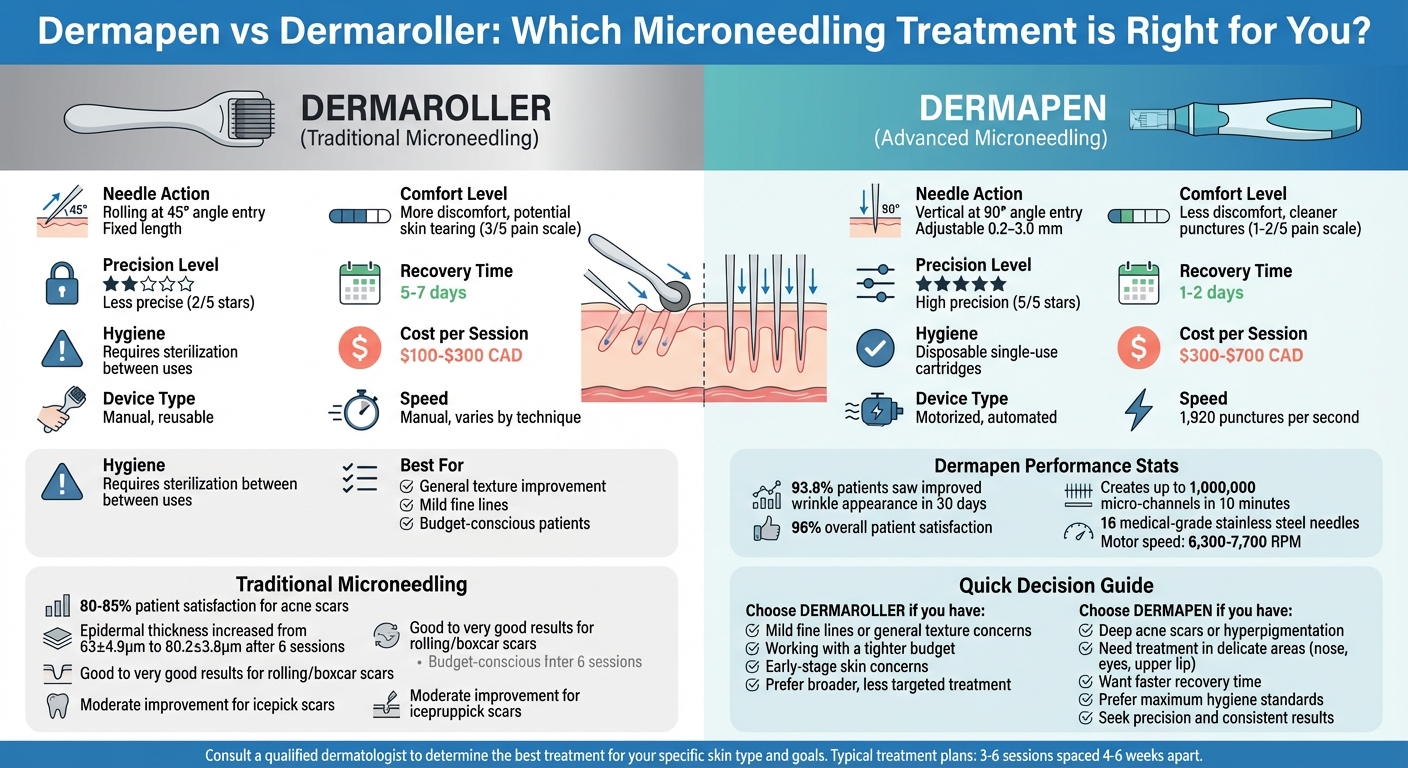
Dermapen vs Dermaroller Microneedling Comparison Chart
Dermaroller Or Dermapen - Which Is Better
sbb-itb-8ec3e54
What is Traditional Microneedling?
Traditional microneedling uses a dermaroller, a handheld device with a barrel covered in fine, medical-grade needles. Rolling this device across your skin creates thousands of tiny pinpricks, known as micro-injuries, on the surface. These micro-injuries trigger your body’s natural repair process, setting off a healing response.
During this process, fibroblast cells are activated to produce fresh collagen and elastin - the proteins responsible for your skin's structure, elasticity, and firmness. This is why the treatment is often referred to as "collagen induction therapy." Over the following weeks, this new collagen framework works to improve your skin from within, reducing wrinkles, softening scars, and enhancing overall texture.
Traditional microneedling is most effective for early-stage skin concerns such as fine lines, mild acne scars, uneven texture, and enlarged pores. At-home dermarollers typically use shorter needle lengths (0.25 mm to 0.5 mm), which can improve product absorption but don’t penetrate deeply enough to address more significant issues. Professional-grade rollers, on the other hand, can reach depths of up to 2.5 mm, offering better results for deeper concerns - though their effectiveness largely depends on the technician’s expertise and pressure control.
However, the rolling mechanism has its challenges. Areas like the nose, eyes, and upper lip are harder to treat with a roller because of the angled needle entry. For these tricky spots, some professionals opt for flat-headed "stamp" tools, which allow for more precise application. This distinction highlights how traditional microneedling differs in approach compared to Dermapen's advanced technology.
What is Dermapen?
Dermapen takes microneedling to the next level with its automated, pen-like device that works differently from traditional rollers. Instead of rolling across the skin, it uses a vertical puncture mechanism - known as the Advanced Vertical Oscillation System - to move needles straight up and down at a precise 90-degree angle. This approach reduces the risk of dragging or tearing the skin, offering a more controlled and less traumatic treatment compared to angled roller entry.
The technology behind Dermapen is impressive. For instance, the Dermapen DP4 employs 16 disposable, medical-grade stainless steel needles, capable of creating up to 1,920 punctures per second. This speed ensures even coverage while significantly cutting down treatment time. With motor speeds ranging from 6,300 to 7,700 RPM, the device delivers consistent results, removing the variability that comes with manual techniques.
One of Dermapen's standout features is its adjustable depth settings, which allow practitioners to tailor treatments to different areas of the face. For delicate spots like the skin around the eyes, the needle depth can be set shallow, while deeper settings are ideal for thicker skin on the cheeks or forehead, especially when targeting scars. This flexibility is a major advantage over fixed-length rollers.
Another benefit of Dermapen is its ability to enhance the absorption of active ingredients. The vertical channels created by the needles allow treatments like hyaluronic acid, Vitamin C, or Platelet-Rich Plasma (PRP) to penetrate deeper into the skin. This process, often referred to as "serum integration," makes topical products applied during the procedure far more effective than they would be on untreated skin.
The device's compact, ergonomic design also makes it perfect for treating hard-to-reach areas like the nose, upper lip, and the delicate skin near the eyes. Unlike bulky rollers, Dermapen's small tip can navigate these tricky spots with precision. Plus, each treatment uses a sterile, single-use cartridge, ensuring a higher level of hygiene compared to reusable rollers. These features collectively highlight why Dermapen is a popular choice for addressing specific skin concerns with precision and care.
Technology and Mechanism Comparison
Traditional microneedling operates through manual effort, while the Dermapen brings automated, motor-driven precision to the table. Traditional devices, like derma rollers, consist of a hand-held drum with fixed-length needles attached to a handle. The effectiveness of these rollers heavily depends on the skill and technique of the practitioner. On the other hand, the Dermapen is a pen-shaped, motorized device that ensures consistent, controlled punctures, elevating the treatment's accuracy and reliability.
One major distinction lies in how the needles interact with the skin. Traditional rollers enter the skin at a 45° angle, which can lead to tearing. In contrast, the Dermapen uses a 90° vertical motion, creating cleaner micro-channels. As Smooth Synergy Medical Spa & Laser Centre explains:
"The Dermapen penetrates the epidermis vertically, which results in a more comfortable treatment, a cleaner wound, minimal skin trauma and a quicker recovery time." – Smooth Synergy Medical Spa & Laser Centre
This technological refinement not only enhances precision but also significantly improves patient comfort. The Dermapen offers adjustable needle depth, allowing practitioners to tailor the treatment to specific areas. For instance, delicate regions might require shallow depths (as low as 0.2 mm), while thicker skin or scars may benefit from deeper penetration (up to 3.0 mm). Traditional rollers, with their fixed needle length, lack this flexibility. Furthermore, the Dermapen 4 delivers an impressive 1,920 punctures per second, producing nearly 1,000,000 micro-channels in just 10 minutes - far surpassing the capabilities of manual rollers.
Hygiene is another area where the Dermapen shines. It uses single-use, disposable cartridges, which, along with medical-grade exam gloves, virtually eliminate contamination risks. Traditional rollers, designed for repeated use, require meticulous sterilisation between sessions - a process that can be challenging to execute perfectly, increasing the potential for contamination.
Technology and Mechanism Comparison Table
Here's a quick breakdown of the key differences:
| Feature | Traditional Microneedling (Roller) | Dermapen (Automated Pen) |
|---|---|---|
| Device Type | Manual drum/roller | Motorized electronic pen |
| Needle Action | Rolling/angled entry (45°) | Vertical puncturing (90°) |
| Needle Depth | Fixed | Adjustable (0.2 mm–3.0 mm) |
| Skin Impact | Arching cuts; potential tearing | Clean vertical micro-channels |
| Precision | Dependent on manual pressure | Motor-controlled for consistency |
| Hard-to-Reach Areas | Difficult to manoeuvre | Easily adapts to facial contours |
| Hygiene | Reusable; requires sterilisation | Single-use, disposable cartridges |
| Speed | Manual; varies with technique | Up to 1,920 punctures per second |
Procedure, Comfort, and Downtime
Treatment Process
Traditional microneedling relies on manual rollers, where the practitioner applies pressure while moving the device across the skin in multiple directions. This technique can vary significantly based on the practitioner's skill, leading to inconsistent results. On the other hand, the Dermapen uses a motorized system that delivers precise, automated punctures. It glides across the skin with uniform pressure, ensuring consistent results every time. This automation not only improves precision but also enhances comfort and minimizes recovery time.
Comfort and Pain Management
When it comes to comfort, the two methods differ noticeably. Traditional rollers often cause more discomfort due to their angled needle entry, which can drag or tear the skin. The Dermapen, however, uses a 90-degree vertical penetration, which is gentler on the skin. Most patients describe the sensation as mild prickling or tingling rather than pain. Belle Ame Skin Studio explains:
"The resulting 'paddle-steamer effect' [of rollers] creates a series of arching cuts in your skin that are more painful and require an extended downtime."
To further enhance comfort, a topical numbing cream is applied 15–40 minutes before the procedure. This is especially effective for shallower treatments with the Dermapen, often eliminating any discomfort entirely.
Downtime and Recovery
Recovery after a Dermapen treatment is typically quick and straightforward. The vertical needle action creates clean micro-channels in the skin, avoiding the tearing wounds associated with traditional rollers. As a result, redness and mild swelling usually subside within 12 to 48 hours, allowing most people to return to their daily routines almost immediately. In contrast, traditional microneedling often leads to redness lasting 24 to 48 hours, with full recovery taking 5 to 7 days.
Following professional training and protocols for post-treatment care is essential for optimal healing. Avoid makeup for 24–48 hours and steer clear of strenuous activities, saunas, or excessive sweating for 3–7 days. Protect your skin with a mineral-based SPF 30+ for at least two weeks, reapplying every 60–90 minutes. Light peeling or flaking may occur around days 3 to 5; resist the urge to pick at your skin to ensure proper healing.
Results, Efficacy, and Suitability for Skin Concerns
Both traditional microneedling and Dermapen treatments encourage collagen and elastin production by creating controlled micro-injuries. However, their effectiveness can vary based on the specific skin issue being addressed. Dermapen's automated precision stands out for tackling targeted concerns like deep acne scars, enlarged pores, and hyperpigmentation. Clinical studies reveal that 93.8% of patients saw improved wrinkle appearance within 30 days, with 96% expressing overall satisfaction.
Traditional microneedling is effective for broader skin concerns. One clinical study found that after six sessions spaced two weeks apart, epidermal thickness increased from 63±4.9µm to 80.2±3.8µm. Additionally, collagen types I, III, and VII showed significant improvements within three months. Patient satisfaction for acne scar treatments ranged from 80–85%, rated as "very good." However, the results often depend on the skill and consistency of the practitioner.
The data highlights how technology-focused tools like Dermapen can refine treatment precision. For specific scar types, traditional microneedling delivers good to very good results for rolling and boxcar scars but offers only moderate improvement for icepick scars. Dermapen’s vertical penetration method breaks down fibrous tissue while promoting regeneration. Its ability to create uniform micro-channels ensures consistent results across the treated area.
Pore refinement and pigmentation issues are areas where Dermapen shines. Many patients report visible pore reduction after just one session, though optimal results generally require three to six sessions spaced four to six weeks apart. When addressing hyperpigmentation, Dermapen rebalances melanocytes without causing heat damage, making it a safer option for darker skin tones.
Results and Efficacy Comparison Table
| Feature | Traditional Microneedling (Roller) | Dermapen (Automated) |
|---|---|---|
| Collagen Production | Significant increase in Types I, III, and VII | Enhanced via high-speed vertical punctures |
| Texture Improvement | Moderate to good; less precise | High precision for scars and pores |
| Treatment Precision | Lower; difficult to treat small/curved areas | High; easily treats nose and eye contours |
| Required Sessions | Typically 6 sessions | Typically 3–6 sessions (1 may suffice for pores) |
| Acne Scar Efficacy | Good for rolling/boxcar; moderate for icepick | Highly effective for all scar types |
| Adjustability | Fixed needle length per device | Adjustable depth (0.25 mm to 2.5 mm) |
Which to Choose: Dermapen or Traditional Microneedling?
Deciding between Dermapen and traditional microneedling comes down to your specific skin concerns, comfort level, and what you hope to achieve from the treatment. While both methods aim to rejuvenate the skin, their differences can play a big role in which option suits you best.
Dermapen excels at addressing specific concerns like deep acne scars, enlarged pores, or hyperpigmentation. Its advanced technology creates precise and consistent micro-channels with less trauma to the skin, making it an excellent choice for targeted treatments.
Traditional microneedling, on the other hand, is great for improving overall skin texture and addressing mild fine lines. It's often a more budget-friendly option and a good starting point for those new to microneedling. However, because it relies on a manual roller or pen with a fixed needle depth, the results can vary depending on the practitioner's skill.
The experience itself also sets these two methods apart. Dermapen generally results in redness and inflammation that subsides within 24 to 48 hours, whereas traditional microneedling may take two to three days for similar recovery. Dermapen's smaller, more manoeuvrable tip is particularly effective for delicate areas like the nose and around the eyes, where traditional rollers can feel bulky and less precise.
Cost is another factor to weigh. Dermapen sessions typically cost between CAD$300 and CAD$700, reflecting the precision and advanced technology involved. Traditional microneedling is usually less expensive, but you might need more sessions to achieve similar results. Most treatment plans recommend three to six sessions spaced four to six weeks apart, so it's worth considering the total cost when deciding which option fits your needs and budget.
Conclusion
Choosing between Dermapen and traditional microneedling comes down to understanding how each works and what outcomes they offer. Both approaches aim to rejuvenate the skin by creating controlled micro-injuries, but Dermapen's technology stands out with its ability to make up to 1,920 punctures per second and adjustable depth settings. This level of precision gives it an edge over fixed-length rollers.
Your specific skin concerns should guide your decision. For deep acne scars, enlarged pores, or areas that require extra precision - like around the eyes or nose - Dermapen is often the better choice. On the other hand, traditional microneedling is a solid option for improving overall skin texture and addressing mild fine lines, especially if you're working within a tighter budget.
Safety and hygiene are also key factors to consider. Dermapen uses sterile, single-use needle tips, which significantly reduces the risk of infection. Traditional rollers, if not properly sterilised, can pose a higher risk. Additionally, Dermapen treatments often come with shorter recovery times.
The best way to decide? Consult a qualified dermatologist. They can tailor a treatment plan to suit your skin type and goals, ensuring the equipment meets proper standards and adjusting parameters as needed. Typically, a full course involves three to six sessions, spaced four to six weeks apart, to achieve optimal results while keeping risks low.
FAQs
How do I know what needle depth is right for my skin?
The right needle depth for microneedling varies based on your skin type, specific concerns, and what you hope to achieve. Shallower depths are better suited for addressing surface-level issues like fine lines or uneven texture, while deeper depths are more effective for tackling scars and wrinkles. To get the best results, it’s a good idea to consult a professional who can evaluate your skin and tailor the treatment to ensure the most suitable depth for your needs.
Can Dermapen help with icepick acne scars?
Yes, Dermapen can improve the appearance of icepick acne scars. It works by creating controlled micro-injuries in the skin, which kickstarts the production of collagen and supports the skin's natural healing process. Over time, this helps break down scar tissue and promotes smoother, healthier-looking skin.
What makes Dermapen especially effective for icepick scars is its ability to target these stubborn marks with precision. By stimulating collagen in the affected areas, it encourages the skin to repair itself and gradually reduce the depth and visibility of the scars.
Is microneedling safe for darker skin tones?
Microneedling is considered safe for darker skin tones when done properly. Tools like Dermapen work by creating tiny, controlled micro-injuries in the skin without using heat or causing ablative damage. This approach significantly lowers the chances of issues like hyperpigmentation or scarring, which are more common with laser treatments.
To minimize risks, it’s crucial to have the procedure performed by trained professionals who use the right techniques and equipment.
Leave a comment