

How to Care for Skin After Microneedling
The first 48 hours after microneedling matter most. I’d keep my routine plain, skip makeup and heat, avoid active skincare for at least 5 days, and protect my skin from sun for 1 to 2 weeks.
Here’s the short version:
- Days 0 to 2: cleanse gently, don’t touch or pick, and avoid sweating, sun, and makeup
- Days 3 to 7: focus on hydration with a serum and moisturiser
- After day 7: add actives back slowly, one at a time, only if redness and stinging are gone
- Sun care: avoid direct sun for 7 to 14 days and use mineral SPF 30 to 50 after the first 24 hours
- Call your provider if you get pus, strong pain, fever, a cold sore outbreak, or redness that gets worse after 48 hours
A few facts stand out. Redness, warmth, and tightness for 24 to 48 hours are common. Surface healing often settles in about 7 to 10 days, but deeper repair can continue for weeks. That’s why I’d keep aftercare simple even when skin already looks fine.
If I had to sum it up in one line, it would be this: protect first, hydrate next, then restart products slowly.
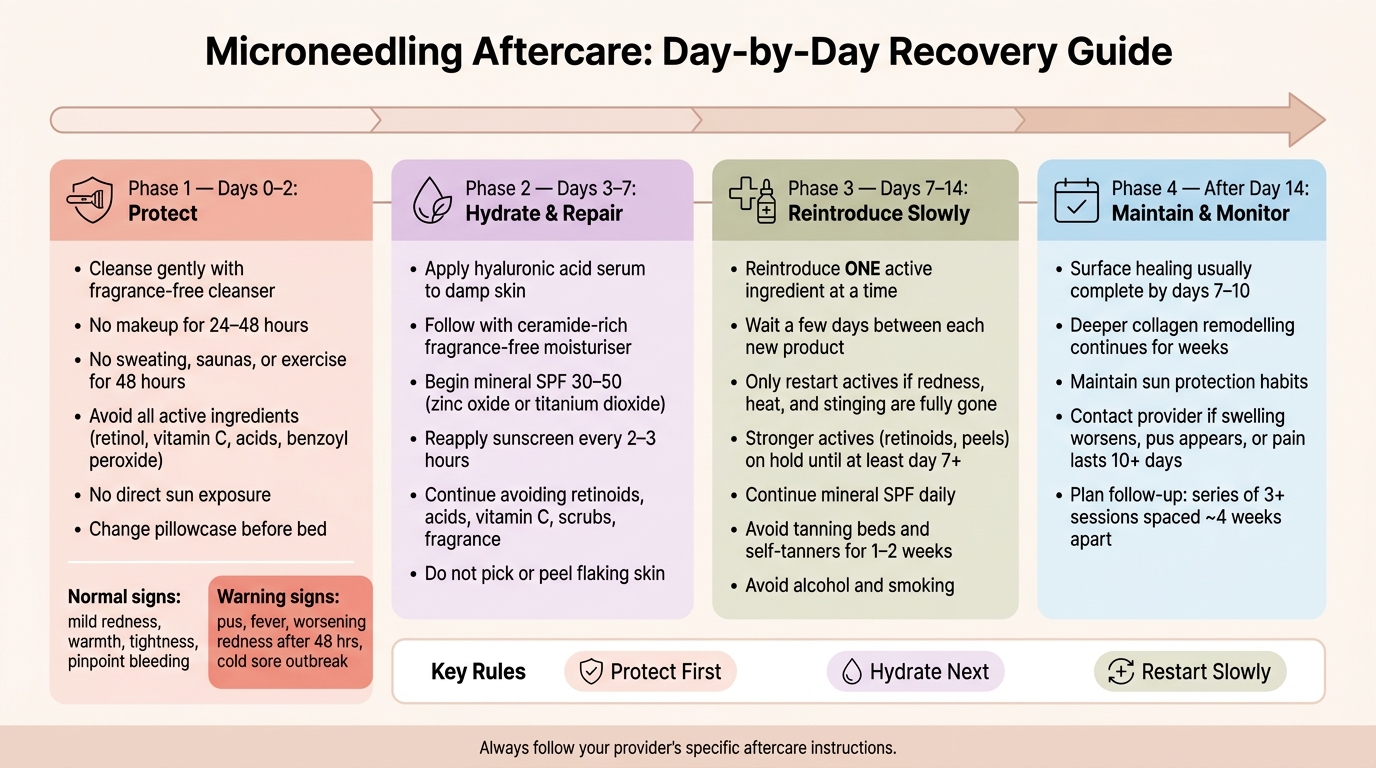
Microneedling Aftercare Timeline: Day-by-Day Recovery Guide
Microneedling Aftercare - Do's and Don'ts for Best Results
sbb-itb-8ec3e54
First 48 hours: protect the skin barrier
The first 48 hours are about protecting your skin barrier, not trying to treat anything. During this window, think of your skin as fragile. Cleanse gently, stay away from heat and friction, and stick to products your provider has approved.
Normal healing signs vs. warning signs
In the first 48 hours, mild reactions are common. That’s normal. The key is knowing what falls under expected healing and what means you should check in with your provider.
| Normal Healing Signs (Days 0–2) | Contact your provider |
|---|---|
| Mild dryness or slight flaking | Crusting, oozing, or pus |
| Mild stinging or tightness | Severe or worsening pain |
| Pinpoint bleeding or minor bruising | Spreading rash or unusual pigmentation changes |
| Fever or cold sore outbreak | |
| Redness that worsens after 48 hours |
If any warning signs show up, contact your clinic promptly.
How to cleanse and keep the skin area clean
Wait until the morning after your treatment before your first cleanse, unless your clinician gave you different timing. Use lukewarm water and a gentle, fragrance-free cleanser twice a day. Apply it with clean hands, then pat your skin dry with a clean towel.
Before bed that night, switch to a fresh pillowcase. Through the day, keep your hands off your face and avoid picking, scratching, or rubbing the area.
What to avoid in the first 48 hours
Hold off on makeup for 24 to 48 hours. Skip intense exercise and anything that makes you sweat, including saunas and steam rooms, for at least 48 hours. Stay out of direct sun.
You should also pause all active ingredients for at least five days, including:
- retinol
- vitamin C
- benzoyl peroxide
- exfoliating acids
Use only products your provider says are okay, such as a fragrance-free moisturiser or a hydrating serum.
After 48 hours, the focus shifts from protection to hydration and repair.
Days 3 to 7: hydrate, repair, and avoid irritation
After the first 48 hours, the focus shifts from protection to hydration and repair. By day 3, your skin may still look pink and feel tight or dry because it's losing more moisture than usual. A bit of light peeling can also show up around this stage. At this point, keep things simple. The goal is to support the skin barrier, not throw a bunch of products at it.
Products to use for hydration and barrier repair
Stick to a minimal routine. Apply a hyaluronic acid serum to slightly damp skin, then follow with a fragrance-free ceramide moisturiser. The serum helps pull moisture into the skin, and the moisturiser helps support the barrier and keep that moisture from slipping away.
Ingredients and products to pause during recovery
Your skin barrier is still in a fragile state during days 3 to 7, so this isn't the time to experiment. Keep your routine basic and steer clear of anything that can irritate the skin.
Use this simple guide during recovery:
| Phase | Allowed | Avoid |
|---|---|---|
| Days 3–7 | Gentle cleanser, hyaluronic acid serum, ceramide-rich moisturiser, mineral SPF, lukewarm water | Retinoids, acids, vitamin C, benzoyl peroxide, fragrance, essential oils, scrubs, and hair-removal treatments |
If your skin starts to flake, don't pick or peel it. Let it shed on its own.
How to reintroduce active ingredients
Once the redness, heat, and stinging are gone, you can bring actives back in slowly, one at a time. Start with your basic gentle routine first. Then add a single active, and wait a few days before adding anything else so you can see how your skin reacts.
Stronger actives, like retinoids and chemical peels, are usually put on hold until at least day 7. In some cases, it may need to be longer if your skin is still reacting. Your provider's guidance comes first here. If your skin still feels red, warm, or stingy, give it more time before restarting actives.
Sun protection and lifestyle steps that support healing
Once the first 48 hours are over, the focus changes. At that point, it’s less about shielding the skin and more about UV defence and keeping your routine calm and low-irritation.
After microneedling, your skin can look better before it’s fully recovered. The micro-channels weaken the barrier for a short time, which makes skin more sensitive to UV and more prone to post-inflammatory hyperpigmentation (PIH).
How to apply sunscreen and limit sun exposure
Skip sunscreen for the first 24 hours. After that, use a broad-spectrum mineral SPF 30 to 50 sunscreen. Mineral formulas with zinc oxide or titanium dioxide are a better fit early on because they’re usually gentler on skin that’s still healing.
Reapply every 2 to 3 hours during the day, especially if you’re sitting near windows. UV rays can move through glass and still affect healing skin. When you go outside, pair sunscreen with a wide-brimmed hat and sunglasses, and stay in the shade as much as you can during the first 2 weeks of recovery. Direct sun exposure should be avoided for 7 to 14 days after treatment.
Daily habits matter too. Heat, friction, and contamination can slow healing more than people think.
Daily habits that help the skin heal
A few simple habits can make recovery smoother:
- Drink plenty of water to support recovery.
- Use a clean pillowcase and fresh face towels for the first week to help keep bacteria away from the microchannels.
- Keep hair products away from the treated area to cut down on irritation.
- Avoid tanning beds and self-tanners for at least 1 to 2 weeks, since both can interfere with healing and increase pigmentation risk.
- Avoid alcohol and smoking for several days after treatment, as both can slow healing.
Monitor recovery and plan follow-up care
Knowing what can happen after the first week takes a lot of the stress out of recovery. The big thing to remember is simple: the surface often heals before the deeper layers do. So even if your skin looks fine, it may still be repairing underneath.
What to expect during the 7 to 10 day healing timeline
After the first week, recovery usually shifts from surface healing to deeper repair. Surface redness often fades within about a week, while deeper healing can continue for weeks. Light flaking may still show up during that first week. By days 7 to 10, the skin usually looks calm and more even.
That said, skin can look healed before healing is finished. Collagen remodelling keeps going for weeks, even after the surface settles down. That’s why steady aftercare and sun protection still matter well past day 7.
How to handle dryness, flaking, breakouts, and red flags
If your skin feels dry or tight, keep using the same bland moisturiser. It can help ease discomfort while the skin settles. And if you notice flakes, leave them alone. Picking or scratching peeling skin can lead to irritation or scarring.
A few people deal with short-term breakouts during healing. If that happens, stick with gentle cleansing and pause acne actives until the skin barrier settles.
Some symptoms need a call to your treating practitioner. Reach out if you notice:
- swelling that gets worse or does not improve
- signs of infection, such as pus or unusual discharge
- pain or irritation that lasts more than 10 days
If healing is going as expected, keep your routine gentle until your provider says it’s okay to bring active ingredients back in.
Conclusion: keep aftercare simple, gentle, and provider-led
As your skin settles, keep aftercare minimal and follow your provider’s timing for adding products back. The basics stay the same: protect the barrier early, keep skin hydrated with gentle products, avoid irritating actives until the skin has settled, and stay out of direct sun and heat. For best results, most providers suggest a series of at least three sessions spaced about four weeks apart. Keep things simple, and contact your provider if healing slows down or symptoms get worse.
FAQs
Can I use ice after microneedling?
Yes, you can use ice after microneedling to calm the skin. A cool compress, like a soft washcloth dipped in cold water, can help ease redness and swelling.
If you use an ice roller, make sure it’s clean to help prevent bacteria from transferring to your skin.
When can I wear makeup again?
Avoid makeup for at least 48 hours after microneedling so your skin has time to heal.
Once that window has passed, you can start wearing makeup again. Stick with lightweight, non-comedogenic products, such as mineral-based cosmetics. Apply them gently, moisturize first, and make sure your brushes or sponges are clean.
How do I know if my skin is healing properly?
Your skin is likely healing as expected if redness, warmth, and sensitivity slowly ease up over time. The same goes for swelling or discomfort that keeps settling down day by day. A bit of flaking or peeling can also be normal, since your skin may be going through its natural turnover process.
For now, keep the area lightly moisturized and treat it gently. Skip active ingredients, stay out of the sun, and don’t pick at the skin, even if it’s tempting.
If redness lasts longer than 48 hours, or you notice lasting pain, unusual discharge, or any signs of infection, get medical advice as soon as you can.
Leave a comment