

7 Microneedling Mistakes to Avoid
Microneedling can work wonders for your skin, but only if done correctly. The wrong approach can lead to infections, scarring, or wasted time and money. Here’s what you need to know to stay safe and achieve the best results:
- Wrong needle depth: Using needles that are too deep or too shallow can harm your skin or reduce effectiveness.
- Reusing cartridges: Always use sterile, single-use cartridges. Reusing them risks infections and poor results.
- Applying strong actives during treatment: Ingredients like retinol or Vitamin C can cause burns when applied to freshly treated skin.
- Treating too often: Your skin needs time to heal. Overdoing it can damage elasticity and lead to chronic inflammation.
- Microneedling over active acne or infections: This can spread bacteria, worsening inflammation and causing scarring.
- Skipping proper sanitization: Unclean tools or environments can lead to serious infections.
- Using derma rollers instead of stamp devices: Rollers can cause uneven wounds and scarring compared to professional tools.
Key takeaway: Stick to proper protocols, use professional tools, and avoid shortcuts to ensure safe, effective microneedling results.
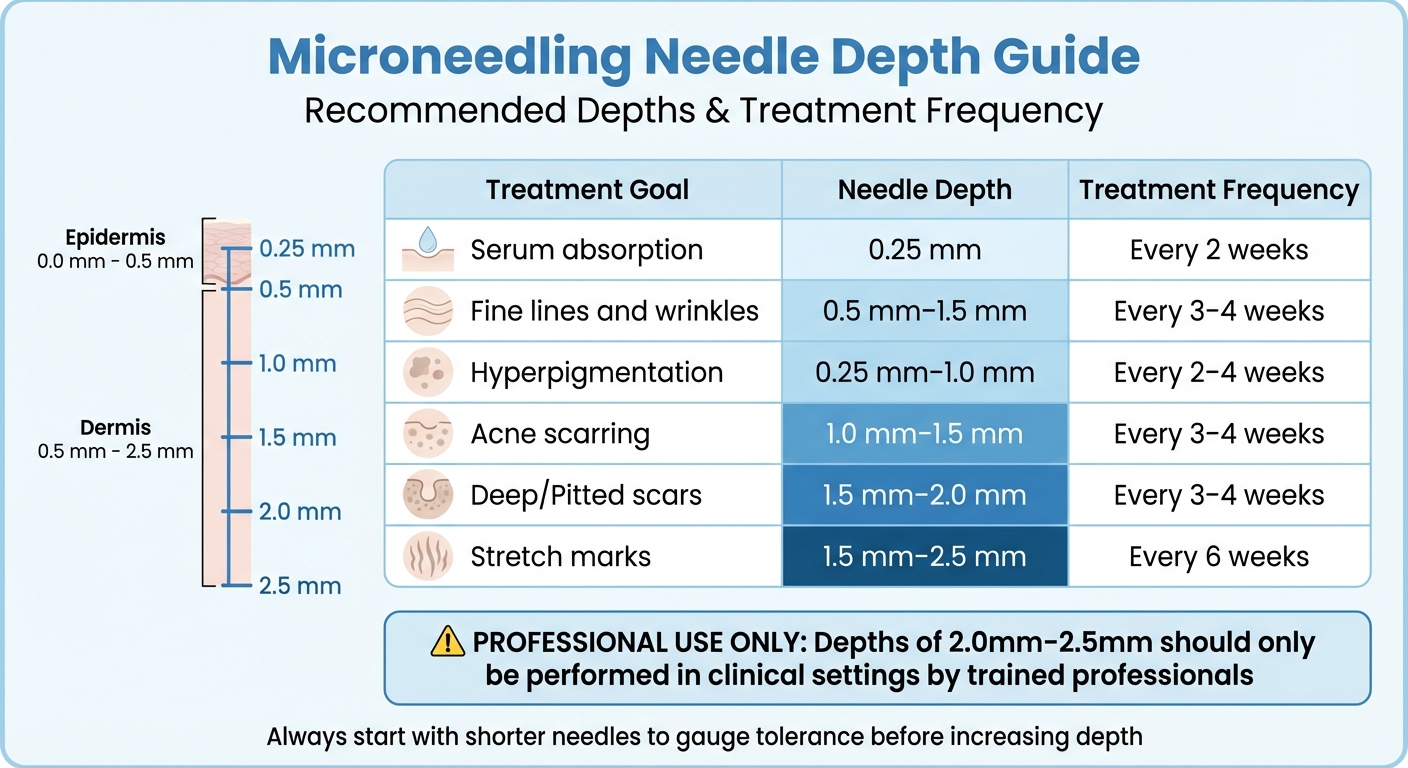
Microneedling Needle Depth Guide by Treatment Goal
Mistakes to Avoid in Your Microneedling Routine
sbb-itb-8ec3e54
1. Using the Wrong Needle Depth
Choosing the right needle depth is essential for safe and effective microneedling. One common mistake is assuming that going deeper always leads to better results. In fact, using excessive depth can harm the skin's structure, leading to permanent loss of elasticity and a rough texture. On the face, needles deeper than 1.5 mm can even hit bones or nerves, which might cause indentations, track marks, or scarring.
As Dr. Pen UK puts it:
"In reality, you don't need a deep needle to induce the wound response that creates more collagen. Using a needle depth of 0.5 mm is deep enough to penetrate the dermis and reap all of the benefits microneedling has to offer."
On the flip side, using needles that are too shallow - like 0.25 mm for deeper acne scars - won’t stimulate enough collagen production, leading to little or no improvement.
The key is to adjust the needle depth based on the treatment goals and the area of the skin being treated. For instance, fine lines and wrinkles often respond well to depths between 0.5 mm and 1.5 mm, while hyperpigmentation may only need 0.25 mm to 1.0 mm. Areas with thinner skin, like the neck or around the eyes, require shallower depths to avoid damage. It's always a good idea to start with shorter needles to gauge the client’s tolerance before increasing the depth.
| Treatment Goal | Recommended Needle Depth | Recommended Frequency |
|---|---|---|
| Serum absorption | 0.25 mm | Every 2 weeks |
| Fine lines and wrinkles | 0.5 mm–1.5 mm | Every 3–4 weeks |
| Hyperpigmentation | 0.25 mm–1.0 mm | Every 2–4 weeks |
| Acne scarring | 1.0 mm–1.5 mm | Every 3–4 weeks |
| Deep/Pitted scars | 1.5 mm–2.0 mm | Every 3–4 weeks |
| Stretch marks | 1.5 mm–2.5 mm | Every 6 weeks |
It’s worth noting that needle depths of 2.0 mm–2.5 mm should only be used in clinical settings by trained professionals. This highlights the importance of following strict protocols and using a professional microneedling device.
Next, we’ll look at the risks tied to reusing microneedling cartridges.
2. Reusing Microneedling Cartridges
Reusing microneedling cartridges is one of the riskiest practices in skincare. During treatment, these cartridges come into direct contact with blood and bodily fluids, creating a serious risk of transmitting pathogens like Hepatitis B, Hepatitis C, and HIV between clients. This is why cartridges are strictly designed for single-use only.
Using a cartridge more than once also compromises its effectiveness. Needles dull and deform quickly with repeated use, leading to skin tearing rather than the creation of clean microchannels. This can result in unnecessary pain, increased inflammation, and even permanent "tram track" scarring. As San, a skincare professional with expertise in microneedling, explains:
"Dermatologists agree: reusing microneedling cartridges poses significant health risks without any significant benefits."
Sterility is another critical concern. Once a cartridge's packaging is opened, its sterility is compromised, even if attempts are made to clean it. Professional-grade cartridges are sterilized using gamma radiation or Ethylene Oxide gas before being sealed. Reopening the packaging eliminates this protection. Additionally, without proper backflow prevention, fluids can seep into the device handpiece, contaminating the equipment and increasing infection risks.
Always use a new, sterile cartridge for every client and every session. Open the cartridge packaging in front of your client to demonstrate your commitment to safety, and dispose of used cartridges immediately in a biohazard sharps container. While Health Canada–approved cartridges often cost upwards of CA$100 per treatment, this expense is a small price to pay for ensuring client safety and safeguarding your professional reputation. York Region Public Health emphasizes this point by stating:
"Needles are not to be saved for reuse on the same client."
Before each treatment, check the cartridge's expiry date and lot number. If either is missing, do not use it. Following these single-use protocols is vital for ensuring both the safety of your clients and the effectiveness of the treatment.
For reliable, Health Canada–approved microneedling supplies, visit Beauty Pro Supplies Canada.
3. Applying Retinol or Active Ingredients During Treatment
Microneedling creates microchannels in the skin, allowing products to penetrate 5–20 times deeper than usual. While this can enhance the absorption of beneficial ingredients, applying strong actives like retinol, Vitamin C, or AHAs/BHAs immediately after treatment can lead to serious issues, including chemical burns. As Dr. Pen Europe explains:
"By filling these microchannels with such a strong ingredient like retinol, you force the product deeper into the skin than intended. If retinol goes in too deep, it can cause more damage, potentially in the form of a chemical burn."
This underscores the importance of carefully choosing what you apply during and after microneedling.
Retinol, in particular, can weaken the skin barrier. Combining it with the open channels created by microneedling increases the likelihood of severe irritation, prolonged redness, inflammation, or even permanent scarring. As a precaution, it’s advised to stop using retinol or retinoids 5–7 days before treatment and only resume them 5–7 days after, or once redness has fully subsided. Similarly, avoid AHAs, BHAs, and high-concentration Vitamin C for 5–10 days post-treatment.
For immediate aftercare, stick to fragrance-free Hyaluronic Acid. This ingredient can hold up to 1,000 times its weight in water, creating a hydrating and healing environment without causing irritation. You can also use soothing serums with ingredients like Peptides, Centella Asiatica, or Panthenol (Vitamin B5) to calm inflammation and promote recovery.
To maximize results and minimize risks, avoid potent actives while the microchannels are still open. Apply a soothing serum within the first five minutes post-treatment to take advantage of the enhanced absorption before the channels start to close. For the first 72 hours, keep your skincare routine simple:
- A gentle cleanser
- A hydrating serum
- A barrier-repair moisturiser containing ceramides
- A mineral-based SPF
Ensure all products are alcohol-free and fragrance-free to prevent irritation or dermatitis. Following these steps will help you achieve the best results while reducing the risk of complications.
4. Treating the Skin Too Often
While microneedling is a powerful way to boost collagen and elastin production, timing is everything. Overdoing it can disrupt your skin's natural repair process. Microneedling works by creating controlled micro-injuries, and your skin needs time to heal properly between sessions. As Dr. Ava Shamban, a board-certified dermatologist, puts it:
"One of those where more is not necessarily better, in fact, it usually proves the opposite. Microneedling too often can be too harsh on the skin."
To allow your skin to go through its full healing cycle - including the inflammatory, proliferative, and remodelling phases - there should be a gap of 4–6 weeks between professional treatments. Pushing treatments closer together can harm your skin's internal structure, leading to issues like chronic inflammation, uneven texture, or even a permanent loss of elasticity. Always tailor session frequency to the individual’s skin condition and response.
For milder concerns like uneven tone, sessions spaced 8–12 weeks apart are usually sufficient. Moderate issues, such as fine lines or acne scars, often benefit from intervals of 6–8 weeks. Severe problems like deep scarring or loose skin may require treatments every 4–6 weeks. If redness or peeling persists for more than 72 hours after a session, consider extending the recovery period.
Keep in mind that collagen production continues for up to three months after a session. Once you’ve completed an initial series of 3–6 treatments, maintenance sessions every 3–12 months are generally enough to sustain the results.
5. Microneedling Over Active Acne or Infections
When planning microneedling treatments, it’s critical to evaluate the skin’s condition thoroughly to avoid complications.
Performing microneedling on active acne or infected skin can lead to serious problems. The needles can spread bacteria from inflamed areas across the treatment zone. Since microneedling creates micro-channels that penetrate about 2 millimetres into the skin, bacteria can travel deeper, potentially causing severe infections. This may result in symptoms like pus, swelling, and heat in the affected areas. Additionally, conditions like cold sores (herpes simplex) or fungal infections can spread across the face during the procedure.
Experts caution that treating inflamed or infected skin with microneedling can worsen inflammation, lead to deeper infections, and even cause permanent scarring. Piercing inflamed areas can amplify the skin’s inflammatory response, increasing the likelihood of long-lasting hyperpigmentation. These risks highlight the importance of a thorough skin evaluation before treatment.
Pre-treatment screening is essential. Always assess the skin for contraindications such as pus-filled bumps, open sores, rashes, warts, psoriasis, or any signs of bacterial, viral, or fungal infections. Even a single cold sore is reason enough to postpone the session. The skin must be fully healed before moving forward with microneedling.
For clients with active acne, consider alternative treatments first. Options like LED blue light therapy, salicylic acid (BHA) peels, or IPL lasers can help clear active breakouts. Once the skin is healed, microneedling is an excellent option for reducing acne scars. Research shows it can improve scarring by 50–70% when performed on healed skin. Ensuring the skin is fully recovered before treatment not only enhances safety but also maximizes results.
6. Skipping Proper Sanitization
Keeping equipment clean and following hygiene protocols is absolutely critical. Microneedling involves needles creating micro-channels that go 2–3 millimetres deep into the skin. If bacteria are present on the surface, they can travel straight into the dermis, leading to infections.
Using sterile, single-use cartridges is non-negotiable. Each session must begin with a fresh, unopened cartridge, which typically costs around CA$100 or more per treatment. To ensure safety, always check that your practitioner opens a new cartridge in front of you before starting.
The cleanliness of the environment matters just as much as the tools. Microneedling should only be performed in a sterile clinic where surfaces are properly disinfected. Clients should also arrive without makeup to avoid introducing contaminants into the micro-channels.
"Infections are rare but serious complications. Watch for yellow or green discharge, pus-filled bumps, fever, or chills. These symptoms often indicate bacterial contamination from unsterilized equipment." - Diaminy Aesthetics
Health Canada–approved devices, which often cost upwards of CA$5,000, meet rigorous safety and manufacturing standards that unregulated tools cannot guarantee. Before booking a treatment, confirm that your practitioner uses certified equipment and adheres to strict hygiene practices. After the procedure, avoid touching the treated area with unwashed hands and skip makeup for at least 24 hours to give the micro-channels time to close safely.
7. Using Rollers Instead of Stamp Devices
When it comes to microneedling, technique is everything. Derma rollers, often used for at-home treatments (unlike a jade facial massage roller), can cause angled needle penetration, creating V-shaped wounds that result in up to 34% more trauma[1]. Professional stamp devices, on the other hand, are designed to avoid these issues with greater precision.
The rolling motion of derma rollers can lead to "tram track" scarring - those parallel indented lines caused by tissue tearing instead of clean punctures. Another challenge with rollers is their fixed needle length, which doesn't adapt to the varying thickness of facial skin. For example, the delicate under-eye area requires a different approach than thicker areas like the cheeks, but rollers often fail to account for this difference, causing unnecessary damage in sensitive regions.
"If you're wanting to do at home microneedling, I wouldn't recommend derma rollers, instead I recommend something like a micro stamp device." - Dr. Nicole James
Professional-grade devices, such as stamp and motorized pen tools, solve these problems by ensuring vertical penetration. These pens can create over 1,000,000 precise microchannels, penetrating the skin perpendicularly at speeds of up to 100 times per second. This method produces clean, I-shaped channels that heal significantly faster - within 24–48 hours - compared to the 3–5 days needed for recovery from roller-induced wounds.
Additionally, professional devices allow for adjustable needle depths, offering the precision needed to address specific skin concerns effectively.
Conclusion
Microneedling can yield impressive results when done correctly, but common mistakes can easily turn a promising treatment into a problematic experience. Using the right technique and professional-grade tools is essential for achieving safe and effective results. The difference between achieving radiant, healthy skin and dealing with complications like infections, scarring, or hyperpigmentation often lies in these critical details.
"It is important to choose a trained and experienced provider for microneedling treatments, as the use of needles on the skin carries the risk of infection and other complications if not performed properly." - Neena Brostowski, Beauty Pro Supplies Canada
This highlights how crucial every step of the process is. With microchannels remaining open for 24 hours post-treatment, decisions like selecting the appropriate needle depth, following proper aftercare, and spacing sessions 4 to 6 weeks apart are vital. These practices allow the skin’s natural collagen production to continue uninterrupted for up to a month.
To avoid these pitfalls, professionals need to prioritize high-quality tools and continual education. Beauty Pro Supplies Canada offers a range of wholesale professional microneedling equipment, hyaluronic acid serums, and post-treatment care products. They also provide online training resources to help practitioners refine their techniques. With a 4.8/5 customer satisfaction rating from 284 reviews, their specialized tools and supplies are trusted by professionals to achieve successful outcomes and maintain high standards of care.
FAQs
How do I choose the right needle depth for each area of the face?
The appropriate needle depth for microneedling depends on the treatment area and the specific skin concerns being addressed. For fine lines and improving skin texture, shallower depths between 0.25 mm and 0.5 mm are effective. On the other hand, deeper depths of up to 2.0 mm are better suited for treating scars or more pronounced wrinkles.
It's also important to consider the thickness and sensitivity of the skin. For delicate areas, such as around the eyes, stick to shallower depths to avoid irritation. For thicker areas, like the cheeks, deeper penetration may be necessary to achieve desired results.
When in doubt, always consult a professional to ensure safe and effective treatment.
What should I put on (and avoid) in the first 72 hours after microneedling?
In the first 72 hours after microneedling, it's important to take extra care of your skin. Avoid using makeup, as well as active skincare products like retinoids, acids, or exfoliants. Also, resist the urge to touch or rub your face during this time.
To protect your skin, apply a broad-spectrum SPF 30+, and steer clear of direct sunlight, excessive heat, or harsh environmental conditions. These precautions can help reduce redness, swelling, and peeling, ensuring your skin heals properly during this delicate phase.
When should I postpone microneedling due to acne, cold sores, or infection?
If you're dealing with active skin issues like cold sores, acne, or infections, it's best to hold off on microneedling. Specifically, avoid the procedure if you have active herpes (cold sores), severe or cystic acne with open sores, or any bacterial, fungal, or viral infection. Going ahead with microneedling in these situations could aggravate outbreaks or spread bacteria, making things worse. Wait until your skin has properly healed before considering treatment.
Leave a comment