

Adjustable Treatment Beds: Benefits for Post-Surgical Care
If I support post-op clients, the right adjustable bed helps with four things right away: breathing, swelling, transfers, and staff back strain.
In Canada, some surgical patients now go home in 1 to 2 days, so more recovery happens in clinics, medical spas, and at home. That means bed setup is not just about comfort. It affects how a client breathes, rests, moves, and protects healing tissue. A flat, fixed table can make swelling, pressure, and sit-to-stand movement harder. An adjustable bed can reduce those problems with backrest tilt, leg lift, height control, pressure-relief foam, and transfer supports.
Here’s the short version:
- Backrest tilt of 30° to 45° can help breathing and may lower reflux after facial, breast, abdominal, and upper-body procedures
- Leg lift above heart level can help lower-limb swelling after knee, hip, or ankle surgery
- Hi-Lo height control can make transfers safer and reduce bending during wound checks or follow-up care
- Foam padding of about 5 to 7.5 cm can lower pressure on the sacrum, heels, and other sore points
- Pressure injuries can start in as little as 2 hours without position changes
- Sleep problems affect about 30% to 80% of surgical patients, so steady positioning matters at night and during rest periods
- Side rails, hand grips, lockable casters, waterproof covers, and cleanable upholstery help with day-to-day post-op care
I’d treat an adjustable bed as part of the recovery setup, not just clinic furniture. The main thing is to match the bed to the procedure, the client’s mobility, and the work staff need to do around it.
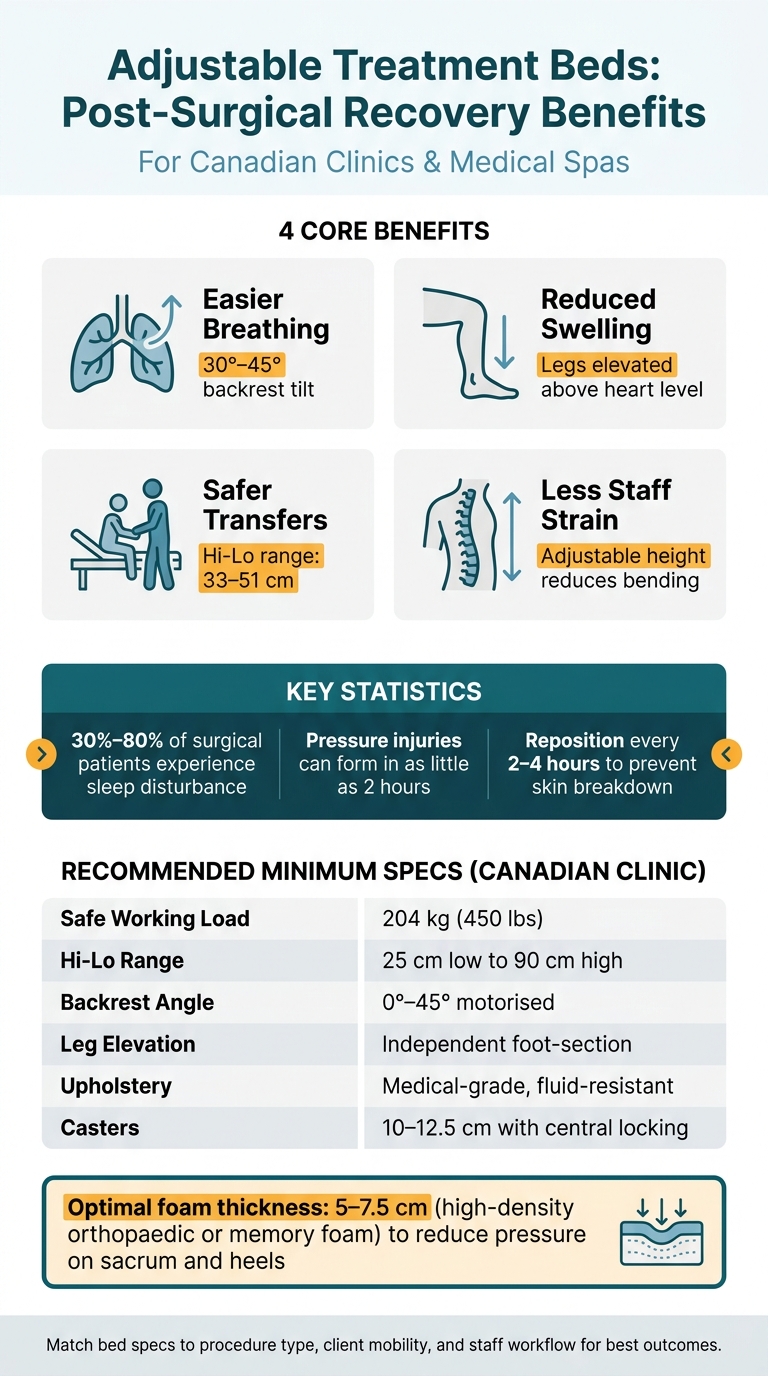
Adjustable vs. Fixed Treatment Beds: Post-Surgical Recovery at a Glance
Adjustable Beds for Sleeping Positions for After Knee and Hip Surgery
sbb-itb-8ec3e54
Post-Surgical Recovery Challenges in Medical Spa and Aesthetic Clinic Settings
Post-op clients need surfaces that make elevation, transfers, and repositioning easier. The first issues usually show up fast: pain, swelling, and pressure.
Pain, Swelling, and Pressure from Lying Still
When a post-op client lies flat on a standard treatment surface, fluid can pool instead of draining away. After facial, abdominal, and lower-limb procedures, that often leads to more throbbing and pressure. Elevation helps fluid move away from the incision, which can ease both.
A flat position can also make breathing harder after upper-body, facial, or abdominal procedures. Head-and-shoulder elevation can make breathing easier, but a flat table doesn’t allow for that adjustment.
There’s also the pressure issue. Clients who can’t shift their position easily put more weight on bony areas for longer periods. Over time, that can increase the risk of pressure sores and skin breakdown, especially at the sacrum, heels, and shoulder blades.
The next problem is simpler, but no less important: getting on and off the bed without added strain.
Transfer Safety and Staff Handling Strain
Getting on and off a treatment bed after surgery can be tough. Even minor abdominal surgery can make core movement painful, and rising from a flat surface often means using the abdominal wall directly.
Fixed-height furniture adds another layer of difficulty. If a bed is too low, standing becomes harder. If it’s too high, balance can suffer and the client’s feet may not stay in firm contact with the floor. Matching bed height to the client’s leg length makes sit-to-stand transfers safer.
Staff feel the strain too. A surface set too low forces repeated bending during wound checks, dressing changes, and repositioning. Adjustable height helps with safer client transfers and cuts down on staff bending.
Adjustable Bed Features That Solve Post-Surgical Problems
These post-surgical issues tie back to three core bed functions: elevation, height control, and pressure support. The beds that help most bring these together in one smooth setup, instead of treating them like separate add-ons.
Backrest and Leg Adjustment for Breathing and Swelling
Elevation helps with two big concerns after surgery: breathing and swelling.
Backrest elevation to the semi-Fowler position, about 30° to 45°, can make breathing easier and may help cut down acid reflux after upper-body, facial, and abdominal surgeries. That slight lift often makes a big difference. Lying flat can feel heavy on the chest and uncomfortable on the torso, while a raised backrest gives the body a bit more room to settle.
Leg elevation helps in a different way. Raising the legs above heart level supports blood flow back toward the heart, so fluid is less likely to collect in the lower limbs. That can ease post-op swelling, especially after knee and hip procedures.
In practice, this works best with multi-section electric adjustment. When the backrest and leg sections move separately, staff can set the position with much more control. In a clinic or medical spa, that makes day-to-day therapeutic positioning far more practical.
Height Adjustment, Padding, and Safety Supports
Once the bed is in the right position, height control helps with transfers and treatment.
Motorised height adjustment, often called Hi-Lo, deals with the transfer issue head-on. Setting the bed to the patient’s popliteal height, or knee height, usually about 33 to 51 cm from the floor to the top of the mattress, cuts down the muscular effort needed to stand. It also lowers fall risk during transfers. For staff, setting the surface closer to waist or elbow height during wound care or dressing changes reduces spinal loading and the strain that comes from repeated bending.
Padding matters too. Pressure injuries can form when pressure stays on the same areas for too long, especially around the sacrum and heels. High-density orthopaedic foam or memory foam layers, ideally about 5 to 7.5 cm thick, spread weight more evenly and reduce pressure on healing tissue during longer recovery periods.
A few support features also help during repositioning and transfers:
- Integrated side rails or hand grips give clients a steady point to hold
- Lockable casters keep the bed stable during transfers
Medical Spa Accessories That Support Post-Op Workflows
Beyond positioning itself, the right accessories can cut handling time and support cleaner, smoother post-op care.
Removable or multi-position armrests and adjustable anatomical headrests allow for more precise positioning during follow-up treatments. A pivoting base gives practitioners access from multiple sides without having to shift the bed, which saves time and reduces extra movement around the client.
Materials matter here as well. Easy-to-clean leatherette upholstery helps with hygiene between clients, and waterproof protectors help manage drainage while protecting the upholstery.
Clinical Benefits of Adjustable Treatment Beds in Post-Surgical Care
These features can mean fewer symptoms, safer movement, and better sleep while the body heals.
Better Comfort, Breathing, and Rest
Raising the backrest to 15° to 30° can make breathing easier after facial, breast, abdominal, or thoracic procedures. That small incline takes pressure off the chest and helps patients rest in a steadier position.
Getting in and out of bed matters too. On a flat surface, patients often need to do a sit-up motion. That engages the abdominal muscles and can put stress on surgical sites. An adjustable bed cuts down that strain by bringing the patient up into a seated position without the same level of effort.
Sleep problems after surgery are common, but they don't always get much attention. Between 30% and 80% of surgical patients deal with major sleep disturbance after their procedure. A bed that keeps a set elevation angle through the night helps more than a stack of pillows that slide, flatten, and need constant fixing. The result is steadier, less broken sleep during recovery.
That same level of position control can also help with fluid build-up and pressure.
Lower Swelling Risk and Easier Repositioning
Swelling is heavily affected by body position and how long that position is maintained. Elevating the legs above heart level helps venous and lymphatic drainage, which can reduce fluid build-up in the lower limbs. For patients recovering from knee, hip, or ankle procedures, that may ease post-op throbbing and swelling in the first few days after surgery.
Pressure injuries are a separate issue, but they're closely linked. They can start to form in as little as 2 hours of unbroken pressure on the same area, especially around the sacrum and heels. Patients with limited mobility should be repositioned every 2 to 4 hours, and an adjustable bed makes those small shifts much easier for both patients and clinical staff.
More Independence During Recovery
There’s also a practical side to all of this: adjustable beds can help patients do more on their own.
A full-electric bed lets patients change position themselves, which supports more independence during recovery. They can reposition without putting extra stress on pain-sensitive surgical sites, and that can cut down on the need for caregiver help with routine comfort changes.
For transfers, motorised Hi-Lo adjustment can set the bed surface to the patient’s popliteal height, so standing up takes less joint torque and less leg effort. In home or clinic care, Hi-Lo adjustment helps make sit-to-stand transfers safer.
Choosing and Using Adjustable Treatment Beds in Canadian Practice
What to Check Before Buying
Once the upside is clear, the next step is simple: pick medical exam tables that fit how your clinic works day to day. Start with these specs.
| Feature | Suggested Minimum Spec (Canadian clinic/medical spa) |
|---|---|
| Safe Working Load | Minimum 204 kg (450 lbs) |
| Hi-Lo Range | 25 cm (10") low to 90 cm (35") high |
| Backrest Angle | 0° to 45°, motorised incline |
| Leg Elevation | Allows independent foot-section elevation |
| Upholstery | Medical-grade, fluid-resistant, antimicrobial upholstery |
| Casters | 10–12.5 cm (4–5") diameter with central locking |
It also helps to check mattress fit and bed clearance before you buy. Memory foam, latex, and hybrid mattresses with wrapped coils can flex with an adjustable base without trouble. Traditional innerspring mattresses with connected coils usually can't, and repeated bending can damage them.
Space matters too. Plan for at least 81–91 cm (32–36 inches) of clearance on at least one side of the bed. That gives staff enough room for safer transfers and easier caregiver access.
How to Fit Adjustable Beds into Post-Op Workflows
Your position presets should line up with the procedure. For abdominal, cardiac, or spine recovery, set a 30° to 45° head incline as the default recovery position. For knee, hip, or ankle procedures, programme a leg-elevation preset that lifts the foot section above heart level.
That may sound like a small setup detail, but it makes a big difference during busy shifts. Staff change over. Patients change rooms. A preset helps keep positioning consistent instead of leaving it to guesswork each time.
Staff should also know when to use - and when not to use - Trendelenburg and Reverse Trendelenburg. That training matters because these settings aren't just comfort features; they're part of safe post-op positioning.
Full-electric beds with patient-accessible remotes add another layer of support. Patients can make small comfort adjustments on their own, which can cut down on routine calls for staff help.
Conclusion
For Canadian clinics and medical spas that handle post-surgical or post-procedure recovery, choosing a bed that meets the minimum clinical specs and fits the workflow is one of the simpler ways to improve patient comfort and care quality. The main goal is to match the bed's specs to post-op positioning protocols so the equipment supports breathing, swelling control, safe transfers, and staff ergonomics from the first recovery session onward.
FAQs
Who benefits most from an adjustable treatment bed after surgery?
Adjustable treatment beds can make a big difference during recovery after surgery, especially after orthopaedic procedures like hip, knee, or spinal surgery. They let patients change position with less effort, which can help ease pressure on healing areas and make day-to-day recovery more comfortable.
They’re also helpful for people with limited mobility or reduced strength. And for caregivers, they can take some of the strain out of helping with repositioning.
Which bed features matter most for post-op recovery?
The most important features are motorized head and foot articulation, which lets you fine-tune positioning with less effort, a Hi-Lo function for safer transfers and easier caregiver access, and side rails for extra stability.
It should also work with therapeutic, fluid-resistant mattresses to help manage pressure sores and keep the sleep surface clean. Beauty Pro Supplies Canada offers professional equipment and furniture that support these recovery needs.
How often should post-surgical patients be repositioned?
Post-surgical patients should be repositioned every 2 to 4 hours to help prevent pressure injuries and support comfort during recovery.
These regular position changes help reduce the risk of pressure sores and can ease discomfort during healing. On adjustable treatment beds, staff can often make these changes more easily and with little assistance.
Leave a comment