

Checklist for Importing Beauty Supplies to Canada
Importing beauty supplies into Canada starts with one question: what is the product, in legal terms? If you get that wrong, the rest can fall apart - labels, duties, customs paperwork, and even whether the goods can be sold.
If I were boiling this down to the shortest useful version, I’d say this:
- I classify each item first: cosmetic, drug/NHP, medical device, or general equipment
- I set up my CRA Business Number and RM import account before ordering
- I check ingredients, claims, and bilingual labels before shipment
- I confirm HS codes, duty, GST at 5%, and any provincial tax
- I gather customs documents and keep records after release
- If it’s a cosmetic, I file the Cosmetic Notification Form within 10 days of first sale
- If labels are off, the ANI process may allow up to 3 months to relabel in Canada before sale
A few dates and numbers matter right away. A shipment can be treated as commercial if it goes past a 90-day supply. Fragrance allergens over 0.01% in rinse-off products or 0.001% in leave-on products must be named on the label as of 12 April 2026. And for cosmetics, the CNF deadline is 10 days after first sale.
Here’s the short version of how I’d think about it:
- Cosmetics: usually skincare, makeup, hair products
- Drug/NHP: products with treatment or health claims, often needing a DIN or NPN
- Medical devices: powered aesthetic devices like lasers, often needing an MDL
- General equipment: non-powered tools and furniture under product safety rules
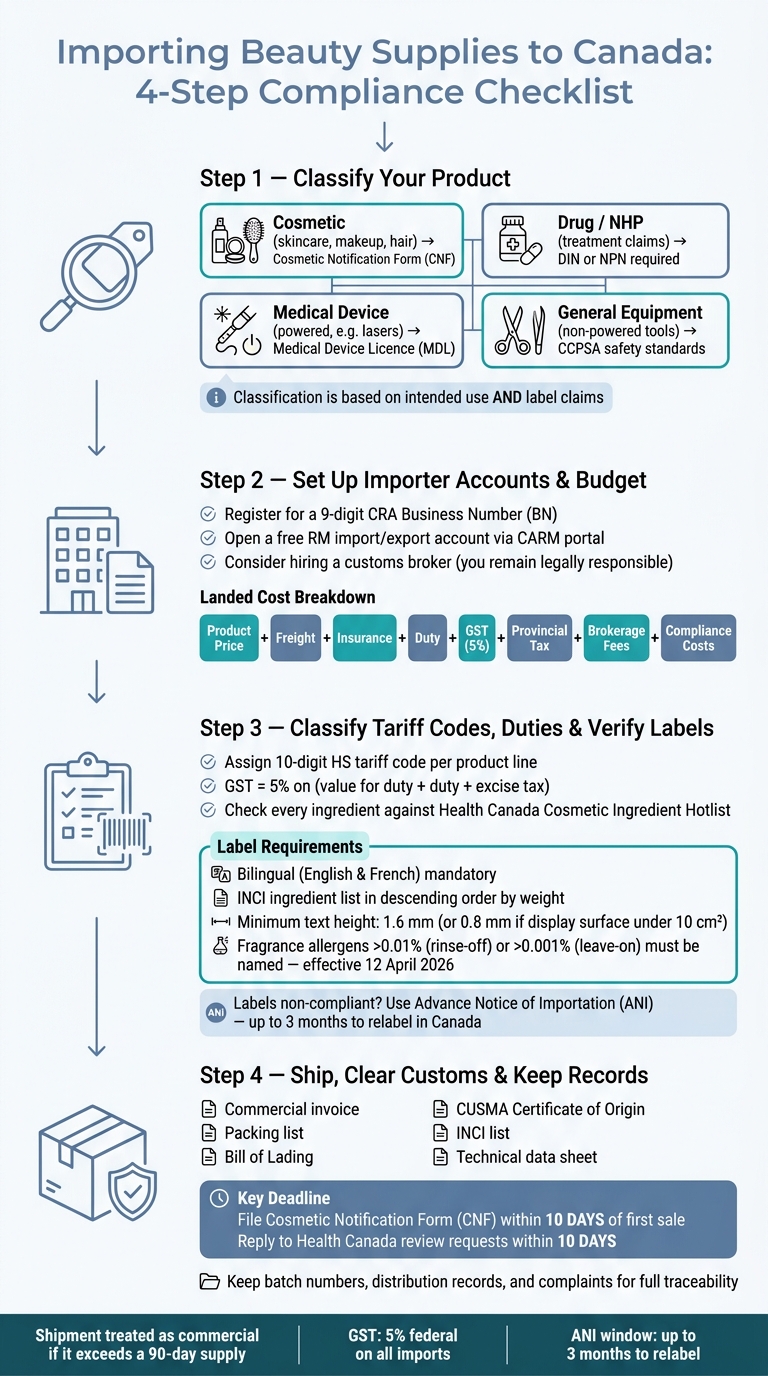
How to Import Beauty Supplies to Canada: 4-Step Compliance Checklist
Health Canada Cosmetics Update 2025: What’s Changed and How to Prepare
sbb-itb-8ec3e54
Quick comparison
| Product type | Main trigger | Main check before import |
|---|---|---|
| Cosmetic | Cleans, colours, changes appearance | Ingredients, bilingual label, CNF timing |
| Drug / NHP | Treats, prevents, or cures a condition | DIN or NPN |
| Medical device | Powered treatment device | MDL before shipping |
| General equipment | Non-powered tools or furniture | Product safety compliance |
Bottom line: I’d treat this as a classification and paperwork job first, not a shipping job first. Once the category, labels, tax setup, and documents are sorted, the border process is usually far less painful.
Step 1: Confirm Product Category and Canadian Regulatory Requirements
Classify each item as a cosmetic, device, or general equipment
Once you know what you're buying, check the rules before you place the order.
Start by classifying each item based on its intended use and the claims used to sell it. That step matters more than many first-time importers think. A skincare cream is usually a cosmetic. But if the label says it treats a skin condition or corrects a medical issue, it may fall into a different category.
Here’s the basic split:
| Product Type | Examples | Regulatory Category |
|---|---|---|
| Cosmetic products | Skincare, makeup, hair products | Cosmetic - Cosmetic Notification Form required |
| Therapeutic or medicated products | Products with disease-treatment or corrective claims | Drug/NHP - DIN or NPN required |
| Powered aesthetic devices | Lasers | Medical Device - MDL required |
| Non-powered tools and furniture | Treatment beds, stools | Consumer Product - CCPSA safety standards |
In plain terms:
- Skincare, makeup, and hair products are usually cosmetics, unless they make therapeutic claims.
- Powered devices like lasers are medical devices and need a Medical Device Licence (MDL).
- Non-powered tools and furniture are consumer products and must meet CCPSA safety rules.
Check ingredient, safety, and licensing restrictions
Before ordering, review every ingredient against the Health Canada Cosmetic Ingredient Hotlist. This list flags substances that are banned outright, along with restricted ingredients that can only be used under set conditions, such as specific concentration limits or warning statements.
That check can save you a major headache. One hotlisted ingredient can delay clearance or stop it altogether.
Fragrance allergens need extra care. As of 12 April 2026, any fragrance allergen present at more than 0.01% in a rinse-off product, or more than 0.001% in a leave-on product, must be listed on the label by name. If the label has a gap, fix it before the goods ship.
And one more hard rule: do not ship powered devices until the MDL is confirmed.
Collect the product details you will need later
Getting the right documents up front makes the rest of the process much smoother. You’ll need this information later for notification, tariff classification, label review, and customs clearance.
Ask your supplier for:
- Full product description and intended use
- Complete INCI ingredient list with concentrations or concentration range codes
- Country of origin and manufacturer's full legal name and address
- Material composition, especially for tools and equipment
- Safety Data Sheets (SDS) and any hazard statements
- Copies of existing bilingual labels in English and French
- Technical specs for powered devices
- For cosmetics already imported into Canada, request the Cosmetic Number from the supplier
These records also help with tariff coding, label checks, and customs clearance. You’ll use the same details again for importer setup, supplier review, and landed-cost estimates in Step 2.
Step 2: Set Up Your Importer Account, Gather Supplier Documents, and Plan Your Budget
Set up your Business Number and import account
Once your classification work is done, set up your importer account before you place an order. You’ll need a 9-digit Business Number (BN) from the Canada Revenue Agency (CRA), plus an RM import/export account.
The RM account is free. You can open it through the CBSA Assessment and Revenue Management (CARM) Client Portal. Don’t leave this until the last minute. Get it done before your shipment is ready to move.
You’ll also need to choose how you want to deal with customs paperwork. Some importers handle it themselves. Others hire a customs broker.
A broker can make life easier, especially if this is your first commercial shipment or your product classification is more involved. But there’s a catch: even if a broker files everything for you, you are still legally responsible for making sure the documents are right and the duties are paid.
Review supplier paperwork before you buy
Before you commit to a supplier, make sure they can provide the paperwork you’ll need. This step sounds basic, but it can save you a pile of trouble later.
At minimum, ask for:
- A commercial invoice with unit values, total value, and a product description
- A packing list
- A Bill of Lading (BOL) or airway bill
- A Certificate of Origin
The Certificate of Origin can help support preferential duty treatment under trade agreements such as CUSMA (the Canada–United States–Mexico Agreement). Duty can change based on the country of origin, the HS code, and the terms of the trade agreement, so these details need to line up.
Estimate landed cost in Canadian dollars
Don’t build your budget around the invoice price alone. That number is only part of the story.
Instead, work from landed cost: the total cost to get your goods into Canada. If you skip this step, it’s easy to think a product looks cheap, then get hit with extra charges at the border.
| Cost Item | What It Covers |
|---|---|
| Product price | EXW or FOB price from your supplier |
| Freight | Air or sea shipping to Canada |
| Insurance | Coverage for goods in transit |
| Duty | Based on the HS code and country of origin |
| GST | 5% federal tax on most imported goods |
| HST, PST, or QST | Provincial tax depending on destination |
| Brokerage fees | Customs broker charges, set privately by the firm |
| Compliance costs | Bilingual relabelling or lab testing if required |
If your labels aren’t bilingual, you may be able to use the Advance Notice of Importation (ANI) process. This lets you bring goods into Canada for relabelling within three months.
Step 3: Classify Goods, Calculate Duties and Taxes, and Check Labels
Assign the correct tariff code to each product line
Once your importer setup is done, sort out the tariff code and tax treatment before the shipment leaves.
Canada uses the Harmonized System (HS) as the base for its 10-digit tariff classification numbers. The first six digits are used across countries. The last four are Canadian subheadings used for duty and reporting. Classification is based on the product itself, while country of origin affects duty treatment.
Each item in a beauty shipment needs its own review. You can't just classify the whole box and call it a day. For beauty products, the line between cosmetics and drugs matters a lot. A product's ingredients and the claims on its packaging can shift its classification. If a product makes health claims, it may be treated as a drug or natural health product at import, even if you plan to sell it later as a cosmetic.
Before classifying anything, gather:
- Product descriptions
- Composition details
- Product literature
- Samples
If you're dealing with a high-value or more involved item, like an electrical beauty device, ask for a CBSA advance ruling before the shipment moves. That gives you a binding classification up front.
Confirm customs value, duty, and GST
Value for duty is usually the price paid or payable, converted to Canadian dollars on the direct-ship date.
GST is 5% on the value for tax, which includes duty and any excise tax.
Taxable value = value for duty + duty + any excise tax
Verify Canadian labelling before shipment
Check labels before the shipment leaves the supplier. For cosmetics, the required information must be bilingual and easy to read. You should also check whether any ingredient limits or bans apply under the Cosmetic Ingredient Hotlist.
| Requirement | Details | Language |
|---|---|---|
| Product identity | Common or generic name, or function, such as "shampoo" or "moisturiser" | English and French |
| Net quantity | Declared in metric units such as mL, g, or count | English and French |
| Ingredient list | Full list using INCI nomenclature, in descending order by weight | INCI |
| Dealer identity | Name and principal place of business of the importer or manufacturer | English or French |
| Safety warnings and directions for safe use | Required cautionary or hazard statements, plus directions for safe use | English and French |
| Contact information | Telephone number, email address, or website for consumer enquiries | English or French |
Mandatory text must be at least 1.6 mm high, or 0.8 mm if the display surface is under 10 cm².
If the product has both an inner and outer label, key information like product identity and contact information must appear on both.
If your supplier's labels don't meet Canadian labelling rules, you can use the Advance Notice of Importation (ANI) process to bring the goods in for relabelling within three months of entry.
With tariff codes and labels confirmed, move to customs release documents in Step 4.
Step 4: Ship the Goods, Clear Customs, and Maintain Post-Release Records
Prepare Shipment and Release Documents
Once your tariff codes and labels are locked in, the next step is simple in theory: make sure the shipment matches the paperwork. That’s what customs clearance comes down to.
Before the shipment leaves, have these documents ready for CBSA or Health Canada:
- commercial invoice
- packing list
- Bill of Lading
- CUSMA certificate
- INCI list
- technical data sheet
One item catches a lot of importers off guard: the Cosmetic Notification Form (CNF).
You need to submit it to Health Canada within 10 days after the first sale. But don’t wait until the last minute. It helps to have the CNF confirmation or Cosmetic Number ready before the goods arrive, because that can help you avoid delays at the border.
Plan for Inspections, Notifications, and Recordkeeping
CBSA often refers cosmetic shipments to Health Canada for review. If Health Canada asks for details about your formula, label claims, or ingredient safety, you need to reply within 10 days.
Miss that deadline, and you could face a sale ban. Miss a notification, and the product’s sale in Canada can be stopped.
If Health Canada asks for a review, reply within the required window, then keep that same file set on hand after release. Think of it as your paper trail. If someone asks where a batch went, what claims were made, or whether a complaint came in, you should be able to pull the answer fast.
After your goods clear customs, keep records that let each product be traced through the supply chain, including:
- batch numbers
- distribution records
- complaints
That traceability helps if a recall ever becomes necessary.
When Buying from a Canadian Distributor Reduces Import Work
If you buy from a Canadian distributor instead of importing the product yourself, a lot of the border work disappears. You won’t need to deal with CBSA release, duty calculation, or Health Canada notification on your own checklist.
Conclusion: Key Import Checks to Complete Before Your Shipment Arrives
Import delays usually come down to prep. If you sort out classification, importer registration, tariff codes, labels, and customs documents ahead of time, you can avoid a lot of hold-ups.
Use this final check before the shipment lands. Go over the product type, paperwork, labels, and CNF timing.
| Check | Key Requirement |
|---|---|
| Product classification | Confirm whether each item is a cosmetic, drug/NHP, device, or general equipment |
| Importer credentials | Register for a BN, RM import/export account, and CARM portal |
| Ingredient compliance | Cross-reference every ingredient against the Cosmetic Ingredient Hotlist |
| Tariff classification | Assign the correct HS code for each item |
| Landed cost estimate | Factor in duty, 5% federal GST, and any applicable provincial tax in CAD |
| Labelling verification | Confirm bilingual labelling, product identity, safety warnings, INCI lists, and metric net quantity |
| Customs documents | Prepare the commercial invoice, packing list, Bill of Lading, and Certificate of Origin |
| CNF submission | File the Cosmetic Notification Form within 10 days of first sale |
| Post-release records | Keep batch traceability and safety records for the required retention period |
When every box is checked before arrival, customs clearance tends to move faster, and you cut down on rework.
If a labelling issue shows up after the goods have shipped, the Advance Notice of Importation (ANI) process can give you up to three months to relabel or modify non-compliant products in Canada before sale. That can buy you some time, but it doesn't replace getting the labels right from the start. If you miss the CNF deadline, the product's sale can be delayed or stopped.
Buying through a Canadian distributor can also reduce import paperwork.
FAQs
How do I know if my product is a cosmetic, drug, device, or equipment?
In Canada, Health Canada classifies a product based on its claims, intended use, ingredients or structure, and format.
A cosmetic is meant to cleanse or improve or alter the complexion, skin, hair, or teeth. But the line can shift fast. If a product makes therapeutic claims, such as treating acne or preventing skin conditions, Health Canada may regulate it as a drug or natural health product instead.
This classification is assessed case by case.
What happens if my beauty product labels are not compliant before import?
If your beauty product labels don't meet the rules, your shipment may be denied entry, held up, or destroyed.
In Canada, you may still be able to import those products for sale. But there's a catch: you need to notify a Health Canada inspector ahead of time and relabel or modify the products so they meet the legal requirements within three months of import.
Miss that deadline, and future shipments may be refused. Health Canada may also take further enforcement action.
Do I need a customs broker to import beauty supplies into Canada?
No. You can import commercial goods yourself and deal directly with the Canada Border Services Agency.
That said, beauty supplies can get tricky. You may need to sort out HS code classification, Food and Drugs Act compliance, and paperwork such as the Cosmetic Notification Form. Because of that, working with a licensed customs broker is strongly recommended.
You remain responsible for all documentation, duties, and taxes.
Leave a comment