
Advertising Claims for Cosmetics: Best Practices
In Canada, crafting compliant cosmetic advertising claims is critical to avoid legal issues and maintain consumer trust. Here's what you need to know:
- Cosmetic vs. Therapeutic Claims: Cosmetics focus on appearance (e.g., "moisturizes", "adds shine"), while therapeutic claims (e.g., "treats acne", "heals eczema") require pre-market approval as drugs or natural health products (NHPs).
- Regulatory Enforcement: Health Canada and the Competition Bureau assess claims based on their overall impression, not just wording.
- Evidence Requirements: All claims must be supported by documented testing, such as clinical studies or consumer testing, conducted before marketing.
- Upcoming Changes: From April 12, 2026, fragrance allergens must be disclosed on labels if concentrations exceed specific thresholds.
- Non-Compliance Risks: Penalties can include fines up to $10 million or 3% of annual revenue, product recalls, and reputational damage.
To stay compliant, avoid therapeutic language, substantiate claims with reliable evidence, and ensure bilingual labelling. Proactive compliance protects your brand and builds trust with consumers.
Cosmetic Claims and Evidence
To ensure product stability and safety, manufacturers often use pH test paper kits to verify formulations during the evidence-gathering phase.
sbb-itb-8ec3e54
Cosmetic Claims vs. Therapeutic Claims
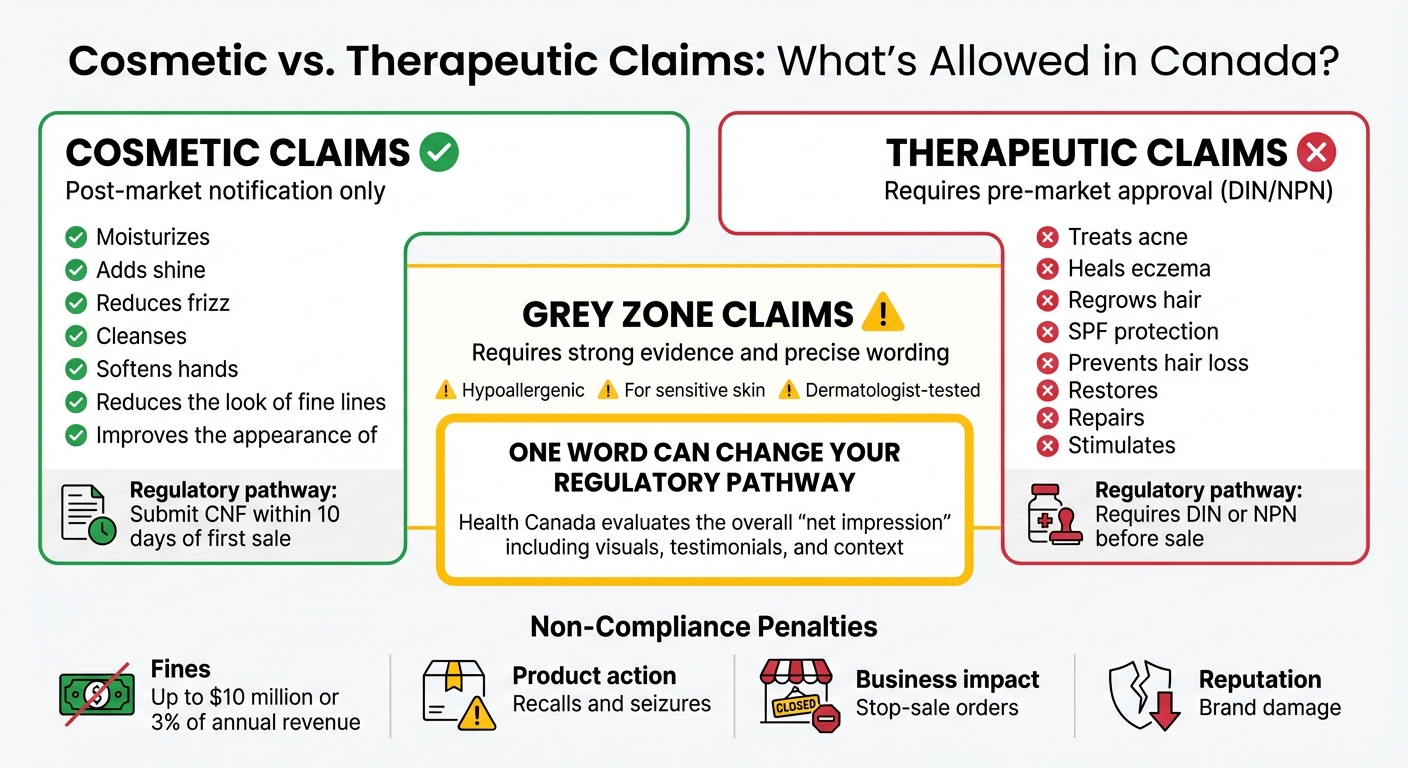
Cosmetic vs Therapeutic Claims: Compliance Guide for Canadian Beauty Products
The language you use to describe your product plays a critical role in staying compliant with regulations and building consumer trust. In Canada, the distinction between cosmetics and drugs largely depends on the claims made about the product. Cosmetics are intended to cleanse, beautify, or alter the appearance of skin, hair, or teeth through actions like moisturizing, perfuming, or protecting. On the other hand, drugs and natural health products (NHPs) are associated with claims about altering body functions or managing diseases. As Health Canada explains:
"Therapeutic claims are those that indicate or suggest to modify body functions or prevent or treat a disease or condition".
This difference matters because cosmetics follow a post-market notification process. Businesses must submit a Cosmetic Notification Form (CNF) within 10 days of the product's first sale. In contrast, therapeutic products require pre-market approval, which involves obtaining a Drug Identification Number (DIN) or Natural Product Number (NPN) after undergoing a detailed scientific review. Even a single word can shift a product from being classified as a cosmetic to being regulated as a drug or NHP. As Progress Therapeutics puts it:
"One word can flip your regulatory pathway, shifting you from post‑market cosmetic notification to a pre‑market authorization as a drug or NHP".
Health Canada also considers the overall "net impression" created by your advertising. This includes visuals, testimonials, and the context of your claims. Even if your product is labelled as a cosmetic, suggesting therapeutic benefits through your marketing can lead to non-compliance. Understanding this distinction is key to crafting compliant cosmetic claims, a topic covered in depth within aesthetician textbooks used by industry professionals.
What Qualifies as a Cosmetic Claim
Cosmetic claims focus on appearance and sensory benefits. For example, you can say your product "softens hands", "reduces frizz", "adds shine", "moisturizes", "reduces the look of fine lines", "improves the appearance of", or "cleanses". These claims highlight surface-level effects without suggesting any physiological changes. Phrases like "increased attractiveness" are generally acceptable, provided they are not misleading.
However, avoid language that implies altering body functions. Words like "restores", "repairs", "prevents", "stimulates", "eliminates", "stops", or "heals" can push your product into the therapeutic category.
Therapeutic Claims That Are Not Allowed
To stay within regulatory boundaries, steer clear of therapeutic claims for cosmetics. Claims suggesting medical benefits are not permitted. For instance, you cannot state that your product "treats acne", "heals eczema", "regrows hair", or provides "SPF protection". In Canada, any product claiming SPF or UV protection is classified as a drug or NHP, not a cosmetic. Similarly, products like anti-dandruff shampoos and fluoride toothpastes and colour correcting treatments are regulated as drugs, even if marketed as cosmetics in other countries.
Making therapeutic claims without proper authorization can lead to serious consequences. Health Canada may halt sales until a DIN or NPN is obtained. This could result in pulling products off shelves, revising labels, and undergoing a lengthy approval process - all of which can be costly in both financial and reputational terms.
| Claim Type | Examples | Cosmetic-Approved? |
|---|---|---|
| Appearance/Sensory | "Moisturizes", "adds shine", "fresh scent" | Yes |
| Therapeutic | "Treats acne", "SPF 30", "regrows hair", "heals eczema" | No – requires DIN/NPN |
| Grey Zone | "Hypoallergenic", "for sensitive skin" | Requires strong test data and precise wording |
Supporting Your Claims with Evidence
When it comes to compliance, backing up your claims with solid evidence isn't just a good practice - it's a legal obligation. Under Section 21 of the Cosmetic Regulations, manufacturers must have proof to support any claims about how a product affects the chemistry of skin, hair, or teeth, or any claims suggesting the product won't harm the user's health. Similarly, the Competition Act mandates that performance claims be based on "adequate and proper" testing conducted before those claims appear in your marketing materials. As the Competition Bureau puts it:
"The test must have been done before the claim is made".
Regulators don't just focus on specific claims - they evaluate the overall impression your advertisement gives. If Health Canada or the Competition Bureau requests your evidence, you must be ready to provide it immediately. The consequences for non-compliance can be steep: corporations face first-time penalties of up to the greater of $10 million or 3% of their annual worldwide gross revenue.
Here’s what you need to know about acceptable evidence and how to keep your documentation airtight.
Acceptable Forms of Evidence
To meet the "adequate and proper" standard, your evidence must be based on controlled testing that accurately reflects real-world use and minimizes bias. Examples of acceptable evidence include:
- Clinical studies with controlled variables
- Peer-reviewed scientific research
- Consumer testing that produces statistically significant results
For instance, if your product claims to "reduce the appearance of fine lines", you’ll need a clinical study showing measurable results under controlled conditions - not just anecdotal feedback.
Specific types of claims come with additional requirements. For example:
- "Dermatologist-tested": Requires documented participation from a medical professional and valid test results.
- Environmental claims: Statements like "biodegradable" must align with recognized methodologies (e.g., OECD standards) and be backed by lab reports detailing the test method, lab name, and scope.
- "Cruelty-free" or "not tested on animals": Since December 2023, these claims require documented proof that no animal testing took place.
On the other hand, certain types of evidence won’t cut it. These include anecdotal stories, testimonials, technical bulletins for similar products, or studies focusing only on individual ingredients rather than the finished product. Testing must be done on the exact formulation you plan to market.
| Acceptable Evidence | Unacceptable Evidence |
|---|---|
| Clinical studies under controlled conditions | Anecdotal stories or testimonials |
| Real-world testing with measurable results | Studies on "similar" products |
| Peer-reviewed research | Technical manuals unrelated to the product |
| Statistically significant findings | Results based on chance or one-off effects |
Once your evidence is in place, proper documentation becomes the next critical step.
Organizing Documentation for Audits
To prepare for potential audits, maintain detailed substantiation files that include study protocols, sample sizes, controls, and dated results. These documents must align with the exact claims in your advertisements. For environmental claims, ensure your file includes the test method, lab name, and scope of the test. Additionally, regularly cross-check your formulas against Health Canada's Cosmetic Ingredient Hotlist to ensure "free-from" claims are valid and don’t imply unwarranted safety benefits.
In Canada, all records must also be bilingual, with consistent claims in both English and French, as required for labelling.
Before launching any product, verify all claims against recognized standards. For terms like "biodegradable" or "eco-friendly", ensure your documentation includes lab reports and testing standards before the product hits the shelves. This proactive approach can save you from fines, recalls, and reputational damage. Stay updated on the latest regulatory changes and industry trends through our industry news and updates.
Writing Truthful and Clear Advertising Claims
Once you've gathered solid evidence to support your advertising claims, the next challenge is crafting language that resonates with consumers while staying within legal boundaries. Regulators don't just dissect individual statements - they look at the overall impression your ad creates. This includes the wording, visuals, layout, and context.
The stakes are high. Companies can face penalties of up to $10 million or 3% of their annual global revenue, whichever is greater. For individuals, fines can reach $750,000, and criminal convictions for knowingly making false claims can result in fines and up to 14 years in prison. The safest approach? Stick to specific, evidence-backed claims that focus on visible or sensory benefits rather than therapeutic effects.
Common Examples of Misleading Claims
Many cosmetic brands unintentionally cross the line with vague or poorly substantiated claims. Here's a breakdown of common missteps and how to fix them:
- "Clinically proven": This phrase suggests rigorous testing, but without detailed data to back it up, it becomes a compliance issue. A better alternative is "Clinically tested for skin hydration", supported by dated lab reports.
- Therapeutic language: Words like "heals", "restores", or "treats" can classify your product as a drug or natural health product (NHP), requiring pre-market approval. For instance, instead of saying "treats acne," opt for "enhances the surface appearance of blemish-prone skin."
- Environmental claims: Terms like "eco-friendly" or "green" are now under stricter scrutiny following updates to the Competition Act in June 2024. Replace these with specific, verifiable statements such as "Packaging made from 50% recycled plastic" or "Biodegradable formula per OECD Method 301B."
- "Fragrance-free": If your product includes masking agents like "parfum" or "fragrance", this claim becomes misleading. To comply, either remove the claim or ensure no added scents are present.
Here’s a handy table to illustrate these examples:
| Misleading/Prohibited Claim | Compliant Rewrite | Regulatory Reason |
|---|---|---|
| "Clinically proven" (no data) | "Clinically tested for [specific benefit]" | Requires proper testing |
| "Treats acne" | "Enhances the surface appearance of blemish-prone skin" | Avoids drug classification |
| "Eco-friendly" | "Packaging made from 50% recycled plastic" | Avoids vague environmental claims |
| "Fragrance-free" (contains masking agents) | Remove claim or eliminate masking agents | Must not include added scents |
| "Heals cracked skin" | "Moisturizes and softens dry skin" | Focuses on appearance, not therapy |
How to Write Specific and Accurate Claims
To stay on the right side of the law, focus on claims related to appearance or sensory benefits rather than physiological changes. Words like "cleanses", "moisturizes", "smooths", or "softens" are safe, while terms like "repairs", "stimulates", or "regrows" should be avoided.
For claims such as "dermatologist-tested," specify what was tested - e.g., "Tested by a dermatologist to ensure low skin irritation." This makes it clear the testing focused on safety, not efficacy, and aligns with your lab data.
If you're making "organic" claims, ensure your product contains over 95% organic ingredients. Anything less, and the term shouldn't be used. Similarly, "hypoallergenic" isn't a regulated term; it simply implies a lower likelihood of allergic reactions, not a guarantee.
Lastly, your visuals must match your claims. Before-and-after photos should reflect actual results without any digital manipulation. If your images overstate the product's effects, the entire ad could be deemed misleading, no matter how accurate the text may be.
Bilingual Requirements for Labels and Advertising in Canada
In Canada, cosmetics must include all mandatory labelling information in both English and French. This rule is outlined in the Cosmetic Regulations and the Consumer Packaging and Labelling Act. Key details such as the product identity, usage directions, warnings, and net quantity (when written in words) must appear in both official languages. However, there’s one key exception: the ingredient list. If you use the International Nomenclature of Cosmetic Ingredients (INCI) system, no translation is required.
The dealer’s name and main business address can be in either English or French. However, introductory titles like "Imported by" or "Distributed by" must be bilingual. All mandatory text must be easy to read, with a minimum font height of 1.6 mm (based on the lower-case "o"), and it must remain legible throughout the product's shelf life. These rules are designed to ensure clarity and consistency across the country.
If you're selling in Quebec, the requirements are even stricter. The Charter of the French Language, reinforced by Bill 96 in 2022, mandates that French text must be at least as prominent as any other language. This means using an equal or larger font size and ensuring French is just as visible. Failing to comply can result in fines of up to $20,000 under provincial laws.
Maintaining Consistent Claims in Both Languages
Consistency in bilingual claims is essential to avoid regulatory issues. Any translations must retain the same legal meaning as the original language. For example, a cosmetic claim like "moisturizes dry skin" in English must remain a cosmetic claim in French. Phrases like "heals" or "restores" should be avoided in the translation, as they could reclassify the product as a drug.
To ensure compliance, work with professional translators who understand cosmetic regulations. Generic translation services might overlook the subtle differences that separate compliant claims from prohibited ones. For instance, "clinically tested for hydration" should be translated into French as "testé cliniquement pour l’hydratation", not "prouvé cliniquement", which could imply a stronger claim of efficacy.
When selling nationwide, consider using mirrored or side-by-side layouts to present both languages with equal prominence. For products distributed in Quebec, you might need separate packaging to ensure French text stands out. Keep your substantiation files organized and updated in both languages, as this will help demonstrate compliance and maintain accuracy across all claims.
2026 Fragrance Allergen Disclosure Requirements
Starting April 12, 2026, cosmetic products sold in Canada will need to meet stricter rules for disclosing fragrance allergens. Specifically, if a fragrance allergen exceeds 0.01% in rinse-off products (like shampoos or body washes) or 0.001% in leave-on products (such as moisturizers or serums), it must be clearly listed on the ingredient label. This marks the end of using broad terms like "parfum" or "fragrance" to conceal specific components.
The implementation will roll out in three phases. By April 12, 2026, all products - whether new or already on the market - must disclose the initial 24 EU-listed fragrance allergens. By August 1, 2026, new product launches must include the expanded list of 81 allergens. Finally, by August 1, 2028, all cosmetics sold in Canada must fully comply with the 81-allergen disclosure. These allergens include widely used ingredients like linalool, limonene, citral, geraniol, and coumarin, which are common in both essential oils and synthetic fragrances. Adjusting to these phased changes is essential to ensure your advertising and product labelling remain compliant.
If your product contains allergens that now require disclosure, your marketing practices will need immediate updates. For instance, any claims like "fragrance-free" or "hypoallergenic" must be removed from packaging, online listings, and advertising materials if allergens are present. Health Canada states:
"If 'parfum' or 'fragrance' appears in the list of ingredients, the product contains a fragrance or a masking agent."
This means claims of being fragrance-free cannot be made if your product lists any fragrance ingredients. Regulators assess advertising based on the "general impression" it creates, so your marketing must align with the ingredient label.
Health Canada will take a "compliance-promotion" approach for the first year, with active enforcement - including border holds, fines, and recalls - beginning after April 2027. Non-compliance could result in delayed shipments, costly relabelling, or public recalls, all of which can harm your brand.
How to Update Your Claims and Labels
- Request updated ingredient details. Ask your fragrance suppliers for Certificates of Composition that specify the exact percentages of each allergen to see if disclosure is required.
- List allergens individually. After "Parfum/Fragrance", include each allergen using its proper INCI name in both English and French. For grouped allergens like "Rose Flower Oil/Extract", use the group name if their combined concentration crosses the threshold.
- Review all marketing materials. Remove claims like "fragrance-free", "unscented", or "hypoallergenic" from products that now disclose allergens.
- Submit updated CNFs promptly. File a revised Cosmetic Notification Form (CNF) within ten days of selling a product with updated labels. Ensure the form includes a valid Canadian mailing address (not a P.O. box), as required since March 2025.
- Use space-saving options for small packages. For products like lipsticks or eyeliners, where label space is limited, direct consumers to a website for the full ingredient list. Use a bilingual statement like: "For the list of ingredients – Pour la liste des ingrédients: www.websitename.ca."
- Ensure label durability. Conduct accelerated-aging tests to confirm that ingredient lists remain legible for the product's entire shelf life. Labels must use a font size of at least 1.6 mm (measured by the height of the lowercase "o").
These steps will help ensure your products and marketing materials meet the new standards while avoiding disruptions to your business.
Claim Compliance Reference Table
Navigating the complexities of cosmetic and therapeutic claims can feel overwhelming. To simplify this process, the table below offers a handy reference to help you determine which claims are safe, what kind of evidence you'll need to back them up, and the risks of non-compliance.
Health Canada assesses claims based on the overall "net impression" they create. This means regulators evaluate not just the text but also the images, context, and overall message. Even seemingly harmless claims might lead to reclassification if they are presented in a therapeutic context.
This table is designed to complement earlier discussions by summarizing the evidence requirements and compliance risks associated with various claim types.
Acceptable vs. Prohibited Claims
Use this table as a quick guide when crafting your advertising claims.
| Claim Example | Regulatory Category | Supporting Evidence Needed | Non-Compliance Risks |
|---|---|---|---|
| "Moisturizes", "Adds shine", "Cleanses" | Cosmetic (Appearance/Sensory) | Basic performance data or consumer use studies; formula support. | Low; potential consumer dissatisfaction or minor Competition Bureau inquiry if claims are found false. |
| "Hypoallergenic", "Dermatologist-tested" | Grey Zone (Cosmetic) | Clinical test data involving medical professionals; precise term definitions; allergen screening protocols. | Medium; Competition Bureau action for misleading advertising; consumer complaints. |
| "Biodegradable", "Eco-friendly" | Environmental Claim | Specific test methods (e.g., OECD 301B); defined scope; third-party lab reports. | Medium to High; scrutiny under 2025 Competition Bureau guidance on greenwashing. |
| "Treats acne", "SPF 30", "Heals eczema" | Therapeutic (Drug/NHP) | Clinical trials; pre-market authorization for a DIN or NPN; compliance with Health Canada monographs. | High; product seizure; mandatory reclassification; legal penalties; immediate stop-sale orders. |
| "Regrows hair", "Prevents hair loss", "Antiseptic" | Therapeutic (Drug/NHP) | Scientific evidence of physiological change; DIN/NPN licensing; clinical data. | High; unauthorized sale of a drug; product confiscation; fines; mandatory recall. |
| "Reduces the appearance of wrinkles" | Cosmetic | Consumer studies; clinical imaging; before-and-after photos with proper protocols. | Medium; misleading advertising charges if unsubstantiated under the Competition Act. |
When drafting claims, avoid language that implies physiological changes. Stick to highlighting appearance or sensory benefits. For instance, instead of saying "heals dry skin", opt for phrases like "moisturizes dry skin" or "improves the look of dry skin." Use this guide to ensure your claims stay compliant with current advertising standards for cosmetics.
Conclusion
Meeting regulatory requirements in cosmetic advertising isn't just about avoiding penalties - it’s a smart business move. Focusing your claims on appearance and sensory benefits, with phrases like "moisturises", "adds shine", or "reduces the appearance of fine lines", helps you stay within the boundaries of compliance while appealing to consumers effectively.
"When you substantiate your claims with intention and honesty, you stand out as a brand that respects both the science and the customer. And that credibility? It's worth everything in today's competitive beauty space." - Rose, MB Cosmetics Academy
Failing to comply can lead to serious consequences, including hefty fines tied to annual revenue, product recalls, or even seizures. Beyond the financial impact, non-compliance can cause irreversible harm to your brand's reputation.
Consumers today expect transparency. Clear, bilingual labelling and strong claim substantiation enable them to make informed choices while protecting your business. This is especially critical with upcoming requirements, such as the April 12, 2026, fragrance allergen disclosure deadline. Transparency not only safeguards your brand but also strengthens consumer trust.
By maintaining detailed substantiation files and ensuring consistent, bilingual claims, your brand demonstrates its commitment to both regulatory standards and customer trust. Honest, well-documented claims set you apart in a competitive market where trust is everything. Investing in compliance now lays the groundwork for long-term success and growth.
At Beauty Pro Supplies Canada, we’re here to help beauty professionals across the country navigate these challenges through our Beauty Pro Blog and excel in cosmetic advertising.
FAQs
How can I tell if a claim makes my product a drug or NHP in Canada?
In Canada, the way you describe your cosmetic product can determine whether it's classified as a drug or a Natural Health Product (NHP). If your claims suggest therapeutic effects - like treating, preventing, or curing diseases, or altering body functions - your product could fall under stricter regulatory categories. For example, terms like "healing" or "eliminating wrinkles" are likely to prompt a drug classification.
To stay within the cosmetic category, focus on benefits related to appearance, such as "cleansing" or "moisturizing." It's also important to ensure that the overall impression of your product’s claims steers clear of any therapeutic connotations.
What proof do I need before saying “clinically tested” or “dermatologist-tested”?
To state that a product is “clinically tested” or “dermatologist-tested,” you need solid evidence from controlled tests conducted prior to making the claim. These tests must account for and eliminate external variables to ensure reliable results. Additionally, the testing process should comply with Canadian regulations and advertising guidelines to support the validity of the claim.
How do the 2026 fragrance allergen rules affect my labels and “fragrance-free” claims?
Starting 12 April 2026, cosmetics sold in Canada will need to disclose fragrance allergens if they are present at levels above 0.01% in rinse-off products or 0.001% in leave-on products. For items labelled as "fragrance-free", no detectable allergens can exceed these thresholds. Additionally, any allergens included in a product must also be reported in the Cosmetic Notification Form (CNF). These updates are designed to provide greater clarity and safeguard individuals with sensitivities to fragrances.
Leave a comment