

Best Heat Tools for Facial Massage Clinics
If I had to boil it down: clinics that want tight heat control usually lean toward heated microcurrent wands or hot/cold hammers, while clinics that want a slower spa feel often lean toward herbal compresses, basalt stones, or warm rollers and gua sha.
I’d judge these tools on 4 things first: surface temperature, comfort, safety, and setup/cleaning time. In most facial work, skin contact tends to stay around 35–45 °C, with some device surfaces topping out near 42–43 °C for facial use. That range sounds simple, but day-to-day use is where the differences show up.
Here’s the short version:
- Heated microcurrent wands: best when I want close control, small treatment zones, and repeatable heat.
- Herbal compress balls: best when I want moist warmth, scent, and a slower spa-style treatment.
- Heated basalt stones: best for broad facial massage and deep relaxation, but they need more prep and cleaning.
- Warm rollers and gua sha tools: best for low-cost add-ons, light sculpting, and short massage steps.
- Hot/cold hammers: best when I want both warming and cooling in one service.
I’d also keep safety front and centre. Heat tools are usually not the right pick for clients with broken skin, active inflammation, very reactive skin, recent injectables or procedures, poor heat sensation, or certain implanted devices. Even a tool that works well in one room can be the wrong fit for the next client.
Heated Gua Sha follow along tutorial - Vraiko Alpenglow Gua Sha
sbb-itb-8ec3e54
Quick Comparison
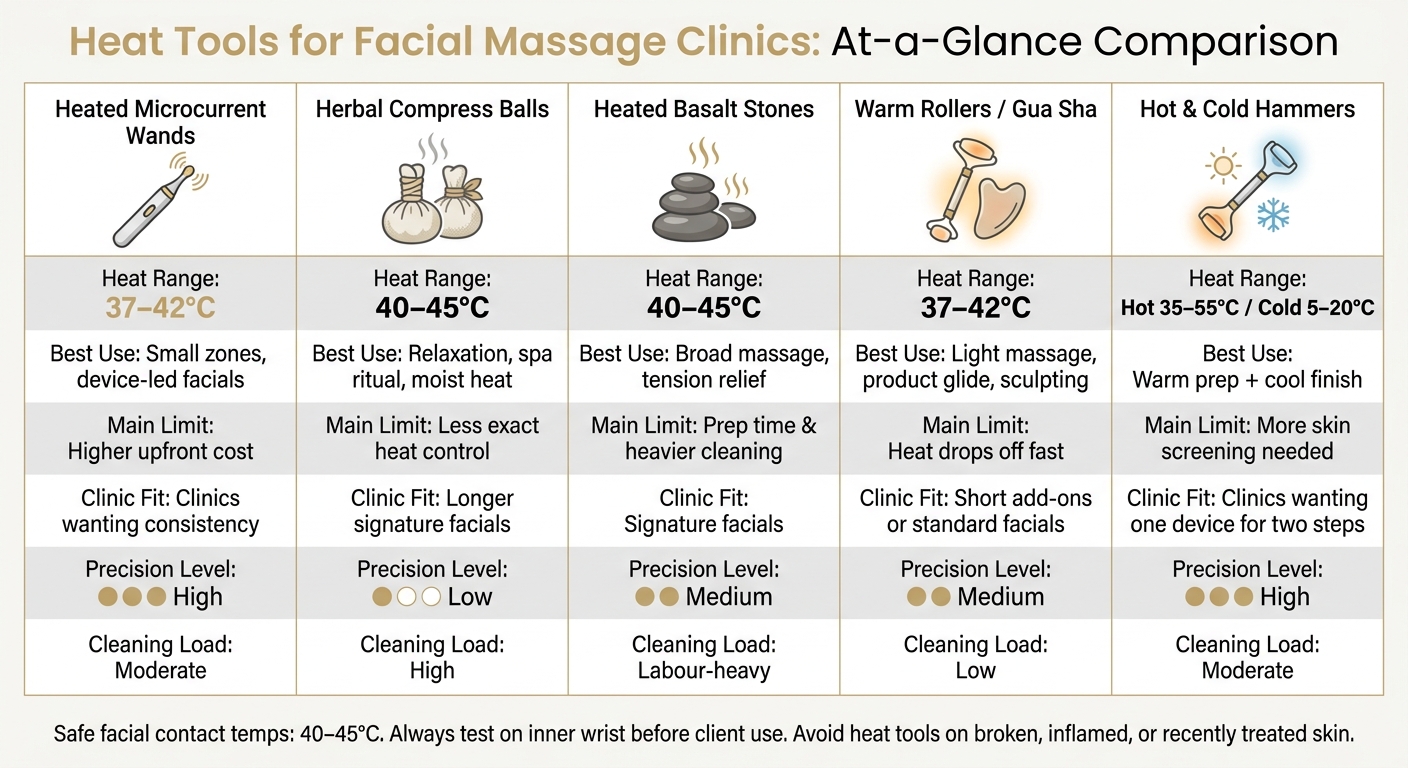
Heat Tools for Facial Massage Clinics: Quick Comparison Guide
| Tool | Usual facial heat range | Best use | Main limit | Clinic fit |
|---|---|---|---|---|
| Heated microcurrent wands | 37–42 °C | Small zones, device-led facials | Higher upfront cost | Clinics that want consistency |
| Herbal compress balls | 40–45 °C at skin | Relaxation, spa ritual, moist heat | Less exact heat control | Longer facials |
| Heated basalt stones | 40–45 °C | Broad massage, tension relief | Prep time and heavier cleaning | Signature facials |
| Warm rollers / gua sha | 37–42 °C | Light massage, product glide, sculpting | Heat drops off fast | Short add-ons or standard facials |
| Hot/cold hammers | Hot: 35–55 °C; Cold: 5–20 °C | Warm prep plus cool finish | More skin screening needed | Clinics that want one device for two steps |
So if you’re choosing for a clinic, I’d keep it simple: pick the tool your team can heat, clean, and use with steady control every single day. The rest of the article breaks down where each option fits best.
1. Heated Microcurrent Wands
Heated microcurrent wands combine low-level electrical current with controlled surface warmth to work the facial muscles and support circulation. Most operate in the 50–200 μA range. The heat helps with glide and comfort during treatment, so the step tends to feel smoother for both the practitioner and the client.
The effect builds over time, not all at once. That makes these wands a strong fit for clinics that want repeatable heat, targeted treatment, and a more premium service menu. In this roundup, they offer the closest control and the most device-led precision.
Heat Control
Clinic-grade wands usually aim for a surface temperature of about 37–42 °C, which sits close to body temperature. For professional use, look for digital temperature control, 1–2 °C adjustments, thermal cut-off, and auto-shutoff. In a busy treatment room, those features matter.
Precision
This is where heated microcurrent wands pull ahead of other heat tools. The tip contact area is usually 0.5–2 cm, small enough to work around the orbital rim, nasolabial folds, and jawline without warming nearby tissue. That makes them a better pick when exact placement matters more than ease of use.
Dual-pole or multi-pole tips can improve targeting in smaller facial zones. Some brands also include sequenced treatment maps, which guide practitioners zone by zone and make the session feel more controlled.
Workflow Fit
Most clinics use this step in the middle or later part of a facial, after cleansing and exfoliation but before the final mask. A typical segment lasts 20–30 minutes, which fits well inside a 60–90 minute appointment.
These devices usually heat up fast and cool down fast, so room turnover stays manageable. They also pair well with peptide-rich or hydrating conductive serums applied right before the wand pass. The warmth can help with absorption and makes the step easier to position as a clear add-on inside an existing facial menu.
Client Comfort
At the right settings, most clients say it feels like mild tingling with gentle warmth. It shouldn't hurt. Start low, then adjust based on feedback, especially for reactive skin.
If you see twitching or hear that it stings, the intensity is too high. A short cool-down can help ease redness.
If you want a simpler, lower-tech heat option, the next section covers herbal compress balls.
2. Herbal Compress Balls
Herbal compress balls work well for clinics that care more about the feel of the treatment than exact spot-by-spot heat placement. They’re tightly wrapped cotton or muslin pouches filled with dried herbs, usually chamomile, lavender, calendula, or lemongrass, then steamed and applied warm across the face, neck, and décolleté.
In a treatment room, these professional spa supplies give up some precision in exchange for mood. You get warmth, scent, and a spa-like feel, but they’re slower and less exact than heat tools built for tighter control.
Heat Control
Keep the compress surface at 40–45 °C when it touches the skin. Heat it in a steamer at 60–70 °C, then test it on the inner wrist or forearm for 3–5 seconds before using it on the face.
Use a brief press-and-release motion, not steady pressure. That’s extra important around the eyes and cheeks, where the skin is thinner and tends to react more. A simple way to keep the session smooth is to rotate two sets of compresses: one in use, one warming back up. That helps keep the temperature more even from start to finish.
Precision
Herbal compress balls offer moderate precision. A smaller compress, about golf-ball sized, can move along the jawline, nasolabial folds, and brow line fairly well. You can also fold the pouch to make the contact area narrower for more targeted work along the orbital bone or at acupressure points on the temples and jaw.
Around the eyes, use the compress at a shallow angle with a light rolling or tapping motion along the brow bone. Never press directly on the eye itself. It helps to think of compresses as a warming step, not a detail tool. They’re better for heating tissue than for targeted correction.
Workflow Fit
Steamers need 15–20 minutes to warm up, so compresses should be started before the client arrives or during the first part of the treatment. Because of that, they fit best in 60–90 minute signature facials and can be harder to fit into express services.
For hygiene, compresses should be used once per client and then either discarded or washed the right way. Herb blends also need clear ingredient labels so allergy risks are easier to manage.
Client Comfort
This is the most sensory-led option in this roundup. The mix of moist heat, gentle weight, and herbal aroma gives the treatment a deeply relaxing feel that clients tend to notice and remember.
The press-and-lift rhythm can help ease tension around the jaw and forehead. The aroma can also be matched to the service: calming lavender and chamomile for stress-focused treatments, or lemongrass for a more energizing feel. After use, a light warm towel wipe clears away any herb residue before the next step.
Avoid using herbal compress balls on inflamed, broken, or recently treated skin, and on clients with known herb allergies. They’re a better fit for ritual and relaxation than for exact precision work.
For a more structured massage option, the next section covers heated basalt stones.
3. Heated Basalt Stones
Compared with wands and compresses, basalt stones give you less pinpoint control but a broader, more even kind of warmth. They hold heat well and glide across the skin with very little drag, which helps the temperature stay steady from one stroke to the next. In facials, they work best as a relaxation add-on for hydrating or anti-ageing services, not for corrective work or device-based treatments.
Heat Control
For facial treatments, keep stones at 40–45 °C. That’s lower than the 50–54 °C often used in full-body hot stone massage. Use an adjustable heater and check the temperature with a digital thermometer.
Before the stones touch a client’s face, test each one on the inner forearm. If it feels hot instead of warm, don’t use it yet. During the massage, keep the stones moving. Don’t leave them sitting still on bony areas or places where the skin is thin.
Precision
Heated basalt stones offer moderate precision. They work well on the cheeks, forehead, and jawline, but they won’t give you the same level of control as a microcurrent wand or hot/cold hammer.
For smaller areas, use mini oval or contour-shaped stones around the under-eye area, nasolabial folds, and along the edges of the jawline. A good way to think about them: they extend what your hands can do, but they don’t replace detail tools.
Workflow Fit
Stone heaters need 30–45 minutes to reach a steady working temperature, so turn them on before the first client arrives. In a 60-minute facial, stones usually come in during the massage portion for about 10–20 minutes. Many estheticians alternate between stone work and manual massage so the stones can warm back up between passes.
After each client:
- Wash the stones
- Disinfect them according to provincial infection-control rules
- Dry them
- Return them to the heater
You’ll also need to plan for the heater’s footprint and access to a standard 120 V outlet.
Client Comfort
Many clients find heated basalt stones deeply relaxing, especially across the jaw and forehead where tension tends to build up. That said, some people find the weight or heat too intense, more so if their skin is sensitive. That’s why verbal check-ins during the session matter. A simple “How does this feel?” can save you from pushing things too far.
Clients with rosacea, active acne, melasma, or recent cosmetic procedures should get cooler stones or a manual option instead. Intake forms should also screen for vascular or neurological conditions, since added heat may not be a good fit for those clients.
For less bulk and more targeted temperature control, the next section covers warm facial rollers and gua sha tools.
4. Warm Facial Rollers and Gua Sha Tools
Warm facial rollers and gua sha tools use mild external heat. Staff usually warm them in a towel cabinet, then apply them at about 37–42 °C. That softer warmth works well for relaxation-led facials, lymphatic drainage, and helping product spread more smoothly on the skin. After that, the main difference comes down to how each tool handles pressure and where it can reach.
Heat Control
Professional towel cabinets can reach up to 82 °C (180 °F) inside. But once the tools come out, they lose heat fast. That means the temperature that actually touches the skin is usually around 37–42 °C, with the lower end being the safer choice for sensitive skin.
Always test the tool on the inside of your wrist before using it on a client's face.
Stainless steel tools heat up and cool down faster than jade or other stone tools. That gives practitioners tighter control over timing. Jade and rose quartz tend to hold a soft warmth nicely, which is why many people like them for soothing treatments.
Precision
If a clinic is deciding between a roller and gua sha, shape matters more than heat.
A dual-ended roller makes it easy to switch between a larger head for broad areas, like the cheeks and forehead, and a smaller head for delicate spots, like under the eyes and around the orbital bone.
Gua sha tools, especially heart-shaped or contoured styles, fit the jawline, cheekbones, and nasolabial folds with more accuracy than a roller. A 2025 randomized trial linked gua sha to better contouring and rollers to better elasticity outcomes, so the better pick depends on the treatment goal.
Workflow Fit
Apply product first, then use the warmed tool for 5–10 minutes during the serum or facial oil step. In many cases, this swaps in for manual massage instead of adding extra time. So a 60-minute facial can still stay 60 minutes.
Client Comfort
Keep the tool moving. Static pressure over bony areas or thin skin can feel uncomfortable fast.
Use room-temperature tools for rosacea, reactive skin, or active inflammation. It also helps to check in halfway through the treatment so you can catch discomfort early.
5. Hot and Cold Hammers
After single-temperature tools, hot and cold hammers give clinics one of the most useful built-in ranges. They do two jobs in one device, which makes them a smart fit when a clinic wants one tool for both prep and finish. The warm setting adds gentle heat to help with glide and client comfort. The cool setting helps calm the skin after exfoliation or more active services.
Heat Control
Professional hot and cold hammers usually stay within moderate therapeutic ranges. Hot settings often sit around 35–55 °C, while cold settings tend to land between 5–20 °C.
Some higher-end units use Peltier technology. That means the device can switch from warm to cool fast, without a long pause while it cycles. In a treatment room equipped with a spa trolley with a power bar, that matters. It keeps the flow smooth and cuts down on waiting.
It also helps to choose a model with a digital temperature display and steady internal sensors. That way, clinicians can keep the output even from start to finish instead of guessing whether the device has drifted.
Precision
The contoured head makes it easier to work around smaller facial zones like the orbital area, temples, jawline, and nasal folds. Stones and compresses can feel a bit clunky in those spots. A hammer gives you more control.
Cold mode also works well for post-procedure cooling when used around the treated area, not directly over it.
Workflow Fit
Hot and cold hammers usually fit into a 10–15 minute block inside a 60–75 minute facial. That makes them easy to work into an existing service without turning the whole treatment plan upside down.
Hot mode tends to work best right after cleansing and mild exfoliation. It helps prep the skin before serums or masks. This is similar to how a professional facial steamer softens the stratum corneum for better product absorption. Cold mode makes the most sense near the end, especially after exfoliating or active steps, when the goal is to calm the skin and leave the face settled with a cool finish.
Client Comfort
Keep the head moving with slow, gliding strokes. Light-to-medium pressure is enough. Holding static pressure near the orbital rim or jawline usually adds discomfort and doesn't do much else.
Most clients find hot mode deeply relaxing, while cold mode feels refreshing, especially after a peel or active facial. In winter, though, a little restraint goes a long way. If a client comes in with wind-damaged or barrier-compromised skin, ease back on the cold setting and keep cool exposure short.
A quick check-in halfway through the treatment can catch discomfort early. That extra range is part of what makes these devices useful, but it also means temperature control and skin screening matter more than they do with simpler heat tools.
Safety, Temperature Control, and Trade-Offs by Tool Type
Facial contact temperatures should stay around 40–45 °C, with lower settings for sensitive or compromised skin. The main difference between these tools isn't just heat. It's how well you can control that heat.
Test every tool with a calibrated thermometer first. Then check comfort on the inner wrist or forearm. If it can't stay comfortably on skin for five seconds, it's too hot. With herbal compress balls, check both the outer cloth and the inner core. Trapped steam can make the inside much hotter than the surface feels.
Avoid heat tools on broken, inflamed, recently treated, or highly reactive skin. That includes clients using retinoids, acids, or photosensitising medications. For rosacea-prone clients, cooling tools or room-temperature tools are a safer fit.
This is the day-to-day trade-off clinics need to weigh: precision, cleaning workload, and tissue risk. The table below turns those safety rules into a quick clinic comparison.
| Tool Type | Safe Facial Temp Range | Warming Scope | Cleaning Complexity | Key Risk |
|---|---|---|---|---|
| Heated microcurrent wands | Below ~42–43 °C | Targeted | Moderate (gel removal, disinfection, calibration) | Localised overheating; avoid recent injectables |
| Herbal compress balls | ~40–42 °C at skin | Broad | High (single/limited use; moisture risk) | Steam burns; barrier disruption on acne-prone or inflamed skin |
| Heated basalt stones | ~40–45 °C at contact | Broad | Labour-heavy (scrubbing, descaling, heater upkeep) | Burn risk from static contact; avoid rosacea-prone skin |
| Warm facial rollers / gua sha | ~35–40 °C | Targeted | Low (non-porous materials; simple disinfection) | Friction risk if over-worked or used too dry |
| Hot and cold hammers | Hot: ~38–42 °C / Cool: short cooling passes | Targeted | Moderate (surface disinfection; internal component care) | Rapid warm-cool cycling can aggravate sensitive skin; cold urticaria in sensitive clients |
In daily use, glide and cleaning matter just as much as temperature. Use enough slip product - oil, balm, or conductive gel - to cut friction and help keep surface temperatures even across the treatment area. Beauty Pro Supplies Canada can help clinics source tools with clear cleaning instructions and replacement parts.
Conclusion
There’s no one-size-fits-all heat tool for every clinic. The right pick comes down to three things: heat control, client comfort, and how your team actually works day to day.
Use heated microcurrent wands when you need precise work around the eyes, brows, lips, and jaw. Basalt stones and herbal compress balls make more sense for slower, spa-style treatments with a calm, unhurried pace. Hot and cold hammers fit sessions that call for both warming and cooling in the same appointment. Warm rollers and gua sha tools are better for gentler sculpting and light lymphatic work.
For reactive skin, keep it simple: use the lowest heat that still does the job and keep contact short. A tool may work well on paper, but if it leads to redness or discomfort, it’s the wrong choice for that client.
It also helps to think past the treatment itself. Setup time, sanitisation, durability, and appointment length all matter. Pick the tool your team can use with steady control, not the one that sounds the most advanced. For Canadian clinics, Beauty Pro Supplies Canada is a practical source for professional facial tools and spa supplies.
FAQs
Which heat tool is best for sensitive skin?
For sensitive skin, go with a Gua Sha tool made for a gentle facial massage, like the Jade Green Gua Sha Facial Tool. Its ultra-smooth surface helps the tool glide more softly over skin, which can make calming, pressure-relieving strokes feel more comfortable while still helping support circulation and lymphatic drainage.
How do I choose the right heat tool for my clinic?
Consider your service volume, the space you have, and the treatments on your menu. That makes it much easier to figure out whether a compact unit will do the job or if you need more capacity, like a hot towel cabinet that holds 30 to 40 towels.
It also helps to look for adjustable temperature controls and safety features such as automatic shut-off or UV sterilization. Those details can make day-to-day use smoother while helping you keep results clean and consistent. If space is tight, a multifunctional unit can pull double duty and help you get more out of the room you have.
What temperature is safe for facial heat treatments?
Safe heat levels depend on the type of treatment. That’s why professional equipment with adjustable controls matters so much. It helps you keep the heat steady and comfortable instead of letting it drift too hot or too cool.
For safety, use devices that include overheating protection, such as automatic shutoff and low-water detection. Just as important, follow the manufacturer’s operating guidelines for the right distance, setup, and technique.
Leave a comment