
Checklist for Choosing Sustainable Spa Supplies
If I want lower-waste spa supplies in Canada, I start with four checks: compliance, ingredients, packaging, and supplier proof. That’s the short answer.
A product can look “green” and still miss the mark. So before I buy, I check:
- Health Canada rules: CNF where needed, bilingual labels, INCI names, SDS for pro-use items
- Ingredients: watch for parabens, phthalates, formaldehyde releasers, synthetic musks, petrolatum, and harsh sulphates
- Packaging: refill options, glass, aluminum, PCR plastic, and FSC paperboard
- Daily-use items: longer-wearing linens, HE laundry products, repairable equipment, and lower-waste disposables
- Supplier proof: current certifications, sourcing records, training support, and clear pricing per 100 mL
A few numbers help show what to check. Towels in the 400–600 gsm range often hold up well in commercial laundry. Washing routine linens at 30°C instead of 60°C can cut energy use by about 60%. And asking for spare parts for 7 to 10 years can help me avoid replacing treatment beds or chairs too soon.
Here’s the article in one view:
| Check | What I look for | Why it matters |
|---|---|---|
| Compliance | CNF, DIN/NPN where needed, bilingual label, SDS | Helps avoid non-compliant products |
| Ingredients | Clear INCI list, fewer red-flag ingredients | Helps screen formulas fast |
| Certifications | COSMOS, ECOCERT, CertClean, Leaping Bunny, B Corp | Gives me something to verify |
| Packaging | Refill systems, glass, aluminum, PCR plastic | Can cut single-use waste |
| Linens & equipment | GOTS cotton, HE washers, repairable furniture | Can lower replacement and utility costs |
| Supplier review | Documents, training, bulk sizes, price per 100 mL | Makes supplier comparison easier |
If I use a simple checklist each time I order, buying gets easier, waste can drop, and product quality stays in focus.
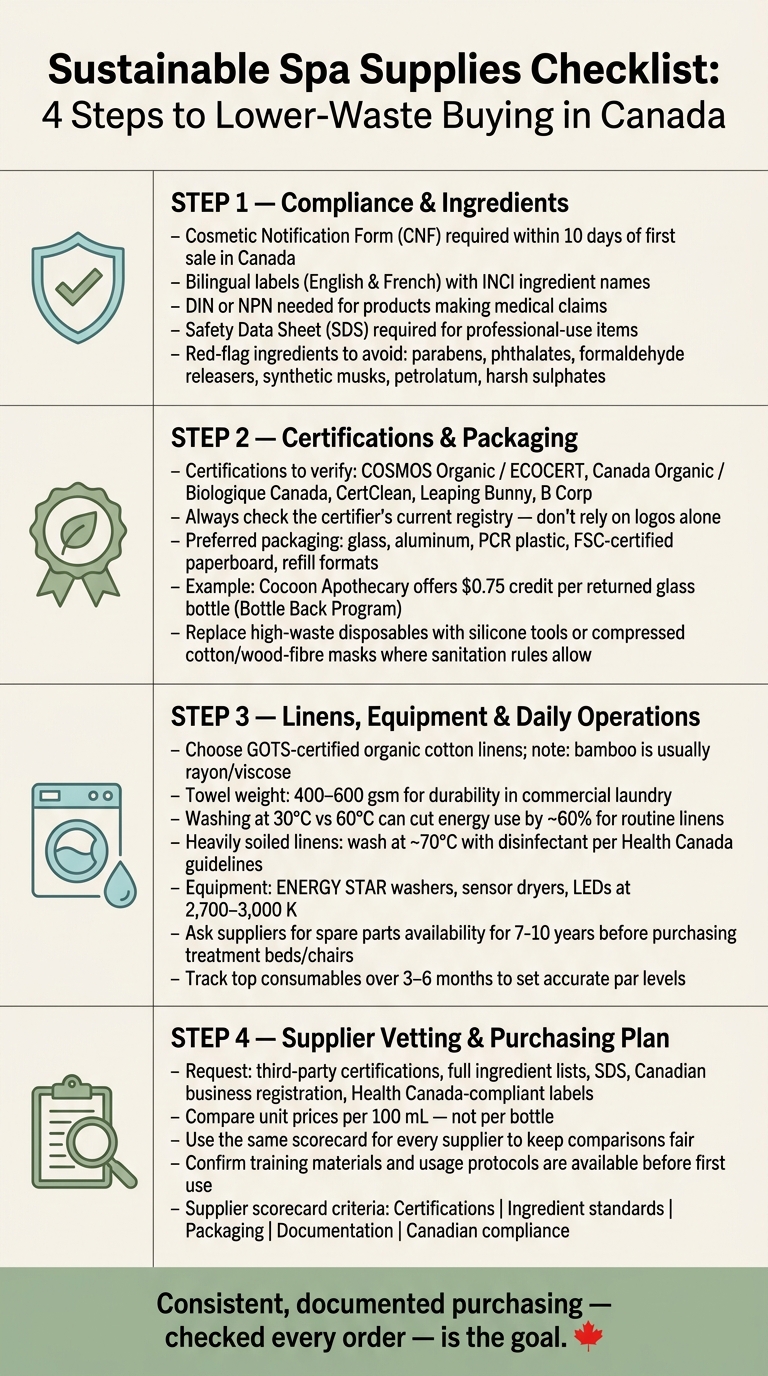
Sustainable Spa Supplies Checklist: 4 Steps to Lower-Waste Buying in Canada
Step 1: Check ingredients, product safety, and Canadian compliance
Start with compliance. A product can't be called sustainable if it's unsafe or doesn't meet the rules in Canada.
Review ingredient lists for common red flags
The ingredient list is your first filter. Before you look at branding or big promises, check the INCI list and scan for ingredients that tend to set off alarms in a professional setting: parabens, phthalates, formaldehyde-releasing preservatives, synthetic musks, petrolatum, and strong sulphates.
Pay close attention to the first few ingredients. They usually tell you most of what you need to know about the formula. And if a label leans hard on "free-from" claims, take that as a starting point, not proof.
Look for traceable and responsibly sourced raw materials
For oils, botanical extracts, masks, and body products, traceability matters. You want to know where the raw materials came from and how they moved through the supply chain. Ask for supply-chain documentation, batch records, and test results.
Look for Canada Organic/Biologique Canada, COSMOS, ECOCERT Canada, and Quebec Vrai where relevant. If botanical ingredients appear with both the common name and the Latin name in parentheses, that's another good sign the brand is being open about what's inside.
If a brand makes fair-trade claims, ask for published sourcing commitments and proof of Fairtrade certification instead of taking the marketing at face value.
Confirm product information against Health Canada requirements
Every cosmetic product sold in Canada must be notified to Health Canada through a Cosmetic Notification Form (CNF) within 10 days of its first sale in the country. Ask your supplier for proof of notification before you add any new product to your treatment menu.
Then check the label itself. In Canada, label warnings and directions must appear in both English and French, and ingredients should be listed using INCI names. Claims also need to be truthful and not misleading. If a product says it can treat acne or another medical condition, it needs a DIN or NPN, not cosmetic notification.
For professional-use supplies, ask the manufacturer for a Safety Data Sheet (SDS). That document can show safety and environmental details that don't appear on the label.
Once a product clears compliance, move on to its certifications, packaging, and disposables.
Step 2: Verify certifications, packaging, and disposable items
Use certifications as checklist items, not decoration
Once a product passes compliance, the next step is simple: what has actually been checked? Certifications matter only when they’re current, verified by an outside body, and tied to the product in front of you.
Use this as your short list:
- COSMOS Organic / ECOCERT - checks organic content and ingredient origin
- Canada Organic / Biologique Canada - checks organic content under Canadian rules
- CertClean - checks clean-ingredient standards; Canada’s leading clean beauty certification
- Leaping Bunny - checks cruelty-free status across the whole supply chain, not just the finished product
- B Corp Certification - checks broader social and environmental performance at the company level
Don’t stop at the logo. Check the certifier’s current registry. If the product isn’t listed there, the badge on the label doesn’t mean much.
Once those checks are done, shift your attention to the package and product format.
Choose lower-waste packaging and refill-friendly formats
A certification can support a claim. Packaging shows how that claim plays out in day-to-day use.
Look for glass, aluminum, post-consumer recycled (PCR) plastic, FSC-certified paperboard, or refill formats with a clear recycling path. Glass and aluminum are the strongest options because both are infinitely recyclable and are often accepted in municipal recycling programs. PCR plastic sits a step below, but it’s still a better pick than virgin plastic. If a brand doesn’t say what type of plastic it uses or how that package should be recycled, treat that as a gap.
For paper outer boxes, check for FSC-certified stock and vegetable-based or low-VOC inks. For refills, focus on options like biodegradable refill pouches, liquid refill stations, or refill-and-reuse programs where the dispenser stays in service and only the product is replaced. Some brands also offer bottle return programs. For example, Cocoon Apothecary in Kitchener, Ontario offers a $0.75 credit for each returned glass bottle through its Bottle Back Program, and its products carry ECOCERT COSMOS certification.
Replace high-waste disposables where possible
After packaging, look at the items your team goes through most often. This is where small swaps can add up.
The practical move is to replace disposables where you can without affecting sanitation. Silicone mixing bowls and brushes can stand in for single-use wax applicators and work with medical-grade disinfectants. Compressed cotton or wood-fibre masks are a good swap for pre-soaked sheet masks. If sanitation rules mean you need disposables, buying in bulk can cut excess packaging per unit.
Before you switch anything, make sure the new option meets the sanitation rules set by your provincial regulatory body. It’s also smart to check with your insurer if you’re bringing in a new tool or changing the treatment format.
sbb-itb-8ec3e54
Step 3: Assess linens, equipment, and daily operating impact
Choose durable linens and lower-impact laundry supplies
After product packaging, look at the systems your spa uses every single day: linens, laundry, equipment, and waste handling.
Linens deserve a close look because they move through your business fast. Few items get used, washed, and replaced as often. That’s why GOTS-certified organic cotton is a solid place to start. The certification limits harmful chemicals across more of the production chain, not just in the finished fabric. And one quick reality check: don’t treat bamboo as a green claim on its own. Most bamboo textiles are rayon or viscose.
For towels, aim for 400–600 gsm. That range tends to hold up well in commercial laundry cycles, and it dries faster than heavier towels. A smart way to test this is to start small with face cloths and hand towels. Run them through daily use for three to six months before you swap out everything else.
On the laundry side, high-efficiency (HE) washers matched with HE-specific concentrated detergents can cut both water use and chemical load per cycle. That adds up fast in a busy spa. For routine linens, washing at 30°C instead of 60°C can reduce energy use by around 60%. That said, heavily soiled linens still need a hotter wash at about 70°C with a suitable disinfectant, in line with Health Canada and provincial infection prevention guidelines.
A couple of simple habits matter here too:
- Keep lint traps clean
- Don’t overload machines
Both help your equipment last longer and keep wash quality steady.
Prioritize energy-efficient equipment and repairable furnishings
A spa’s biggest running costs - electricity and water - often come down to the equipment chosen at the start. So it pays to be picky. Look for ENERGY STAR washers, sensor-controlled dryers, and warm white LEDs in the 2,700–3,000 K range. Those choices usually mean lower utility use and a longer service life.
For treatment beds and chairs, the main issue isn’t just comfort. It’s repairability. If something breaks, can you fix it without replacing the whole unit? Before you buy, ask whether the supplier carries replacement parts such as motors, hydraulic pumps, upholstery panels, and hand controls for at least seven to ten years.
Warranty details can tell you a lot too. Separate coverage for the frame, motors, and upholstery is a good sign that the product is built for long-term use. It also helps to confirm spare-parts access and Canadian service support before signing off.
Cut waste through bulk buying and in-spa sorting
Once your equipment and linens are sorted out, the next step is tightening up purchasing and waste sorting so less gets thrown out month after month.
Start by tracking your highest-use consumables - detergents, disinfectants, carrier oils, and paper goods - over three to six months. Then set par levels based on what the numbers show, not guesswork. That makes ordering a lot cleaner and helps avoid stock sitting on shelves until it expires. Storage and labelling also need to meet Health Canada rules, with the product name, lot number, and expiry date clearly marked on every container.
For waste sorting, placement matters more than a nice poster on the wall. Bins need to sit where waste is actually produced: laundry areas, treatment rooms, and backbar storage. Not off in one corner that nobody uses. Colour-coded labels with simple pictograms make sorting faster between clients, which is when staff need things to be dead simple.
A short 15–20 minute training session when the system is first rolled out can make a big difference. So can occasional spot checks. They help keep the process steady without turning it into a big production. And before setting your waste categories, check local municipal recycling rules. Accepted materials vary across Canadian cities and regions, so what works in Toronto may not work in Calgary or Halifax.
Use these checks to compare suppliers based on long-term waste, not just the price you see upfront.
Step 4: Vet suppliers and build a lower-waste purchasing plan
Score suppliers on proof, not promises
Once you've checked the product itself, turn that same level of scrutiny toward the supplier. The idea is simple: verify claims with documents.
A one-page scorecard makes this much easier. It gives you a clean way to compare suppliers side by side instead of relying on polished sales language. Ask for third-party certification documents, full ingredient lists, safety data sheets (SDS), Canadian business registration, and Health Canada-compliant labelling. If a supplier can't provide these when asked, that's a strong warning sign.
Use the same scorecard for every supplier. That's what keeps comparisons fair and useful.
| Criteria | What to Ask For |
|---|---|
| Certifications | Third-party eco-certifications or organic sourcing documentation |
| Ingredient standards | Full ingredient disclosure |
| Packaging | Professional bulk sizes and refill formats |
| Documentation quality | SDS, test data, country of origin |
| Canadian compliance | Canadian business registration; Health Canada-compliant labelling |
For consumables, ask for bulk or backbar sizes. Then compare the unit price per 100 mL, not per bottle. That's the better way to see what you're actually paying.
Factor in training and support when choosing a supplier
Even a solid lower-waste purchasing plan can fall apart if staff aren't shown how to use products the right way. Small application mistakes add up. Too much product, poor handling, or misuse can all lead to waste that was easy to avoid.
That's why supplier support matters. When you're vetting suppliers, check whether they provide product education, usage protocols, or professional training resources along with their catalogue. This becomes even more important when you're bringing in new equipment or new techniques. Your team needs clear guidance before the first treatment, not after problems start.
It's also smart to confirm that training materials are available right away after purchase. A delay in access to online course materials can slow down rollout and throw off implementation.
Use the same checklist across the supplier's product range, documentation, and training support. Good training support helps cut misuse, waste, and returns.
Conclusion: Use the checklist to make practical, lower-waste buying decisions
Work through each step in order: start with ingredient and safety review, verify certifications, assess packaging and disposable choices, account for linen and equipment impact, and then choose suppliers using documented criteria instead of label claims. A structured scorecard helps make trade-offs visible and keeps purchasing decisions tied to evidence.
The goal is consistent, documented purchasing that gets better with each order.
FAQs
How do I verify a product is compliant in Canada?
Check that the product or equipment meets Health Canada rules under the Food and Drugs Act and Cosmetic Regulations.
For medical equipment, confirm that it has a valid Medical Device Licence when one is required, along with approved electrical certification such as CSA, cUL, cETL, or QPS.
For cosmetics, verify:
- GMP documentation
- Ingredient compliance
- Bilingual English/French labelling
- Batch tracking or certificates of compliance
Which sustainability certifications matter most for spa supplies?
Put safety and quality first when reviewing spa supplies for Canada.
The main documents to look for are:
- Good Manufacturing Practices (GMP)
- CAN/CSA-ISO 13485 for medical devices
- Recognized electrical safety marks such as CSA, cUL, cETL, or QPS
Environmental labels can still help. But for spa supplies in Canada, the core focus should be regulatory compliance and standardized manufacturing certifications.
What should I ask a supplier before placing a bulk order?
Before you place a bulk order, make sure the supplier meets all Health Canada rules and follows Good Manufacturing Practices (GMP). That step matters up front. It can save you from a mess later.
Ask for a full ingredient list so you can check it against restricted substance rules. Then review the packaging details to make sure the product includes the required bilingual labelling.
You should also ask for:
- batch-tracking records
- certificates of compliance
- a clear process for telling you about future regulatory changes
Leave a comment