

Top 5 LED Machine Factors for Clinic ROI
If I were buying an LED machine today, I’d ignore the sticker price first and test one thing: can it earn back its cost under low-demand numbers?
In plain terms, clinic ROI comes down to five checks:
- Patient demand: Will people book and rebook this service?
- Session length: How many full appointments fit into my week?
- Staff time: How much paid time does each treatment use?
- Ownership cost: What will repairs, warranty gaps, financing, and downtime cost me in C$?
- Upgrade path: Will future add-ons lead to paid services, or just extra spend?
The article’s core point is simple: a C$6,000 machine can beat a C$18,000 one if it fits my clinic better. And a treatment priced at C$50 to C$75 per session can still underperform once I include taxes, labour, cleaning time, cancellations, and monthly payments.
A simple way I’d frame it:
- Estimate weekly sessions
- Multiply by 4.33
- Multiply by my actual average price
- Then subtract labour, financing, maintenance, training, consumables, and downtime risk
So if I expect 12 sessions a week at C$60, monthly LED revenue is about C$3,118. If monthly delivery costs total about C$1,450, contribution is about C$1,668 before clinic overhead.
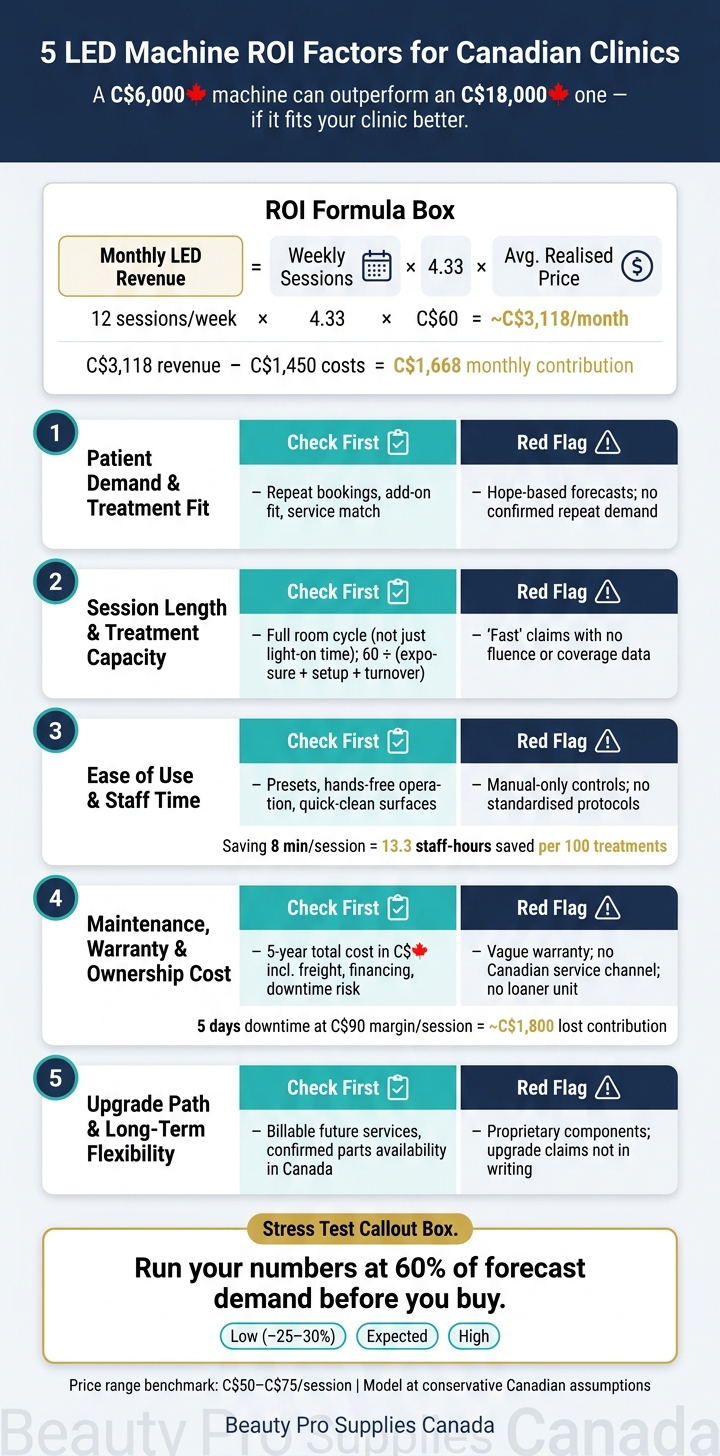
5 LED Machine ROI Factors for Canadian Clinics
Quick comparison
| ROI factor | What I’d check first | What hurts ROI |
|---|---|---|
| Patient demand | Repeat bookings, add-on fit, service match | Hope-based forecasts |
| Session length | Full room cycle, not just light time | Long setup and turnover |
| Staff time | Presets, easy cleaning, low supervision | High hands-on time |
| Ownership cost | Warranty scope, Canadian parts, downtime | Vague service support |
| Upgrade path | Paid future services | Add-ons with no clear use |
My takeaway: I’d buy the machine with the best fit, the lowest wasted room time, and the lowest ownership drag under conservative Canadian assumptions.
sbb-itb-8ec3e54
How to Estimate LED Machine ROI Before You Buy
Inputs to Gather Before Purchase
Before you decide if an LED machine is worth the money, get clear on what it will cost and what it can bring in each month. Start with the machine’s full landed price in C$, not just the sticker price. That means adding shipping, installation, taxes, accessories, and any financing fees. Then split that total into two buckets: the one-time cost and the monthly costs that keep showing up.
On the income side, estimate your expected weekly treatment volume and your average realised price per session. Use the price you can charge in your market after package discounts, not the price you hope to charge. A practical planning range is C$50–C$75 per session. It also helps to be clear about the offer itself: are you selling LED as its own service, or as a facial add-on?
A few costs often slip through the cracks. Think consumables such as protective goggles, disinfectants, and single-use items. Add training allocation, financing interest, and some room for downtime, especially if replacement parts can take time to arrive. And don’t treat the machine as a cost you claim all at once. It should be handled as a depreciable capital asset claimed over time.
A Simple Monthly ROI Formula in C$
Once you have the inputs, use this formula:
Monthly LED revenue = Weekly treatments × 4.33 × average realised price
So, if you expect 12 sessions a week at C$60 each, that works out to about C$3,118 per month in gross LED revenue. From there, subtract the costs tied to delivering the service:
Monthly contribution = LED revenue − (labour + financing + maintenance + training allocation + consumables + other ownership costs)
Here’s what that can look like in plain numbers:
- Labour: C$650
- Consumables: C$100
- Financing: C$500
- Maintenance and training: C$200 combined
With C$3,118 in revenue, that leaves an estimated monthly contribution of about C$1,668 before broader clinic overhead.
One more thing matters here: track total booking time, not just LED exposure time. A 20-minute treatment can easily turn into a 30-minute room booking once you add 5 minutes for setup and 5 minutes for cleaning. That extra time cuts into how many sessions you can book in a day.
Those numbers give you a starting point for comparing machines based on throughput, labour, maintenance, and upgrade value.
Why Conservative Assumptions Work Better for Canadian Clinics
A cautious model usually gives you a better read than an optimistic one. In the first few months, it makes more sense to model 8–10 sessions per week than 20. That slower ramp-up leaves room for staff training, client education, and the simple fact that demand for a new service takes time to build.
Canadian operating costs can also hit harder than they first appear. Employer payroll obligations, provincial tax treatment, GST/HST on sessions, and seasonal swings in demand all shape the monthly contribution you keep. That’s why it helps to test your numbers at C$50, C$60, and C$75 per session, and at a few weekly booking levels.
If a machine only makes sense under your highest price and booking assumptions, that’s a red flag. Use these inputs to compare devices based on demand, throughput, labour, maintenance, and flexibility. The next step is to look at the features that push that return up or pull it down.
What Makes One LED Device a Better Buy Than Another
If you're looking at monthly ROI, don't judge a device by price alone. Look at the things that change bookings, staff time, room use, and what it costs to own over time.
Why a Higher Price Does Not Mean a Higher Return
A machine proves its worth through booked treatments, smooth use of rooms and staff, and ownership costs you can plan for. A higher price tag doesn't automatically lead to a better return.
The practical test is simple: estimate monthly contribution, subtract operating costs, and compare that number with the all-in acquisition price. If the math only works when you assume best-case booking levels, the device is probably a poor fit for your clinic.
The 5 Factors Used to Judge ROI in This Article
Judge each machine by five ROI factors, not price alone.
These five factors turn sticker price into something you can actually compare.
| Factor | What it measures |
|---|---|
| Patient demand and treatment fit | Whether the clinic has an appropriate patient base, repeat-treatment potential, and a clear treatment menu |
| Session length and treatment capacity | How long each session takes, including setup and cleaning, and how many treatments can realistically fit into the week |
| Ease of use and staff time | How much staff time, positioning, calibration, and training the device requires per session |
| Maintenance, warranty, and ownership cost | Purchase or financing cost, warranty coverage, repairs, replacement parts, consumables, electricity, and possible downtime |
| Upgrade path and long-term flexibility | Whether the device can support additional indications, applicators, protocols, or service expansion without requiring early replacement |
These five factors help separate a machine that's just expensive from one that can support steady clinic economics.
1. Patient Demand and Treatment Fit
Before you even glance at a spec sheet, start with your own booking data. Look back at the last three to six months of consultations, skincare visits, injectables, post-procedure follow-ups, acne or photoaging enquiries, and any requests for add-on services.
That booking history tells you more than a sales pitch ever will. It shows whether patients are already asking for the kind of Infrared + LED Light Therapy supports. And it gives you a grounded way to check if LED could bring in enough bookings to make the monthly ROI model work.
Revenue demand fit
The main question is simple: how many patients will pay for LED, and how often?
A good place to start is with three booking scenarios:
- a conservative case of about 12 sessions per month
- a likely case of 25
- an optimistic case of 40
Here’s the key part: the purchase needs to make sense at the conservative level, not only in the best-case version.
How you sell the service matters too. A standalone session model can work, but only if patients are likely to book a separate visit instead of just agreeing to it at checkout. That’s a big difference. A quick “yes” as an add-on is not the same as steady demand for dedicated appointments.
Once you’ve pinned down demand, the next step is practical: can the device handle those bookings without slowing your team down?
Clinical parameter transparency
Pick wavelengths that line up with the services you plan to offer, and ask for documented output so treatments stay repeatable.
In plain terms, clear specs beat flashy settings. A simpler device with documented output is often a better buy than a pricier unit with vague modes and unclear treatment data.
If the output is not documented, the device cannot support consistent treatment planning.
2. Session Length and Treatment Capacity
The number that matters isn't the exposure time on its own. It's the full room cycle.
In practice, that means consultation, skin prep, positioning, light exposure, charting, disinfection, and turnover. So even if the light is on for 10 minutes, the full appointment can still run 20 to 30 minutes once everything around the treatment is included.
That full cycle, not just the minutes under the light, is what sets room capacity.
Booking limits and throughput
A faster device only adds revenue if you can actually fill the extra appointments it makes possible. That's the catch.
Before you compare treatment protocols, check whether patient demand and staffing can support the added bookings that a shorter cycle might open up. If the schedule won't absorb those extra slots, the shorter session doesn't do much on its own.
Throughput per treatment room
A simple way to compare devices is to look at the full room cycle rather than the light-on time alone:
Completed cycles per room per hour = 60 ÷ (exposure time + setup + turnover)
Here's what that looks like in practice:
- A 20-minute exposure plus 10 minutes for setup and turnover allows about two cycles per hour
- A 10-minute exposure with the same overhead gets you closer to three cycles per hour
In the real clinic day, it's smart to plan for 70% to 85% of theoretical capacity. That buffer matters. Gaps between patients, delays, and staff workload all eat into the perfect model on paper.
Session length only improves ROI if the clinic can turn saved time into more completed bookings.
Clinical parameter transparency
Session length only means something if irradiance is documented at the actual treatment distance. Without that detail, it's hard to compare capacity or dosing in any dependable way.
And there's one more thing people often miss: a fast session can still slow the team down. If the device is awkward to position or use, staff friction creeps in fast. At that point, the labour cost can wipe out the time saved.
3. Ease of Use and Staff Time
Once you’ve set session length, the next ROI check is simple: how much staff time does the device eat up?
Ease of use matters because every extra minute spent on setup, cleaning, charting, or rebooking cuts into daily capacity. Those small delays add up fast over a full clinic day.
The features that help most are pretty practical:
- saved or pre-programmed protocols
- quick-start controls
- hands-free operation
- surfaces that clean fast between clients
Staff involvement during the session matters too. If a staff member has to stay in the room the whole time, that device uses up clinic capacity. But if it can run safely with minimal supervision, that same person can finish charting or get the next room ready. That has a direct effect on how many billable treatments the clinic can handle in a day.
Visible settings
Pre-programmed modes can speed up setup, but they shouldn’t replace clear clinical documentation. Preset modes only work well when staff can still see and record the settings needed to repeat the protocol.
That matters for ROI in a very practical way. If a new staff member can’t follow a protocol properly without hands-on training, training time goes up and treatment consistency slips. A device with a clear interface, named protocols, and visible parameters removes a lot of that drag. Clearer protocols cut coaching time and make delegation easier across shifts.
Reducing active staff involvement by just 8 minutes per treatment saves about 13.3 staff-hours per 100 treatments. So a lower-priced device can still produce worse ROI if it needs more staff time for each session.
After labour efficiency, compare maintenance, warranty, and downtime.
4. Maintenance, Warranty, and Ownership Cost
Five-Year Ownership Cost (C$)
The purchase price is just the opening number. Five-year ownership cost is what shapes ROI.
Build a five-year estimate that covers delivery, installation, training, financing, maintenance, replacement parts, and downtime. Downtime needs to be in that math. If you run four sessions per day with a C$90 contribution margin, a five-business-day repair can mean about C$1,800 in lost contribution. That turns service speed into a direct ROI issue.
That’s why service terms matter just as much as maintenance costs.
When you review warranty terms, look past the headline length. Check the actual scope. You’ll want to confirm which parts are covered, including LED panels, the power supply, cooling system, cables, and controls. Then look at what’s left out. Also check whether the device is repaired on-site or sent away for service, who pays return freight, and whether a loaner unit is available during repairs.
A one-year warranty with Canadian technical support and a loaner unit can be more useful day to day than a longer parts-only warranty that depends on international shipping. If a supplier can’t give you a written response-time commitment and confirm parts availability, that’s a red flag.
Use the checks below to compare ownership risk, not just sticker price.
| Ownership question | Lower risk | Higher risk |
|---|---|---|
| Warranty scope | Written parts-and-labour coverage with clear exclusions | Warranty offered without terms |
| Parts availability | Stocked or readily available in Canada | International shipping only |
| Repair turnaround | Defined response time or loaner unit offered | No written response-time commitment |
| Maintenance schedule | Documented cleaning, inspection, and maintenance costs | No maintenance instructions provided |
| Regulatory status | Model verifiable in Health Canada's MDALL listing | Seller cannot clarify Health Canada listing status |
Once ownership cost is clear, the next step is to compare how long the device is likely to stay useful before you need to replace it.
5. Upgrade Path and Long-Term Flexibility
Once you know the full cost of ownership, the next step is simple: will this device stay useful long enough to save you from buying another one too soon?
The first four factors show whether the machine fits your clinic right now. This one looks ahead. It tells you whether the device can still do its job later, as your service menu shifts. A flexible LED machine is only worth more if that flexibility can bring in added revenue without pushing you into an early replacement.
That’s the key test. Do the upgrades lead to billable services your clinic can actually sell? If not, they shouldn’t count in your return math.
Only treat an upgrade as a return driver when it opens up a service you can offer on a steady basis. An extra wavelength or applicator might sound great on paper. But if it ends up sitting on the shelf, it’s not an asset. It’s just added cost.
There’s another issue people sometimes miss: documentation. A device without recorded specs is much harder to expand safely. Future modules need to match the base unit at a clinical level, and you can only check that properly when the original output is documented.
Time matters too. If an upgrade adds setup time, calibration work, or longer changeovers between patients, that extra friction can eat into room capacity. And that affects revenue just as much as the upgrade price itself.
A good way to frame it is to compare two costs:
- the premium you pay now for an upgradeable platform
- the cost of replacing the whole machine later
In many cases, a platform that takes add-on modules will cost less over time than a fixed unit that has to be replaced when your clinic adds new services. But that only holds if the upgrade pricing makes sense, parts are still available, and supplier support is there in Canada.
ROI Snapshot Table for Canadian Clinics
Use this table as a first-pass filter before you get into specs. It helps you spot weak options early, so you don't waste time comparing machines that likely won't pay off. The goal is simple: trim your shortlist before you dig into the technical details.
| Factor | What to Check | Why It Impacts ROI | Red Flags |
|---|---|---|---|
| Patient demand and treatment fit | Current client base, suitable indications, repeat-treatment potential, and realistic monthly bookings. Use realistic paid-session volumes, not ideal capacity. | A device pays off only if it supports services your clinic can sell on a steady basis. | Forecasts based only on total patient count; no evidence of repeat bookings; indications that do not match your current services. |
| Session length and treatment capacity | Full workflow time, including setup, positioning, eye protection, treatment, cleaning, charting, and room reset; irradiance at the actual treatment distance; coverage area; and fluence. | Shorter sessions help only when the dose stays the same. | "Fast" treatment claims with no fluence, distance, or coverage data; irradiance measured only at the centre point; small treatment area relative to session time. |
| Ease of use and staff time | Minutes per session for setup, operation, documentation, and turnover; whether presets are available; and training time for new staff. | Staff time adds up over a month, so a simpler workflow can improve margin per session and cut labour cost. | Manual-only controls; frequent repositioning; no standardised presets; cleaning that adds major unpaid time between clients. |
| Maintenance, warranty, and ownership cost | C$ purchase price, freight, installation, financing, consumables, warranty scope, Canadian service time, and downtime risk. | Total installed cost - not just the sticker price - sets the real payback period. Include freight, installation, taxes, and financing. | Short or vague warranty; no Canadian service channel; exclusions for LED modules or control systems; repair delays that disrupt bookings. |
| Upgrade path and long-term flexibility | Compatible modules, wavelengths, software updates, accessory pricing, and parts availability after warranty. | A platform that supports future services can push back the need for a full replacement as your treatment menu grows. | Proprietary components with no published replacement plan; upgrade claims not documented in writing; software requiring recurring fees; no confirmed Canadian parts availability. |
Use C$ throughout, and state clearly whether your figures include tax, freight, installation, and financing. That sounds basic, but it's where ROI math often goes sideways.
Run your numbers in at least three scenarios:
- Low demand, about 25% to 30% below your expected booking volume
- Expected demand
- Higher-volume demand
That range shows how sensitive your payback period is if bookings start slower than planned.
Next, verify the machine's wavelength, irradiance, fluence, exposure time, and coverage area.
Key Specs to Check on Any LED Machine
Check dose before price.
That’s the only fair way to compare LED machines. Wavelength, irradiance, fluence, exposure time, and coverage tell you whether two devices are actually in the same class. These are the figures that show whether a machine can support the bookings in your ROI model.
Wavelength, Irradiance, and Fluence
Wavelength tells you how deep the light is meant to go. Red light in the 630–660 nm range is usually used for more surface-level work. Near-infrared light around 830–850 nm is chosen when the goal is deeper tissue reach.
Don’t rely on colour labels alone. Ask for the exact nanometre (nm) value. Also ask whether the device delivers more than one wavelength at the same time or through separate outputs. That detail matters more than it may seem at first glance.
Irradiance (mW/cm²) is the amount of power reaching the skin per unit area. You should ask for this on the spec sheet. Fluence (J/cm²) is the total energy dose delivered during the session, and you should ask for that too, along with how it was calculated.
For continuous output, fluence can be estimated as:
[ \text{Fluence (J/cm²)}=\frac{\text{Irradiance (mW/cm²)}\times\text{Time (seconds)}}{1{,}000} ]
For example, 50 mW/cm² delivered for 10 minutes equals 30 J/cm².
If the supplier’s stated fluence doesn’t match the math, stop there and ask how the figure was measured before you buy. Confirmed dose figures are what let you run the same treatment again and again without drift from one session to the next.
Exposure Time, Treatment Distance, and Coverage Area
Exposure time on its own doesn’t tell you much. It only means something when you pair it with irradiance and coverage.
A 5-minute session at 20 mW/cm² delivers about 6 J/cm². The same 5 minutes at 50 mW/cm² delivers about 15 J/cm². Same clock time, very different dose.
Always ask for irradiance measured at the skin, at the manufacturer’s stated operating distance. Don’t accept a reading taken right at the LED surface, because that can make output look higher than what the patient actually gets.
Coverage area matters too. It tells you whether the target area can be treated in one position or whether staff need to reposition the device several times, often requiring a professional spa trolley. And once that happens, appointment length and handling change.
Ask for:
- the usable treatment area
- the emitter arrangement
- uniformity across the treatment field
- whether the stated fluence applies to the full area or only to a central measurement point
When you estimate daily capacity, use the machine’s actual usable coverage, not its full physical size. That gives you a much better read on throughput than session length alone.
Documented and Repeatable Settings
For each service you plan to offer, there should be a written protocol that sets out wavelength, irradiance, fluence, exposure time, distance or contact condition, coverage area, mode, contraindications, eye-safety, and cleaning steps.
If the device stores or locks presets and shows dose, staff can repeat the same treatment without guessing. That helps keep appointment time and room capacity steady from one staff member to the next.
| Specification | What to request | Common gap to watch for |
|---|---|---|
| Wavelength | Exact nm value per channel | Colour labels only, no nm data |
| Irradiance | mW/cm² at skin, at operating distance | Output measured at the LED, not the patient |
| Fluence | J/cm² per preset, with calculation method | No fluence stated; session time used as a proxy |
| Coverage area | Usable treatment area and uniformity data | Total panel size listed instead of active treatment field |
| Protocol documentation | Written protocol with all parameters locked or preset | Fast treatment claims with no supporting dose data |
Buying Mistakes That Reduce LED ROI
These are the buying mistakes that wipe out the ROI gains from the five factors above.
Paying for Features You Will Not Use
Pay only for wavelengths, modes, or attachments that match services you can actually sell. This ties straight to the upgrade path factor: extra capability helps ROI only when it leads to billable services your clinic can deliver consistently. If a facial rejuvenation clinic rarely books body treatments, it probably won’t earn back the cost of large body panels.
Before you ask for quotes, write down:
- the service you plan to offer
- expected monthly sessions
- which staff member will use each feature
Here’s a simple example. If a C$4,000 upgrade adds two C$150 sessions per month, the simple payback is about 13 months before labour, financing, or downtime. If those sessions are based on hope rather than confirmed demand, leave them out of your forecast. If a feature doesn’t change bookings or staff time, it doesn’t improve ROI.
Overestimating Bookings and Underestimating Labour
Model confirmed demand, not full theoretical capacity. This links straight to patient demand and session length. A machine that performs well at 15 sessions a week may fall short at 5.
LED exposure time is not the same as room time. You need to count screening, setup, positioning, cleaning, charting, and rebooking. That’s where margins quietly slip. At a staff cost of C$25 per hour, an extra 10 minutes of room turnover adds about C$4.17 per session. On its own, that doesn’t look like much. Across hundreds of appointments, it adds up fast.
If the numbers still work after demand and labour are factored in, then service support becomes the next screen.
Overlooking Warranty Limits and Service Delays
Warranty and service delays are part of ownership cost, and most buyers put too little dollar value on them. A 12-month warranty headline sounds good, but it doesn’t tell you much by itself. You need to check what’s covered for parts, labour, shipping, and accessories.
The lowest sticker price is not the lowest total cost. A cheaper unit that sits idle during repairs can cost more per completed treatment than a better-supported option. Get written confirmation on whether the supplier stocks replacement parts in Canada, offers a loaner during repairs, and has technicians who can service your province.
Use the checklist below as a final filter before purchase. Each row points to a buying mistake tied to ownership cost, not a general evaluation point.
| Buying mistake | What to confirm before purchase |
|---|---|
| Assuming warranty covers everything | Get parts, labour, shipping, and accessories confirmed in writing |
| No Canadian service channel | Confirm local technician availability, response time, and repair turnaround |
| Unknown parts lead times | Confirm stocking and pricing for controllers, cables, and replacement panels |
| Ignoring downtime risk | Confirm loaner policy and estimated contribution at risk per week of unavailability |
Conclusion
The best LED machine is the one that fits your services, your booking capacity, and your payback target under conservative C$ assumptions. That’s the benchmark worth using when you compare shortlisted devices.
Price on its own doesn’t tell you much. ROI comes from lower labour needs, steady service delivery, and dependable Canadian support. If those gains fall apart when demand softens, the price is too high for what you’re getting back.
Run your numbers at 60% of forecast demand. That simple stress test can save you from buying more machine than your business can use. And while an upgrade path can sound good on paper, it only matters if it supports a service you can sell at a price you can keep charging.
Buyers can review Beauty Pro Supplies Canada’s professional equipment and training resources as one input in their supplier check. After that review, the choice gets pretty clear:
Choose the device with the strongest fit and the lowest wasted capacity.
FAQs
How do I stress-test LED ROI before buying?
Look past the sticker price. What matters is the total cost of ownership over the life of the device.
That means factoring in:
- shipping
- GST/HST
- maintenance
- replacement parts over time
A device that looks cheaper upfront can end up costing more once those extra expenses start piling up.
Before you buy, check a few things first. Make sure the device is authorized by Health Canada and that it has documented temperature safety testing up to 45°C. Then review the warranty, technical support, training resources, insurance impact, and financing options.
This part may not feel as exciting as comparing features, but it can save you a lot of hassle later.
What ownership costs are easiest to miss?
It’s easy to look at the sticker price and miss the total cost of ownership. And that’s where budgets can go sideways.
Make room for costs like:
- shipping
- GST/HST
- maintenance and replacement parts
- training
Repairs matter too. If a repair bill is more than 50% of the price of a new unit, replacing the unit is often the better call from a cost point of view. Older or discontinued models can make that decision even easier, since parts may be hard to get or priced far too high.
Which LED specs matter most for ROI?
For ROI, focus on three core specs: wavelength, irradiance, and coverage.
- Blue light (400–495 nm) targets acne.
- Red light (630–700 nm) supports collagen.
- Near-infrared light (700–1,000 nm) reaches deeper tissue.
Irradiance (mW/cm²) shapes how fast treatments can work and how deeply the light may reach.
Coverage matters too. High LED density and the right beam angles help spread light more evenly, which can lead to more consistent results from one session to the next.
Leave a comment