

Cold Therapy Devices: Clinic Buying Guide
If I were buying a cold therapy device for a Canadian clinic today, I’d start with one question: does it fit my treatment mix, room, and budget? That answer usually narrows the choice fast.
Here’s the short version:
- I’d choose a cold air system if my clinic mostly does laser hair removal, IPL, or other light-based treatments.
- I’d choose a contact cooling device if I mostly do facials, post-treatment calming, or support around injectables.
- I’d check more than the purchase price. I’d also price out filters, seals, jars, cryogen, cleaning supplies, training, and downtime risk.
- I’d confirm the basics before ordering: 120 V power, floor space, ventilation, hose reach, noise level, cleaning rules, warranty in writing, and Canadian parts stock.
- I’d screen clients for cold sensitivity, Raynaud’s phenomenon, peripheral neuropathy, and broken or inflamed skin before using any cooling support.
- I’d track temperature (°C), time (minutes), and skin response at each visit.
- I’d calculate break-even with a simple formula: total investment ÷ net profit per treatment.
A few cost points stand out right away. The article notes water chiller filters may need replacement every 8–12 weeks, rubber ring seals cost $12.95 CAD, replacement glass jars cost $36.95–$39.95 CAD, filter air valves cost $19.95 CAD, and a set of three 400 mL Aqua Peeling Solutions costs $39.95 CAD. Those numbers matter because a lower device price does not always mean a lower yearly cost.
Quick comparison
| Device type | Best for | When it helps most | Space needed | Cost level |
|---|---|---|---|---|
| Cold air system | Laser, IPL | During treatment | More floor space | Higher |
| Contact cooling device | Facials, post-care, injectables support | Before or after treatment | Smaller setup | Lower to mid-range |
I see this guide as a buying filter, not just a product overview. It helps me cut weak options early, check room fit, estimate payback, and order with fewer surprises.
sbb-itb-8ec3e54
Match the Device to Your Treatment Menu
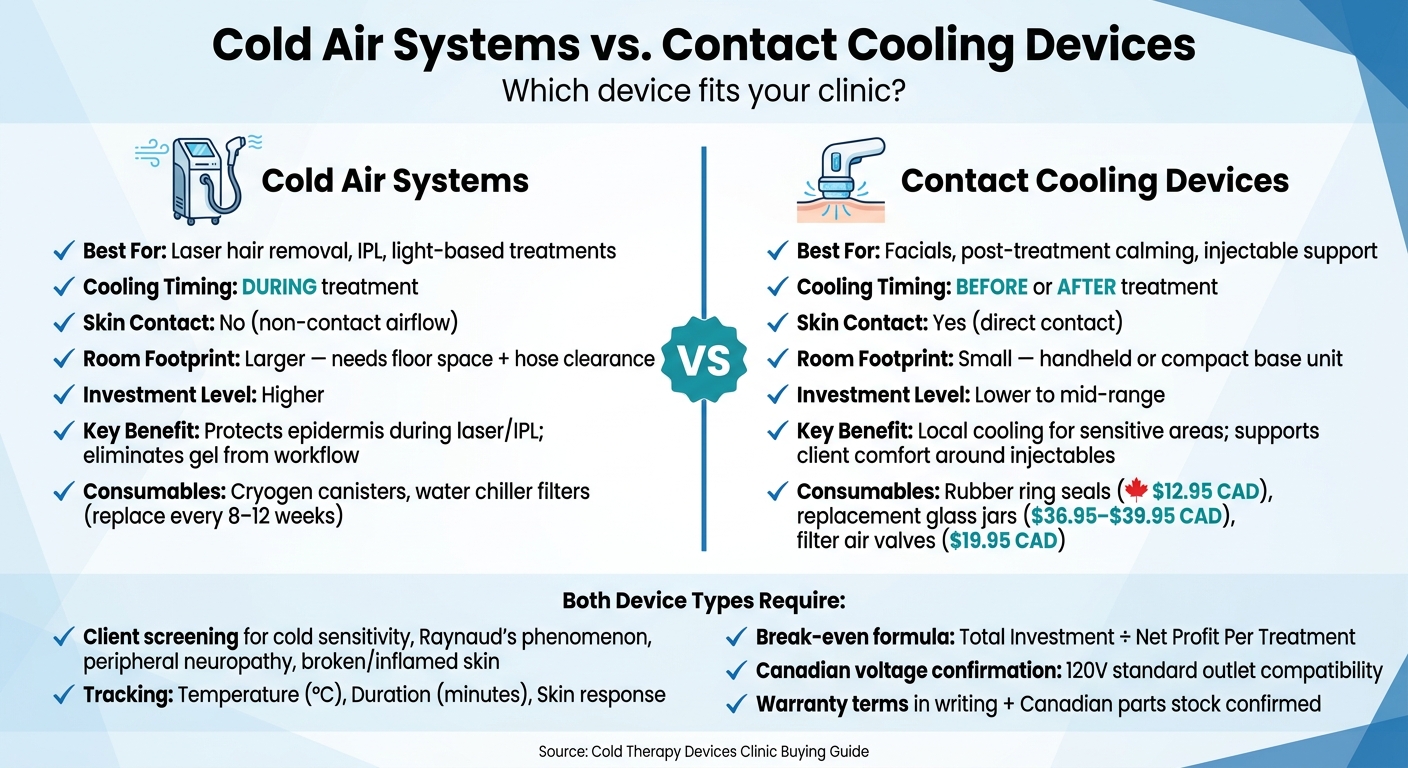
Cold Air vs. Contact Cooling Devices: Canadian Clinic Buying Guide
Cold Air Systems vs. Contact Cooling Devices
Once you understand how cooling works, the next step is simple: match the device to the treatments you do most.
Pick the device around your main treatment mix. If your clinic is busiest with laser and IPL, a cold air system usually makes more sense. If facials and injectables make up more of your day, a contact cooling device is often the better fit.
| Device type | Best fit | Comfort use case | Room footprint | Typical investment level (CAD) |
|---|---|---|---|---|
| Cold air system | Laser, IPL, laser and IPL procedures | During-treatment cooling without skin contact | Larger console or cart; needs floor space and hose clearance | Higher |
| Contact cooling device | Facials, post-treatment calming, injectables support | Local cooling before or after treatment | Small handheld or compact base unit | Lower to mid-range |
This choice also shapes appointment flow. On paper, two devices may look similar. In a treatment room, the difference is much more obvious.
How Cooling Fits Into a Real Appointment
Cooling can show up at three points in an appointment: before, during, and after treatment.
Before treatment, use cooling for pre-cooling ahead of injectables or other sensitive procedures. It can take the edge off and help the client settle in.
During laser or IPL, cooling helps protect the epidermis. Integrated cryogen cooling also removes gel from the workflow, which cuts prep and cleanup time. That may not sound like a big deal at first, but in a busy clinic, those saved minutes add up.
After treatment, cryotherapy pain relieving gel or other cooling methods can help reduce redness and swelling. It also helps clients get back to normal activities right away, which matters when someone is heading back to work, errands, or school pickup.
That workflow has a direct effect on screening, room setup, and staff training.
Client Screening and Treatment Limits
Screen every client before the first session. Some clients should be excluded from cooling-based treatment support, including those with cold sensitivity, vascular conditions such as Raynaud's phenomenon, peripheral neuropathy, or broken or inflamed skin, including active eczema, psoriasis, or open lesions.
Track the basics every time:
- Temperature in °C
- Duration in minutes
- Any skin response
If you see unexpected redness or any vascular response, note it right away and review it before the client's next visit.
Those limits can help narrow your device shortlist before you start comparing costs and suppliers.
Budget, Ownership Costs, and Return on Investment
Common Ownership Costs in Canada
Purchase price changes from one model to another, but that’s only part of the story. You also need to look at the recurring costs that come with owning and using the device.
| Cost Item | Typical Cost (CAD) | Frequency | Notes |
|---|---|---|---|
| Water chiller filters | Varies | Every 8–12 weeks | Replacement timing depends on usage volume |
| Rubber ring seals | $12.95 | As needed | Keep spares on hand to prevent leaks and downtime |
| Replacement glass jars | $36.95–$39.95 | As needed | Confirm compatibility before ordering |
| Filter air valves | $19.95 | As needed | Useful for routine maintenance |
| Cryogen canisters | Varies | Based on treatment volume | Applies to systems that use cryogen cooling |
| Aqua Peeling Solutions | $39.95 for a set of three 400 mL bottles | Based on treatment volume | Relevant for multifunction facial units |
Buying from Canadian suppliers can make life easier. Ordering tends to be simpler, billing is more straightforward, and delivery times are often easier to plan around.
Maintenance, Consumables, and Downtime Costs
Once you know the sticker price, the next step is figuring out what it costs to keep the device working day after day.
Most running costs come from replacement filters, seals, disinfecting supplies, and treatment-specific consumables. If the system uses water-based cooling, plan for filter changes every 8–12 weeks, depending on usage volume. If it uses cryogen cooling, you’ll also have a recurring canister expense.
Low maintenance can make a big difference in a busy clinic. Downtime doesn’t just mean a machine is out of service. It can also mean missed appointments, gaps in the schedule, and lost revenue. Something as small as a missing seal or filter can bring bookings to a halt. For that reason, it’s smart to keep a small supply of key parts on-site.
How to Estimate Break-Even for Your Clinic
These recurring costs help you figure out how fast the device can pay for itself.
The simplest way to estimate break-even is to divide your total investment by the net profit you make per treatment.
Break-even treatments = total investment ÷ net profit per treatment
Your total investment should include the device price, training, initial consumables, and setup costs. Payment plans may spread out the upfront cost, which can help with cash flow. Before you buy, also confirm any insurer requirements tied to the device or the treatments you plan to offer.
Power, Room Setup, Cleaning, and Staff Training
Power, Noise, Ventilation, and Floor Space Requirements
Once you’ve picked a model and set your budget, the next step is simple: make sure the unit actually works in your space.
Before a cold therapy device arrives at your clinic, check that it’s compatible with standard Canadian outlets and confirm the voltage and amperage requirements. Smaller facial cooling units often plug into a standard outlet without much fuss. Larger chiller systems, on the other hand, may need extra electrical planning.
Floor space matters too. A compact unit can usually sit beside a treatment bed. A larger chiller system needs enough clearance for airflow and heat removal. If the machine runs loudly, place it where it won’t interrupt a quiet treatment room. It’s also smart to check hose length before you lock in the setup. If the hose can’t comfortably reach the treatment bed, the layout can become awkward fast.
Cleaning Protocols and Device Upkeep
Cleaning needs to be part of every appointment, every time. Any contact surfaces should be disinfected between clients using approved solutions. Always check the manufacturer guidelines first so you know which products are safe for the materials on your device.
Surface cleaning is only part of the job. You should also inspect:
- Rubber seals
- Hose connectors
- Hoses
- Other fittings
Look for wear, cracks, or loose parts. Follow the manufacturer’s filter-change schedule and record each change. It also helps to log every cleaning task in a dedicated maintenance record. That gives your team a clear paper trail and makes routine upkeep much easier to track.
Staff Training and Protocol Consistency
Your staff need more than a quick demo. Training should cover operation basics, contraindications, troubleshooting, temperature settings, treatment timing, and documentation. The goal is to make sure the device is used safely and the same way every time.
Training should match your clinic’s screening criteria, timing limits, and documentation rules so each client gets the same standard of care. Beauty Pro Supplies Canada offers online training and portal access that typically lasts 90 days after purchase, so download all relevant materials during that period and keep them on file at the clinic.
Written protocols matter just as much as hands-on training. After your team is trained, create a clear treatment protocol that covers:
- Client screening criteria
- Device settings
- Session length
- Treatment documentation
A written protocol keeps sessions consistent and gives you a clear record if an issue comes up.
Once staff training and protocols are in place, confirm supplier terms and order details.
How to Evaluate a Supplier and Place Your Order
What to Confirm Before You Order
Now that you've narrowed the device type (such as stainless steel ice globes), it's time to check the supplier side before you commit.
Start with the warranty terms in writing. Don’t settle for a verbal promise. Confirm whether a 30-day money-back guarantee applies, and ask exactly what parts and labour are covered.
Replacement parts matter more than many clinics expect. Filters, rubber seals, and hoses should be available from Canadian stock. If they’re not, a small repair can turn into weeks of waiting. That’s the kind of delay that throws off bookings and frustrates staff.
Support is another thing to pin down early. Make sure the supplier has at least one reliable support channel and response hours that work across Canadian time zones. If help is only available when your clinic is closed, that’s a problem.
It’s also smart to have a direct conversation about electrical compatibility. Ask whether the device works with a standard outlet or needs a specific voltage or amperage beyond that. If the supplier includes Wi‑Fi or app-based temperature control, confirm how setup works and what support looks like if something goes wrong.
One point is easy to miss: the purchaser is responsible for using the equipment in line with applicable national, provincial, and local requirements. In plain terms, your clinic needs to confirm the equipment meets those requirements. You should also check with your insurer before you buy. That responsibility sits with the clinic, not the supplier.
A Buying Checklist for Canadian Clinics
Use this checklist to turn your budget, room, and training notes into a clear order decision.
| Decision Point | What to Confirm |
|---|---|
| Treatment menu fit | Does the device match the services you plan to offer? |
| Total cost in CAD | Have you confirmed device price, consumables, and annual upkeep? |
| Voltage, space, ventilation | Are outlet, floor space, and airflow requirements met? |
| Manual, portal access, training length | Is documentation included and portal access confirmed? |
| Approved disinfectants and material compatibility | Are cleaning products compatible with device materials? |
| Canadian stock, warranty, service contact | Are parts available locally and warranty terms in writing? |
| Insurance | Has your insurer confirmed coverage for this equipment? |
Before placing the order, confirm shipping timelines, delivery costs, and payment terms too.
FAQs
Which cold therapy device best suits my clinic?
Choose a device that matches your service menu, available space, and budget. For facial treatments, a compact, professional-grade unit with steady, even cooling usually makes the most sense. If you also provide body treatments or recovery services, a self-standing unit that can handle more than one use case may be the better pick.
It’s also smart to put safety standards, tech support, and build quality near the top of your list. Look for verified safety certifications, dependable technical help, and commercial-grade construction so the device can meet compliance needs, hold up to daily use, and deliver steady performance.
What ongoing costs should I budget for?
Budget for shipping, any GST/HST, routine maintenance, cleaning, and replacement parts over the device’s lifespan.
Warranty limits matter too. If a repair isn’t covered, you could end up paying for both service and troubleshooting out of pocket. And if the repair bill gets close to 50% of the cost of a new unit, replacing the device may be the smarter call.
It also helps to factor in possible downtime. A unit that’s out of service can cost you time, money, or both. Keep your receipts and service records on file so you can confirm warranty eligibility if something goes wrong.
What should I confirm before ordering in Canada?
Confirm the device meets Health Canada rules, including the Radiation Emitting Devices Act and Medical Devices Regulations. Make sure the supplier is authorized and can provide paperwork for temperature safety testing, including a clear justification if the device goes above 45°C.
Also check that the product labelling is bilingual, that manufacturing and ingredient compliance documents are available, and that your clinic can handle the device’s power and electrical safety needs.
Leave a comment