

Electric vs Hydraulic Spa Beds: Price Guide
If I need the short answer: hydraulic spa beds usually cost less upfront, while electric spa beds usually cost more but can cut staff strain and save time in busy rooms.
In this guide, I compare the two on the points that matter most to Canadian buyers: price, service life, maintenance, comfort, and workload on staff. In Canada, professional spa beds often start around $3,395 CAD and can go past $24,995 CAD, though lower-priced entry models can fall under that range.
Here’s the simple breakdown:
-
Hydraulic beds
- Lower buy-in cost
- Fewer parts that can fail
- More manual effort for height and position changes
- A better fit for lower-volume rooms or tighter budgets
-
Electric beds
- Higher upfront cost
- Smoother and quieter adjustments
- Less physical strain during back-to-back bookings
- A better fit for high-use rooms, longer treatments, and fast turnover
I also look at what happens after purchase:
- Repair risk: hydraulic beds often need seal, fluid, or pump checks; electric beds can need motor, wiring, actuator, or hand-control service
- Downtime: electric systems may have a higher chance of service interruptions because there are more parts involved
- Day-to-day use: electric controls can help when staff make 10 to 20 bed adjustments in a day
- Comfort: smoother movement can help clients stay relaxed during longer services
Bottom line: if your main concern is upfront cost, hydraulic usually makes more sense. If your room is booked all day and staff fatigue is a problem, electric may be worth the higher price.
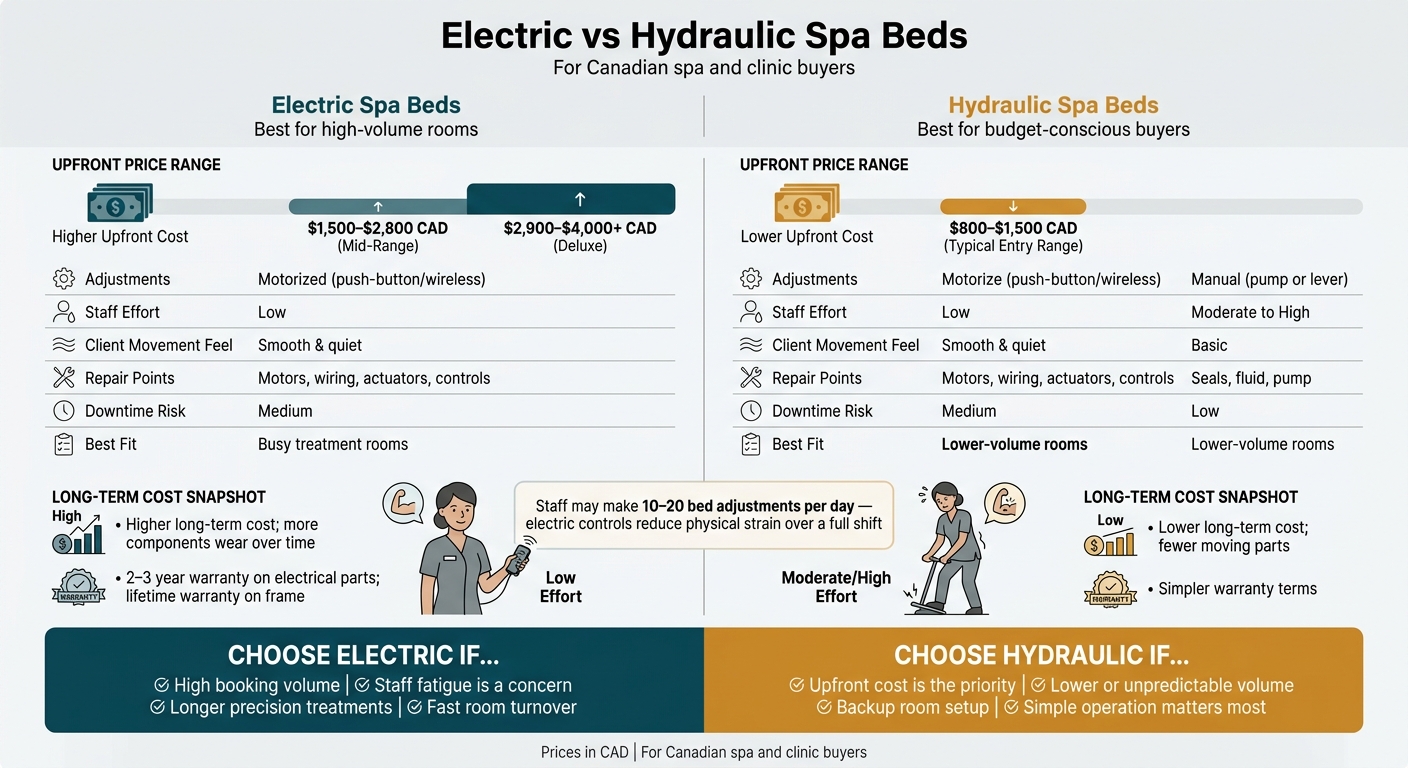
Electric vs Hydraulic Spa Beds: Side-by-Side Comparison
The Best Massage Table | The Benefits Of Electric Hi-Lo Treatment Tables
sbb-itb-8ec3e54
Quick Comparison
| Factor | Electric Spa Beds | Hydraulic Spa Beds |
|---|---|---|
| Typical upfront cost | Higher | Lower |
| Adjustments | Motorized | Manual or pump-based |
| Staff effort | Lower | Higher |
| Client movement feel | Smoother, quieter | More basic |
| Repair points | Motors, wiring, controls | Seals, fluid, pump |
| Downtime risk | Medium | Lower |
| Best fit | Busy treatment rooms | Lower-volume rooms |
If I were buying for a Canadian spa or clinic, I’d look past the sticker price and match the bed to daily room volume, treatment length, and staff workload.
Upfront Price: Electric vs Hydraulic Spa Beds
Hydraulic beds usually cost less to buy because the frame is mechanically simpler. Electric beds cost more because motors, actuators, and controls add parts and assembly work. You can see that gap across most price tiers.
| Price Tier (CAD) | Bed Type | Key Adjustment Features | Best For |
|---|---|---|---|
| $800–$1,500 | Hydraulic | Foot-pump height; manual backrest | Budget-conscious startups; low-volume rooms |
| $800–$1,500 | Entry-Level Electric | Single motor for height; manual backrest | Budget-conscious startups; low-volume rooms |
| $1,500–$2,800 | Mid-Range Electric | Powered height and backrest; hand remote; standard frame | Growing salons; standard treatment rooms |
| $2,900–$4,000+ | Deluxe Electric / Hi-Low | Multi-motor (height, back, legs); wireless remote; higher lift capacity | High-volume luxury spas; advanced medical aesthetics |
Put simply, the more powered movement, control, and lift capacity a bed has, the more you’ll usually pay.
Why Hydraulic Beds Usually Cost Less at Purchase
Hydraulic beds have fewer parts and no electronics, so they cost less to make. That simpler build keeps the purchase price down.
For many businesses, that makes a hydraulic bed a good starting point. If you need sturdy equipment and want to avoid a big upfront spend, hydraulic models often hit that sweet spot. They’re especially common in lower-volume spaces where staff can manage manual adjustments without much hassle.
Why Electric Beds Cost More
Electric beds cost more because they handle more adjustments with less manual effort. Every motor added to the frame - for height, backrest, or leg position - pushes the price up.
In the mid-range, you’ll often see powered height and backrest adjustment. Move into the deluxe tier, and you’re usually paying for multi-motor systems, wireless controls, advanced positioning presets, and higher lift capacity. In busy treatment rooms with back-to-back clients, those extras can make day-to-day work a lot smoother.
Upfront price is only one piece of the picture. Lifespan and repair costs also affect what the bed is worth over time.
Long-Term Value: Service Life and Maintenance Costs
The purchase price is only one piece of the bill. How long a bed lasts and what it costs to keep it working matter just as much. A higher upfront cost can sting less if the bed stays in service longer and needs fewer repairs.
| Factor | Hydraulic Spa Beds | Electric Spa Beds |
|---|---|---|
| Typical Warranty Coverage | Often simpler warranty terms on hydraulic bases | 2–3 years on electrical parts; lifetime on frame |
| Common Repair Points | Fluid leaks, seals, pump mechanisms | Motors, actuators, hand controls, wiring |
| Routine Maintenance | Fluid checks, lubrication | Safety checks, wiring inspections |
| Long-Term Cost | Lower; fewer moving parts to fail | Higher; electrical components wear out faster |
| Downtime Risk | Low | Moderate; more complex components can lead to service interruptions |
Expected Lifespan in Commercial Treatment Rooms
In busy Canadian treatment rooms, day-to-day use usually matters more than the name on the frame. The same issues tend to shorten the life of both bed types: heavy use, going past the weight limit, and skipping routine upkeep.
Hydraulic beds are simpler. That usually means fewer parts that can go wrong. In high-use rooms, that can matter more than saving money at the time of purchase.
Electric beds make adjustments easier, but they also bring more parts that can fail. A hydraulic bed that never gets pump or seal checks will wear out sooner than one that gets basic care. The same goes for an electric bed if nobody checks the wiring or motor connections.
Routine Upkeep and Likely Repair Issues
After lifespan, maintenance is the next big cost factor.
With hydraulic beds, the main things to watch are:
- hydraulic fluid levels
- seals
- the pump mechanism
If a seal starts leaking or pressure drops, the bed may need service to keep working smoothly.
Electric beds need closer attention to their electrical parts. Motors, actuators, control switches, and wiring are the trouble spots most often. If a hand control stops working or a motor burns out, you'll likely need a technician. In a busy treatment room, that can mean downtime you didn't plan for. One of the simplest ways to cut down on early motor strain and accidental damage is to train staff on the controls from day one.
Sanitation also plays a part in both options. Moisture and debris around moving or electrical parts can speed up wear and cause malfunctions. Clean, dry equipment tends to last longer and is less likely to end up out of service for preventable repairs.
Comfort and Ergonomics: Client Experience vs Staff Strain
Price and maintenance matter, but day-to-day use matters just as much. A bed can look good on paper and still be a pain to use for eight hours straight. After cost and upkeep, ergonomics is often the thing that tips the decision.
| Factor | Electric Spa Beds | Hydraulic Spa Beds |
|---|---|---|
| Client Comfort | High; smooth, quiet transitions; may include programmable positions | Standard; reliable but limited to basic height and angle changes |
| Repositioning Ease | Effortless; push-button or wireless remote | Manual; requires pumping or lever activation |
| Therapist Effort | Minimal; automated controls reduce physical strain | Moderate; repeated manual adjustments add up over a full day |
| Throughput | Faster transitions between services | Dependable but slower to adjust between clients |
How Bed Movement Affects the Client Experience
For longer services like facials or massage, smooth movement makes a difference. If a bed shifts too suddenly or jolts during an adjustment, it can pull a client right out of that relaxed state.
Electric beds usually handle this better. Quiet motors help the bed move gently, and some models include programmable memory positions. That means staff can return to saved setups without fiddling around each time, which helps keep clients comfortable during long bookings. When a treatment runs for an hour or more, that extra control is hard to match with manual adjustment.
Hydraulic beds work well for basic changes, but they give you less fine control during a service.
And that same smooth operation helps the person doing the treatment too.
How Bed Operation Affects Therapist Fatigue
The difference becomes more obvious over a full day of back-to-back appointments. Electric beds keep physical effort low. Hydraulic beds ask more from staff, and that adds up.
Hydraulic beds are reliable, but manual pumping or lever-based changes can wear on therapists in a busy room. One adjustment might not seem like much. Ten or twenty in a day is another story. Repeated repositioning creates strain that could be avoided with automated controls.
That trade-off shows up most clearly in high-volume treatment rooms.
Best Fit for High-Volume Rooms and Final Buying Takeaway
When you stack up price, upkeep, comfort, and day-to-day staff effort, the decision mostly comes down to room volume and how your team works. The right pick depends on your daily booking load, how long each service runs, and what you can spend.
When an Electric Bed Makes More Sense
Electric beds are the better fit for treatment rooms with back-to-back bookings. The built-in controls help staff adjust the bed faster, which can improve client turnover and cut down on physical strain during a busy day.
They also fit well in higher-end treatment rooms. If your service menu includes longer treatments or work that needs careful positioning, such as those using massage stones and tools, electric beds have a level of quiet, precise adjustment that’s tough to get with a manual setup. Yes, the upfront cost is higher. But in a busy room, the time saved each day can make that spend easier to justify.
On the other hand, if your room moves at a slower pace or follows a more predictable schedule, a lower-cost hydraulic bed may be the smarter call.
When a Hydraulic Bed Is the Better Budget Choice
Hydraulic beds make sense when upfront cost is the main issue. They work well in lower-volume rooms where manual adjustment isn’t a problem.
For a start-up clinic, a backup treatment room, or any space where powered positioning doesn’t need to happen all day, a hydraulic bed is a practical, durable choice. It handles the job without adding a bigger equipment bill.
Here’s a quick side-by-side view:
| Choose Electric If… | Choose Hydraulic If… |
|---|---|
| You run a high-volume treatment room | Your volume is lighter or unpredictable |
| Staff strain and fatigue are a concern | Upfront cost is the main constraint |
| You offer longer, precision treatments | You need a reliable backup room option |
| Fast room turnover is a priority | Simple operation matters most |
FAQs
How many motors do I really need?
It depends on how much control you want and how comfortable you want the setup to feel for clients. Electric spa beds can use separate motors for height, backrest tilt, and leg position.
Beds with three or more motors give you more ways to adjust the bed and cut down on manual work. In busy treatment rooms, that can help reduce strain on staff. Simpler models use fewer motors to keep the price lower.
What lift capacity should I look for?
Choose a lift capacity that fits your usual clients and the treatments you provide. Spa beds are often grouped into three ranges: under 150 kg, 150–200 kg, and over 200 kg.
Your bed should comfortably support your heaviest clients. That matters for safety, and it can also help the equipment last longer. In busy treatment rooms, a higher weight capacity gives you more flexibility and can help the bed hold up better with frequent daily use.
How do I reduce spa bed downtime?
Reduce spa bed downtime with regular preventative maintenance and steady cleaning. It’s one of the simplest ways to keep equipment running and avoid surprise service issues.
Check electrical parts like adapters, cables, and connections for wear, damage, or loose fits. And when you can, plug equipment straight into a wall outlet instead of using extension cords or power bars.
Keep surfaces disinfected with approved products, and follow the recommended contact time. That step matters. Wiping too soon can leave surfaces less clean than they should be.
It also helps to inspect mechanical parts, pumps, and plumbing for blockages or mineral buildup. Small issues can snowball fast if no one spots them early.
If repair costs are more than 50% of the price of a new unit, replacement is often the better value.
Leave a comment