

How Bulk Orders Impact Supplier Negotiations
Bulk orders can reshape how you negotiate with suppliers. They lower costs, improve payment terms, and enhance delivery reliability. While smaller, frequent orders offer flexibility, they come with higher per-unit costs and stricter payment terms. The right approach depends on your business size, cash flow, and storage capacity.
Key takeaways:
- Bulk buying reduces per-unit costs, unlocks volume discounts, and strengthens supplier relationships.
- Larger orders often lead to better payment terms (e.g., Net 30–60) and priority shipping.
- Smaller orders maintain cash flow but result in higher costs and lower negotiation power.
- Hybrid strategies - bulk-buying core products and ordering niche items in smaller quantities - can balance savings and flexibility.
Example: A bulk purchase of anti-aging serums at $5–$15/unit with a resale price of $20–$50 can achieve profit margins of 75%–80%. Smaller orders shrink these margins significantly.
For Canadian beauty businesses, tariffs on imports (e.g., 55% from China by 2026) make cost-saving strategies like bulk buying even more critical. However, always weigh the risks of overstocking against the benefits of lower prices.
How to Negotiate with Suppliers - Amazon FBA
sbb-itb-8ec3e54
1. Bulk Ordering Approach
Buying in bulk doesn’t just lower the cost per unit - it also puts you in a stronger position when negotiating with suppliers. By committing to larger quantities upfront, you’re giving suppliers the security of a guaranteed sale, which helps them cover their fixed costs like labour, machinery setup, and materials. In return, they’re often more open to offering better pricing, payment terms, and delivery options.
Unit Pricing
One of the biggest benefits of bulk ordering is the reduction in per-unit costs. Suppliers can spread their fixed expenses across a larger number of items, making each unit cheaper to produce. Most suppliers set Minimum Order Quantities (MOQs) to ensure profitability, and meeting these thresholds often unlocks significant price breaks. If you can’t hit a supplier’s MOQ, you could offer to pay a slightly higher per-unit price to offset their costs on a smaller production run. Another smart strategy is standardizing components - using the same packaging, caps, or tubes across multiple product lines. This lets you consolidate orders and qualify for better pricing on those shared parts, while also opening the door to improved payment terms.
Payment Terms
Larger orders can give you the leverage to negotiate more favourable payment conditions. Suppliers are more likely to offer Net 30–60 terms (allowing payment 30–60 days after delivery) once you’ve proven reliability, which can greatly improve cash flow. If paying for a bulk order upfront feels like a stretch, you might propose a split payment plan - such as 50% upfront and 50% on delivery - to share the financial risk. Platforms like Beauty Pro Supplies Canada also offer interest-free payment plans that divide purchases into manageable instalments over six weeks, making it easier to handle bigger orders. On top of payment flexibility, bulk orders often come with additional perks like volume incentives.
Volume Discounts and Rebates
Suppliers typically offer tiered pricing - the larger your order, the deeper the discount. Beyond these standard savings, you can also negotiate rebates based on your total annual spend or for hitting specific volume milestones. If you’re a smaller business, joining a Group Purchasing Organization (GPO) can be a game-changer. These organizations pool orders from multiple buyers, reducing unit prices by an average of 5% before factoring in additional rebates. For Canadian beauty professionals, this kind of cost-saving becomes even more important as tariffs on imports - such as 55% on goods from China and 50% from Brazil - are set to rise by 2026.
Delivery and Reliability
Bulk buyers often enjoy priority treatment when it comes to deliveries. This means your essential products are more likely to arrive on time, even during supply chain hiccups. Bulk orders also allow for consolidated shipping, which can lower freight costs. If storage space is an issue, you can negotiate staggered deliveries - this way, you still secure bulk discounts without overwhelming your warehouse. This strategy helps you avoid stockouts while keeping your storage manageable.
"When you buy from wholesalers, you often develop a relationship with them that can result in many great advantages such as being able to negotiate pricing, being given priority in delivery and much more!" - Rysons
2. Non-Bulk Ordering Approach
Non-bulk ordering focuses on maintaining cash flow flexibility rather than maximizing cost savings. Unlike bulk purchases, smaller orders come with higher per-unit costs because suppliers lack the assurance of guaranteed sales to offset their production setup expenses. This trade-off means you'll pay more per item, have stricter payment terms, and may face delays in delivery.
Unit Pricing
One of the biggest drawbacks of non-bulk orders is the higher per-unit cost. Without the advantage of economies of scale, suppliers distribute their fixed costs over fewer units, resulting in a premium price. For instance, while bulk buyers might secure anti-aging serums for $5 to $15 each, smaller orders can push those prices significantly higher due to added surcharges that make the production run worthwhile.
Payment Terms
Non-bulk orders often come with stricter payment requirements compared to bulk purchases. While bulk buyers might enjoy extended payment terms like Net 30 or Net 60, smaller orders usually demand more upfront payment with little room for negotiation. The upside? You’re not tying up large amounts of cash in inventory, which is especially helpful for new beauty businesses trying to maintain liquidity. However, this limited payment flexibility can make smaller orders less reliable overall.
Delivery and Reliability
When it comes to delivery, non-bulk orders often take a backseat. Suppliers tend to prioritise bulk buyers, which can lead to longer lead times or even delays in fulfilling smaller orders. Additional administrative and shipping fees can further inflate costs, and during periods of high demand, smaller orders are more likely to face stockouts. To avoid running out of stock, consider using inventory management software to set reorder points and ensure you replenish supplies before hitting critical levels.
Pros and Cons
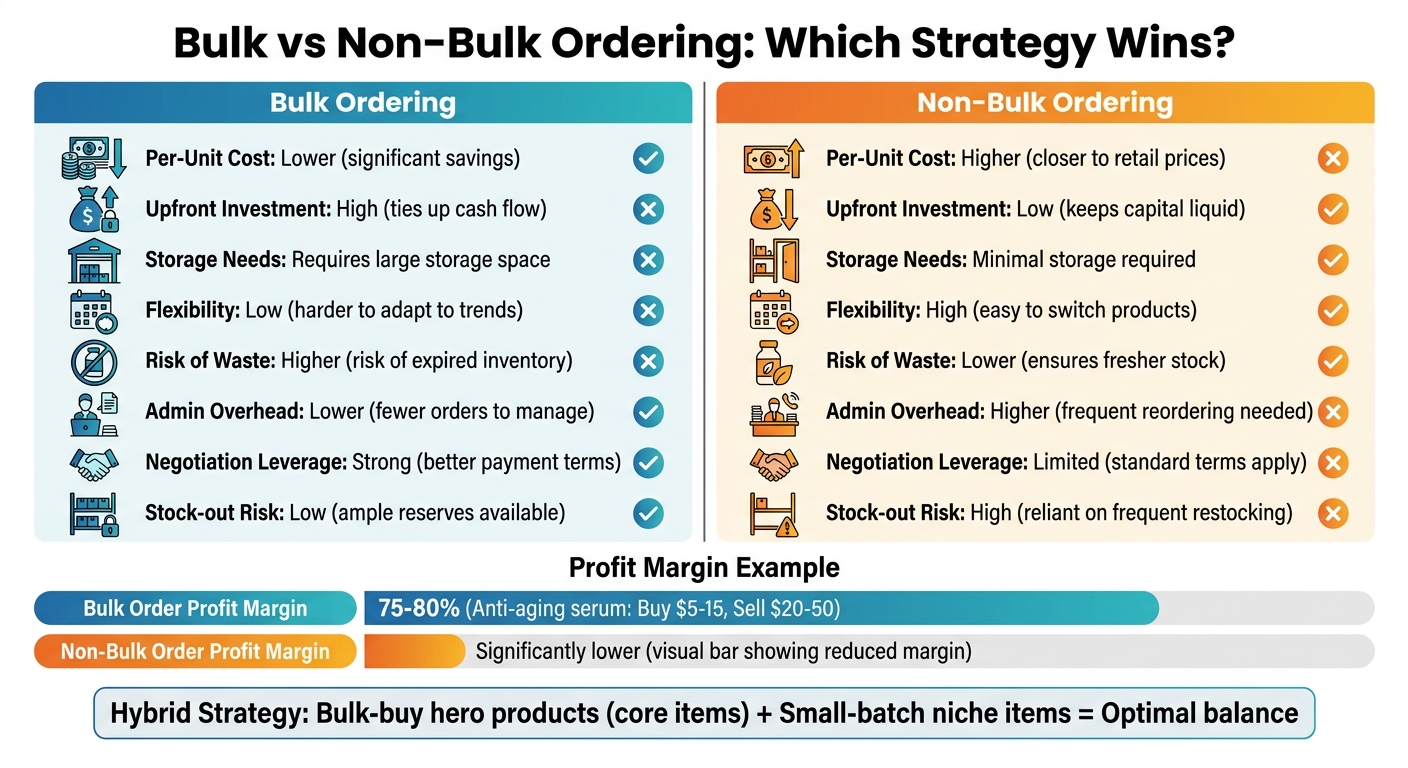
Bulk vs Non-Bulk Ordering: Cost and Benefits Comparison for Beauty Suppliers
Deciding between bulk and non-bulk ordering comes down to factors like cash flow, storage availability, and product demand. Bulk ordering offers lower per-unit costs and better negotiation opportunities, but it demands a significant upfront investment and plenty of storage space. On the other hand, non-bulk ordering helps maintain cash flow and provides more flexibility, making it ideal for testing trends or adapting quickly, though it comes with higher per-unit costs. Here's a closer look at the advantages and trade-offs:
Healthy profit margins in the beauty industry generally range from 50% to 80%, with skincare products often hitting 60% to 80% gross profit margins. For example, if you're purchasing anti-aging serums in bulk at $5 to $15 per unit and selling them at $20 to $50, you're achieving a 75% to 80% profit margin. With non-bulk orders, those margins shrink, making it harder to remain competitive while staying profitable.
To break it down further, here’s a side-by-side comparison:
| Feature | Bulk Ordering | Non-Bulk (Small Batch) |
|---|---|---|
| Per-Unit Cost | Lower; significant savings | Higher; closer to retail prices |
| Upfront Investment | High; ties up cash flow | Low; keeps capital liquid |
| Storage Needs | Requires large storage space | Minimal storage required |
| Flexibility | Low; harder to adapt to trends | High; easy to switch products |
| Risk of Waste | Higher; risk of expired inventory | Lower; ensures fresher stock |
| Admin Overhead | Lower; fewer orders to manage | Higher; frequent reordering needed |
| Negotiation Leverage | Strong; better payment terms | Limited; standard terms apply |
| Stock-out Risk | Low; ample reserves available | High; reliant on frequent restocking |
Given these contrasts, many Canadian beauty businesses opt for a hybrid strategy. This means bulk-buying "hero" products - those core items like popular cleansers or hair dyes that make up the bulk of sales - while using small-batch orders for niche or experimental products. This method helps cut costs on high-demand staples while reducing the risk of holding onto outdated inventory when customer preferences change. To make this work, track monthly usage and factor in shipping and taxes when calculating your true per-unit cost.
"The debate between bulk and small-batch buying is essentially a tug-of-war between upfront cost and long-term flexibility." - Kelly, Pure Spa Direct
Conclusion
Placing bulk orders can give you a strong edge in negotiations, helping you secure lower costs. By presenting suppliers with data-driven purchase commitments, you can enjoy reduced per-unit prices, better payment terms like Net 30 or Net 60, and even priority shipping.
To make the most of these savings, consider a blended strategy for managing your inventory. For instance, bulk-buy your high-demand products - think anti-aging serums or popular cleansers - while sticking to smaller orders for niche or experimental items. This approach helps maintain healthy profit margins (often ranging from 60% to 80% in skincare) while avoiding the risk of being stuck with unsold stock. Be sure to monitor your monthly usage closely and account for storage costs, shipping fees, and any applicable duties to get an accurate picture of your true savings per unit.
While bulk buying does require an upfront investment, options like staggered shipments or long-term contracts can help ease cash flow challenges. Many wholesalers also provide flexible payment plans to make the process more manageable.
FAQs
How do I know the right bulk order size?
To figure out the right bulk order size, think about your minimum order quantity (MOQ), current demand, and storage limits. Striking the right balance is key - ordering too much can lead to overstocking, while ordering too little might leave you short. Take a close look at your sales trends and projected growth to make informed decisions. Starting with smaller orders can help you gauge demand before scaling up. Plus, maintaining strong relationships with suppliers can open up opportunities to negotiate terms that fit both your budget and inventory requirements.
What can I ask for besides a lower unit price?
In addition to securing a lower unit price, you might also negotiate for more flexible payment terms, bulk purchase discounts, customized delivery schedules, or even extra services like training or ongoing support. These perks not only help reduce your overall expenses but can also strengthen your relationship with suppliers.
How can I avoid overstocking when buying in bulk?
When buying in bulk, it's important to avoid overstocking. Start by planning your inventory based on sales forecasts and demand trends. Look at past sales data to identify patterns and set reorder points that ensure you’re ordering just the right amount. Using smart inventory management practices can help you sidestep excess stock, lower storage costs, and keep your operations running smoothly.
Leave a comment