

Hydrotherapy Jet Placement Tips
Positioning hydrotherapy jets correctly can make or break your spa experience. The key? Align jets with muscle groups and maintain balanced water pressure for effective relief. Misplaced jets or overcrowded configurations can weaken the massage or cause discomfort. Here’s what you need to know:
- Water Pressure Matters: Ensure your pump matches the number of jets to maintain consistent flow. Smaller jets target specific points, while larger ones soothe broader areas.
- Anatomy Alignment: Place jets to address tension zones like the shoulders, spine, or lower back. Use zone therapy by designing seats for specific areas.
- Customization Counts: Fewer, well-placed jets often outperform crowded setups. Adjustable jets and air-to-water controls enhance the experience.
Avoid common mistakes like overcrowding jets or misalignment, which can lead to uneven pressure and reduced performance. Test placements to ensure jets hit the right spots, and maintain your pump and plumbing for smooth operation. Proper jet placement transforms a spa into a therapeutic tool, delivering relief and relaxation where it’s needed most.
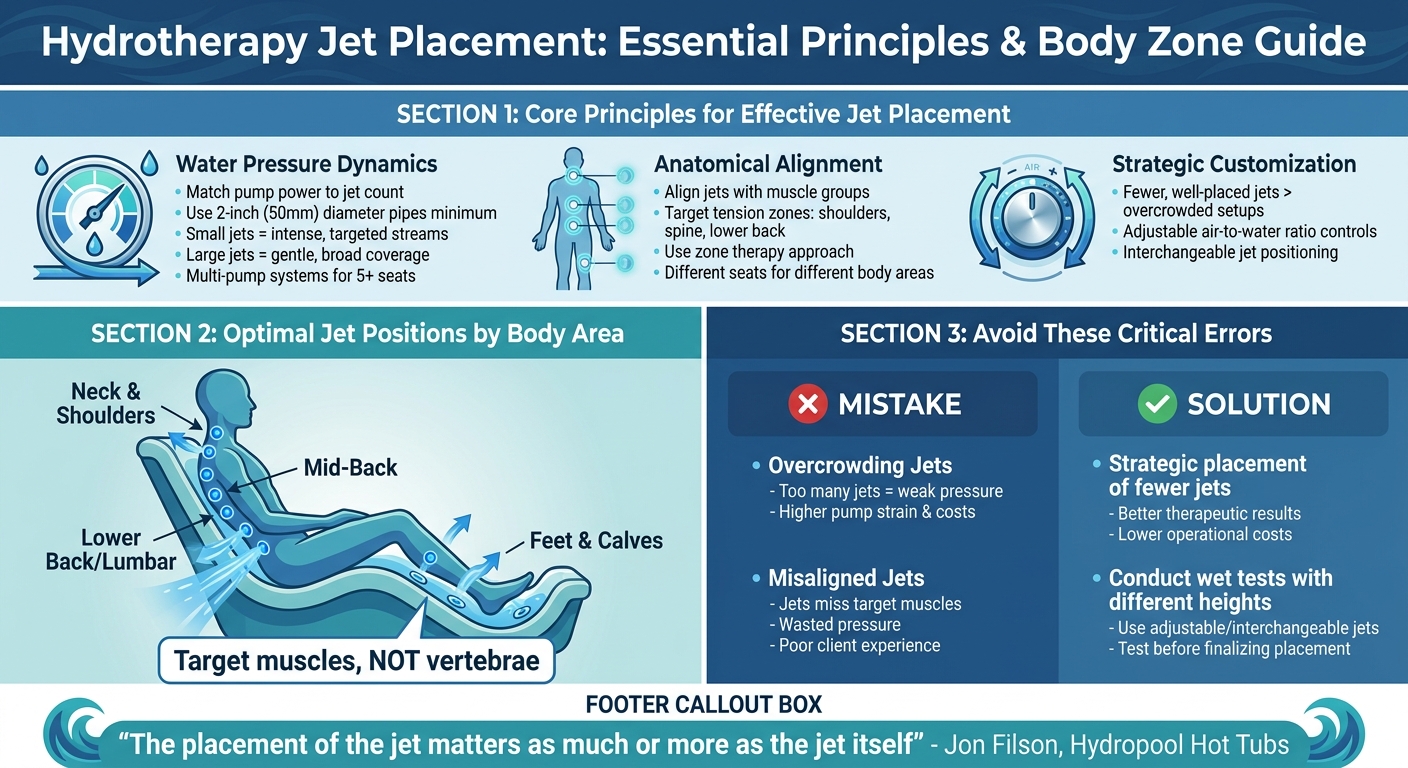
Hydrotherapy Jet Placement Guide: Key Principles and Body Zone Targeting
Core Principles of Jet Placement
Water Pressure Dynamics
Water pressure is the backbone of any effective hydrotherapy experience. Pumps pressurize water to create various sensations, such as pulses, swirls, or bubbles. To achieve a soothing and therapeutic effect, it's essential to maintain balanced pressure and flow across all jets. As Hydrorelax puts it, "Balanced pressure and flow distribution are essential to a great spa experience."
The connection between jet count and pump power is straightforward: more jets demand more power. If you add jets without upgrading the pump, the water flow weakens significantly. For spas loaded with jets, a multi-pump system ensures consistent performance. This setup avoids situations where some seating zones feel underwhelming while others are too forceful.
Jet size also makes a difference. Smaller jets concentrate pressure into intense streams, perfect for targeting specific trigger points. Larger jets, on the other hand, deliver a gentler flow, ideal for soothing larger muscle groups like the lower back or thighs. A well-thought-out layout strategically combines these jet types, ensuring every seat offers balanced flow without creating dead zones or overly intense areas.
The next step? Aligning jet placement with the body's anatomy to maximize therapeutic benefits.
Anatomical Alignment for Targeted Therapy
Beyond pressure dynamics, effective jet placement hinges on aligning jets with key muscle groups and pressure points. The aim is to direct water flow to areas where tension tends to build - whether it's the spine, shoulders, or lower back.
This is where zone therapy comes into play. Instead of trying to cram every jet type into one seat, spas are designed so users can move between seats for a full-body treatment. For instance, one seat might focus on relieving neck and shoulder tension, while another targets the lumbar region or provides foot therapy. This approach ensures that each body area gets the right type of jet and pressure for maximum therapeutic impact.
Customizing Placement for Different Client Needs
After aligning jets with specific body zones, customization fine-tunes the experience to meet individual needs. Jon Filson from Hydropool Hot Tubs stresses this:
The placement of the jet matters as much or more as the jet itself in most cases.
Strategically placing fewer, well-positioned jets often delivers better results than overcrowding a spa with poorly placed ones. Overloading with jets not only weakens water pressure but also increases operational costs.
Some systems take customization further by offering interchangeable jets. These can be moved or swapped within the tub, giving users the freedom to position jets exactly where they need relief. This flexibility allows for a truly tailored experience.
Another layer of customization comes from adjusting the air-to-water ratio. By introducing air into the water stream, users can increase pressure and create a bubbly texture. With adjustable controls on individual jets, clients can fine-tune the intensity of their massage in real time, ensuring both comfort and effectiveness.
sbb-itb-8ec3e54
Best Jet Positions for Specific Body Areas
Lower Back and Lumbar Region
Focusing on the lower back can provide much-needed relief by addressing key muscle groups. For the best results, position jets to target the paraspinal muscles - these are the erector spinae muscles running along both sides of the spine. Avoid directing jets at the vertebrae themselves. Instead, opt for a vertical or "V" pattern that widens towards the hips. This setup mirrors the natural alignment of the muscles, covering the area from the mid-back down to the sacrum for balanced and effective support.
How to choose the best hydrotherapy jets for your spa pool (Considerations, features, tips)
Pump and Plumbing Considerations for Jet Performance
To achieve peak jet performance, you need a pump and plumbing system that complements precise jet placement and balanced pressure. These components work together to ensure your hydrotherapy system delivers consistent and effective results.
The pump acts as the core of your system, and its power must align with the number of jets in use. As Hydrorelax explains, "Make sure the pump is strong enough to support all jets and maintain proper pressure." A pump that's too weak will lead to poor flow and uneven jet performance, which can compromise the entire experience.
For larger spa setups - especially those with five or more seats - you might need to evaluate whether a single pump or a multi-pump system is better suited. Multi-pump configurations provide consistent flow to all seats, avoiding uneven pressure. Alternatively, single-pump systems can use diverter valves to balance flow between different seating areas. Beyond pump capacity, your plumbing design is just as important in maintaining steady pressure across all jets.
A smart plumbing layout ensures that both pressure (measured in PSI) and flow rate (measured in GPM) meet the therapeutic demands of your system. Your pump must be capable of delivering both at the same time. Spartan Tool highlights this issue: "If you consistently feed a jetter pump with less flow than its designed rate, you will face premature wear." To avoid this, make sure your supply lines can deliver enough water to prevent pump starvation, which can lead to increased wear and tear.
Air control valves can also optimise your system by using the venturi effect to amplify perceived pressure without increasing water flow. This allows you to offer a more intense massage experience without requiring a higher-capacity pump, keeping energy consumption manageable. Lastly, don’t overlook filter maintenance - clogged filters create resistance in the system, reducing jet pressure and overall performance. Regular upkeep ensures your system runs smoothly and efficiently.
Common Jet Placement Mistakes and How to Avoid Them
Even with a solid understanding of pump performance, mistakes in jet count and positioning can sabotage your system's efficiency. A hydrotherapy setup with poor jet configuration won't deliver the results your clients expect. Two common errors - overcrowding and misalignment - can reduce therapeutic benefits and put unnecessary strain on your equipment.
Overcrowded Jet Configurations
Packing too many jets into your system can weaken water pressure, making massages far less effective. When your pump is forced to handle more jets than it can support, each jet receives less force, resulting in a lacklustre massage experience.
Jon Filson from Hydropool Hot Tubs and Swim Spas puts it bluntly:
Adding more jets without proper placement just costs you money as your pumps will have to work harder to move the water in all those jets.
Instead of focusing on quantity, aim for strategic placement. Position jets to target key muscle areas like the lower back or shoulders. A few carefully placed jets can deliver a much better massage than a large number of poorly positioned ones. Also, ensure your plumbing uses pipes with at least a 2‑inch (approximately 50 mm) diameter to maintain proper flow. Double-check that your pump system can handle the jet configuration you've chosen.
Beyond overcrowding, the angle of the jets plays a critical role in the system's overall effectiveness.
Misaligned Jets
Proper alignment is essential for jets to hit the right muscle groups. Misaligned jets can miss their mark entirely, wasting pressure and reducing the therapeutic benefits. For example, a jet aimed at the nose instead of the neck doesn't just underperform - it also detracts from the overall experience.
To prevent misalignment, conduct a wet test before finalising the jet placement. Have individuals of different heights sit in the tub to ensure the jets reach the intended areas. Many high-quality systems allow you to adjust or swap jets, giving you the flexibility to fine-tune their positions. This customisation ensures your system delivers consistent, targeted relief, no matter the client's body type or treatment goals.
Conclusion and Key Takeaways
Strategic jet placement is the cornerstone of effective hydrotherapy. As Jon Filson from Hydropool Hot Tubs explains:
The placement of the jet matters as much or more as the jet itself in most cases.
To achieve optimal results, focus on aligning jets with specific muscle groups. Whether you're addressing neck tension, lower back discomfort, or fatigue in the feet and calves, anatomical precision is key. Use 2‑inch (approximately 50 mm) diameter pipes and ensure your pump system is equipped to handle the configuration without overloading.
A dual-pump system can significantly improve performance, providing the mechanical support needed to maintain efficient jet operation and targeted relief.
Before completing any installation, test the jets to ensure they effectively address key muscle zones. Adjustable jets offer the flexibility to customise treatments, catering to different body types and individual needs.
FAQs
How do I know if my pump can handle my jet count?
To figure out if your pump can handle your jet count, start by calculating the total flow rate (GPM) needed for all your jets. Then, compare this with your pump's flow rate to ensure it meets or exceeds the requirement. Also, check the pump's horsepower and pressure capabilities to confirm they align with your system's demands. If you're unsure, a pump sizing calculator can be a useful tool to double-check whether your pump is up to the task.
What’s the best jet height for people of different sizes?
When setting up jet heights, their placement should align with the body part being treated. Generally:
- Lowest jet: Position it around the knee or thigh area.
- Middle jet: Align it at hip or waist level.
- Highest jet: Place it to target the shoulders or back.
Feel free to adjust these positions to accommodate individual body sizes and ensure a comfortable experience.
Should I choose fewer adjustable jets or more fixed jets?
When deciding between fewer adjustable jets and more fixed jets, it’s essential to consider your goals and the comfort of your clients. Adjustable jets allow for customisation and precise targeting, making them perfect for tailored therapy. On the other hand, fixed jets deliver consistent pressure and broader coverage, which can help promote overall relaxation. Combining both types can strike a balance between personalised therapy and simplicity, ensuring clients experience both effective treatment and comfort.
Leave a comment