
Future of Personalized Beauty Equipment in Canada
Canada’s beauty market is shifting towards hyper-personalized devices, driven by advanced tech like AI, AR, and machine learning. These tools cater to individual skincare needs, offering tailored solutions for concerns like acne, pigmentation, and aging. With growing consumer demand for at-home, professional-grade treatments, the market for personalized beauty devices is set to grow from USD 20.1M in 2025 to USD 194.1M by 2035, at a 25.4% CAGR.
Key players include L'Oréal Perso, which uses AI for daily skincare formulas, and SmartSKN K-OWN, a Canadian innovation offering clinical-grade skin diagnostics and on-demand formulations. Both emphasize reduced waste and precision, aligning with eco-conscious Canadian values. While Perso targets individual consumers with quick, app-based customization, K-OWN serves salons with advanced skin analyzers and real-time analysis.
For professionals, adopting these tools early is essential as Canada’s beauty tech market grows at 18.3% CAGR, reaching $8.5B by 2030. The future lies in blending advanced tools with expertise to meet the rising demand for personalized, data-driven skincare.
The Science Behind Personalized Cosmetics
sbb-itb-8ec3e54
1. L'Oréal Perso
L'Oréal Perso is a cutting-edge device that uses AI to create daily skincare formulas tailored specifically to the user. It begins with the Perso app, where users upload a photo of their face. The AI then evaluates the image to detect skin conditions like dark spots, large pores, fine lines, and wrinkles. It also factors in real-time environmental data - such as UV index, humidity, pollen levels, and pollution - based on the user’s location.
AI Analysis Method
After users set their skincare preferences and goals, the device employs a three-ingredient cartridge system to mix and dispense a single-use dose. This system adapts over time by learning from user feedback to improve future formulations. Guive Balooch, Global Vice President of L'Oréal Technology Incubator, elaborates:
"If it's very dry outside with high levels of pollution, you could increase the antioxidants and moisturizer. You can play with SPF. You can basically have something that's precisely made for you every morning."
This AI-driven process ensures formulas are adjusted on demand, offering a highly personalized skincare experience.
Customization Speed
L'Oréal's "CUSTOM D.O.S.E" service takes personalization further by creating serums with lab-grade ingredients. Its algorithms can generate over 2,000 ingredient combinations, addressing a growing consumer demand for bespoke products. Research shows that while 72% of consumers are willing to pay more for personalized skincare, only 23% of brands currently meet this demand.
In addition to speed and precision, Perso also focuses on reducing waste.
Waste Reduction
Perso promotes sustainability by dispensing precise amounts of product based on daily environmental conditions. This eliminates waste from half-used bottles and unnecessary chemicals. This approach resonates with Canada's clean beauty movement, where 67% of Gen Z buyers consider environmental impact when choosing beauty products. By reducing bulk production and overuse of ingredients, Perso aligns with these eco-conscious values.
Canada Launch Status
These innovations highlight the shift in Canadian consumer priorities towards precision and sustainability. While initially slated for a 2021 release, L'Oréal Canada has shifted focus to other advancements, such as Cell BioPrint, which evaluates biological skin age, and the Beauty Genius AI assistant, expected to launch soon. Reports suggest the company is also working on infrared and LED-based personalization tools, set for release by 2027, showcasing its evolving technological strategy in Canada.
2. SmartSKN K-OWN
SmartSKN K-OWN takes a fresh approach to personalized beauty by combining advanced skin diagnostics with on-demand manufacturing. It builds on the AI-driven personalization foundation laid by devices like L'Oréal Perso but takes it a step further. Instead of focusing solely on photo analysis, K-OWN uses the Muilli AI Dermascope, a device equipped with 60X magnification and bioimpedance sensors. This advanced tool analyses nine key skin parameters - hydration, oil balance, pore size, redness, sensitivity, pigmentation, wrinkles, dryness, and blemishes - offering a highly detailed skin profile. With access to a database of over 150,000 global skin profiles, it ensures precise, tailored results.
AI Analysis Method
The Muilli AI Dermascope collects in-depth skin data through its bioimpedance sensors. This information is then processed by AI to create a personalized formulation tailored to the user's specific needs. Once the analysis is complete, the data is sent to SmartSKN LAB, where robotic mini-labs can create over 25,000 adaptive formulations based on the results.
Customization Speed
These robotic mini-labs can produce customized formulations within minutes, offering a fast and efficient solution. In February 2025, independent clinical trials were conducted at the Human Co., Ltd. Skin Clinical Trial Centre in Seoul, South Korea, under the supervision of Dr. Wonkyu Hong. The results were impressive: an immediate 275.05% boost in skin hydration and a 117.56% increase after 72 hours. Participants also reported noticeable improvements in skin tone and texture. This rapid, on-demand model aligns perfectly with Canadian consumers' preference for high-performance beauty solutions that deliver quick results.
Waste Reduction
The made-to-order design eliminates the need for mass production, reducing waste and the risk of expired products being thrown away. Val Neicu, CEO and Co-Founder of SmartSKN, highlights this shift:
"K-OWN hands product creation to consumers. It's ushering in a new era of personalized beauty, and it is all possible thanks to AI advancements."
This method reflects a growing trend in the beauty industry towards reducing waste. By creating formulations on demand, K-OWN ensures freshness and precision, meeting the expectations of Canadian consumers who are quick to embrace innovative beauty technologies.
Strengths and Weaknesses
L'Oréal Perso vs SmartSKN K-OWN: Personalized Beauty Device Comparison
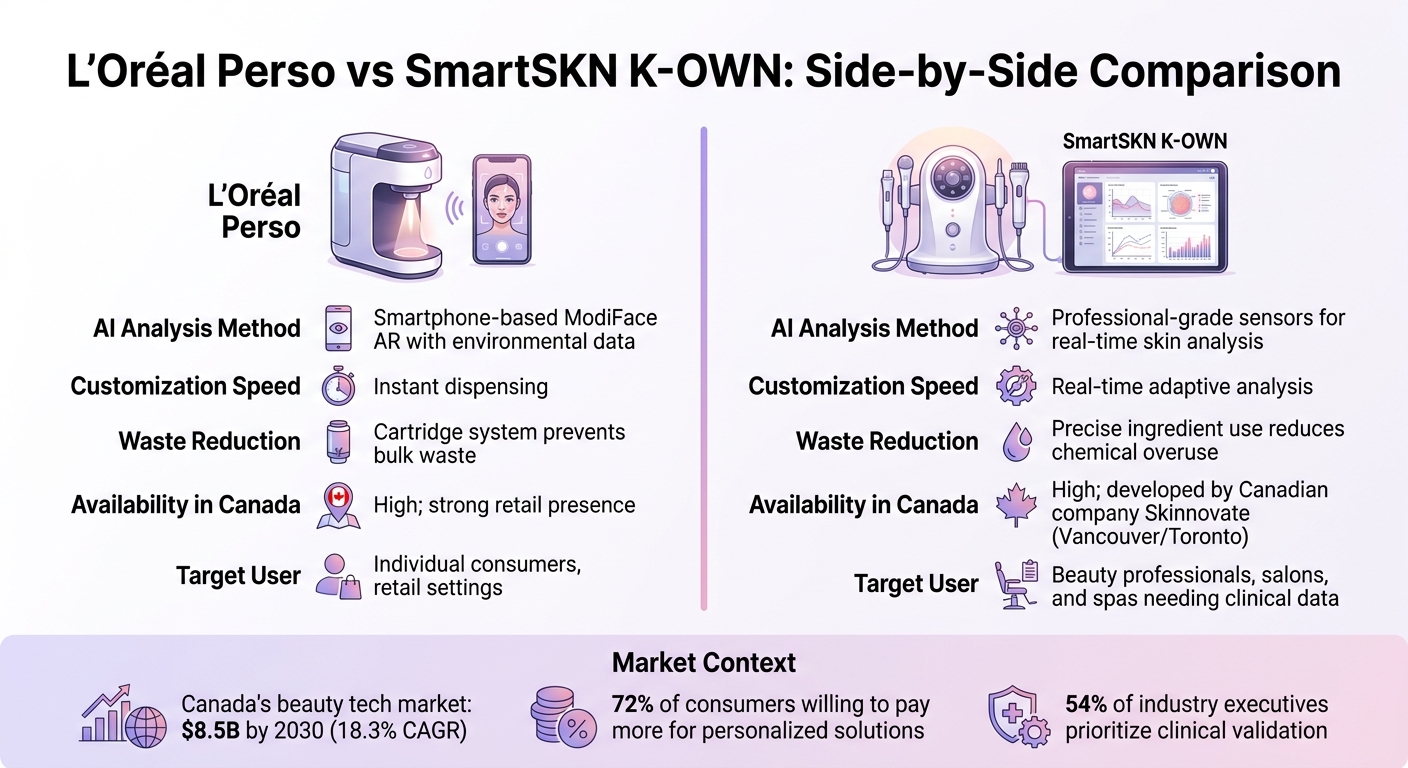
L'Oréal Perso and SmartSKN K-OWN each bring unique advantages to the table, catering to different segments of the beauty market. L'Oréal Perso focuses on instant at-home personalization, making it perfect for retail settings where convenience is key. It uses a smartphone-based ModiFace AR system that analyses photos and environmental factors, rather than direct skin measurements. This system also reduces waste through its cartridge-based design, which aligns with Gen Z's growing interest in sustainability.
On the other hand, SmartSKN K-OWN, developed by the Canadian startup Skinnovate, is designed for professional-grade precision. It uses advanced sensors to deliver real-time skin analysis, making it a great fit for salons and spas that require medical-grade equipment and clinical-grade data. This device also minimizes waste by optimizing ingredient concentrations, appealing to Canadian consumers who value eco-conscious solutions.
The key difference lies in their approach to customization and analysis. L'Oréal Perso excels at quick, on-the-spot dispensing, ideal for individual consumers. Meanwhile, SmartSKN K-OWN offers in-depth analysis and adaptive regimens tailored for professional use. For Canadian beauty professionals, this distinction matters - especially since 71% of salon clients are likely to abandon bookings if they encounter any friction during the process.
Here’s a side-by-side comparison to highlight their differences:
| Feature | L'Oréal Perso | SmartSKN K-OWN |
|---|---|---|
| AI Analysis Method | Smartphone-based ModiFace AR with environmental data | Professional-grade sensors for real-time skin analysis |
| Customization Speed | Instant dispensing | Real-time adaptive analysis |
| Waste Reduction | Cartridge system prevents bulk waste | Precise ingredient use reduces chemical overuse |
| Availability in Canada | High; strong retail presence | High; developed by Canadian company Skinnovate (Vancouver/Toronto) |
| Target User | Individual consumers, retail settings | Beauty professionals, salons, and spas needing clinical data |
Both devices stand to benefit from Canada's booming beauty tech market, projected to reach $8,545.6 million by 2030, growing at a compound annual growth rate (CAGR) of 18.3%. For Canadian beauty professionals, the decision comes down to balancing consumer convenience with the clinical validation that 54% of industry executives see as crucial for addressing consumer doubts. These differences reflect the broader push toward precision and personalization in the evolving Canadian beauty landscape.
Conclusion
L'Oréal Perso and SmartSKN K-OWN are reshaping beauty practices in Canada. The industry is shifting from fleeting trends to what experts call "biological proof", where scientific diagnostics take precedence over mere aesthetic appeal. With Canada’s beauty devices market expected to grow from $1,180.41 million in 2024 to $2,826.35 million by 2033 (a CAGR of 10.24%), professionals who adopt these technologies early stand to capture the attention of the 72% of consumers willing to pay more for personalized solutions. This shift aligns with earlier discussions on tailored diagnostics and environmentally conscious practices.
The future of beauty lies in blending advanced technology with human expertise. This combination is redefining the industry. As Ashley Edwards from BeautyMatter explains:
"Innovations designed for B2B customers for retail POS environments now transform today's beauty advisors into expert professionals, allowing them to precisely diagnose and recommend customized solutions for their clients."
For Canadian professionals, it’s not just about acquiring new technology - it’s about mastering it to stay competitive.
Success in this evolving market requires more than just equipment. A full 82% of Canadian beauty leaders stress the importance of employee training, highlighting the need for reliable partners who provide both devices and the knowledge to use them effectively. This dual focus on technology and training is critical in such a rapidly changing landscape.
FAQs
Are AI skin-device results accurate enough for sensitive skin?
AI-powered skin devices are making strides in addressing the needs of sensitive skin, but their accuracy can differ depending on the specific device and technology used. Many of these tools now incorporate factors like skin type, environmental conditions, and even genetic data to offer more tailored recommendations. However, sensitive skin often demands a level of subtlety and care that AI might not completely grasp. While these devices show promise, they work best when combined with advice from skincare professionals, particularly for intricate or delicate skin issues.
How do salons in Canada protect client data from these tools?
In Canada, salons take client data protection seriously by adhering to strict privacy regulations, such as the Personal Information Protection and Electronic Documents Act (PIPEDA). This involves using secure platforms, encrypted communication tools, and robust cybersecurity protocols to safeguard sensitive information. Salons also maintain transparency by clearly explaining how client data is used and seeking consent before collecting or processing any personal details. These practices align with Canada’s legal and ethical expectations for privacy protection.
What training do staff need to use personalized devices well?
Staff need thorough training to work effectively with personalized beauty devices. This training includes learning how to operate the devices, following safety protocols, and mastering application techniques to ensure clients are safe and receive the best possible results.
With advancements like AI and augmented reality becoming part of these devices, training might also involve understanding digital diagnostics and customizing treatments based on individual skin types and concerns. This approach not only improves the performance of the devices but also enhances client satisfaction.
Leave a comment