
Rotating Stock vs. Bulk Buying: What Works Best?
When managing beauty inventory, two key strategies stand out: rotating stock and bulk buying. Each has its strengths and challenges, and the best approach depends on your products, storage space, and cash flow. Here's a quick breakdown:
- Rotating Stock: Ideal for products with short shelf lives, like skincare with active ingredients. Methods like FIFO (First In, First Out) and FEFO (First Expired, First Out) help ensure older items are used first, reducing waste.
- Bulk Buying: Suited for high-demand consumables like gloves or shampoos. It lowers unit costs but requires ample storage and careful planning to avoid overstocking.
Quick Comparison
| Factor | Rotating Stock | Bulk Buying |
|---|---|---|
| Unit Cost | Higher per unit | Lower due to volume discounts |
| Waste Risk | Lower for perishable items | Higher for short shelf-life items |
| Storage Needs | Minimal | Significant |
| Cash Flow Impact | Smaller, frequent investments | Larger upfront investment |
| Flexibility | Easier to adjust to trends | Limited by large stock volumes |
To optimize your inventory, combine both methods: bulk buy essentials with long shelf lives and rotate stock for time-sensitive items. This hybrid approach balances cost savings and waste reduction, ensuring your business runs smoothly.
Rotating Stock in Beauty Inventory
What is Stock Rotation?
Stock rotation involves using or selling older inventory before newer stock. When fresh shipments arrive, they should be placed behind existing products. This ensures older items are used first, preventing them from expiring unnoticed while newer stock gets used prematurely.
For beauty professionals, stock rotation is critical. Active ingredients in beauty products can degrade when exposed to light, heat, or oxygen. Expired products not only fail to deliver results but can also compromise client safety. Wet products like creams, shampoos, and cleansers are particularly at risk. Their moisture-rich formulas can encourage bacterial growth once preservatives lose effectiveness.
"If you're using expired or compromised formulas, clients will associate that lapse with your professionalism. That's how one lazy inventory habit leads to a Yelp review no one wants." - The Hair Society
Aside from safety concerns, there's a financial angle to consider. Beauty products often yield a 42–48% profit margin, while backbar products used during treatments can cost between $8 and $40 per session, depending on the service. Allowing products to expire before they’re used reduces both service profitability and retail earnings.
FIFO and FEFO: The Two Main Stock Rotation Methods
Two key stock rotation strategies are commonly used in beauty inventory management. Knowing when to apply each one ensures products are used efficiently and safely.
FIFO (First In, First Out) relies on the arrival date - the oldest stock is used first. This method is simple to follow and works well for high-turnover items where shelf lives are generally consistent across batches.
FEFO (First Expired, First Out) prioritizes stock based on expiration date, regardless of when it arrived. This approach is more precise and is ideal for products with shorter shelf lives, such as organic skincare or medical-grade supplies, where chemical stability is critical and often regulated.
| Method | Primary Driver | Best Used For |
|---|---|---|
| FIFO | Arrival date | High-turnover consumables, general retail stock |
| FEFO | Expiration date | Organic skincare, wet products, medical-grade supplies |
FEFO requires more attention to detail, as it involves checking expiration labels rather than relying on arrival dates. However, it’s the safer choice for products where stability impacts client outcomes. Both methods are essential tools for effective stock management, ensuring products are used in the right order.
What You Need to Rotate Stock Effectively
To prevent waste and expired products, a few practical steps can streamline stock rotation. Start by placing older inventory at the front and newer items behind whenever new shipments arrive. This simple habit ensures older stock doesn’t get overlooked.
Accurate labelling is also key. For backbar items, mark the open date when a product is first used to track its Period After Opening (PAO). For instance, organic scrubs often have a lifespan of 6–12 months once opened, making it crucial to monitor their usage.
Regular inventory audits are the final piece of the puzzle. A quarterly review - checking for changes like separation, discolouration, or unusual odours - helps identify products that may have degraded, even if their printed expiration date hasn’t passed. Creating a designated "near-expiry" zone for items close to their end date can also help staff prioritize their use during treatments or flag them for discounted retail sales, reducing waste and financial loss.
sbb-itb-8ec3e54
Bulk Buying for Beauty Professionals
What is Bulk Buying?
Bulk buying means purchasing products in larger quantities to save on unit costs and ensure a steady supply. For beauty professionals, this approach is especially useful for essentials like gloves, cotton pads, disinfectants, core hair colour shades, and backbar shampoos.
By buying in bulk, you can lower your cost of goods sold (COGS), which directly boosts your profit margins on treatments. It also reduces the frequency of orders and shipping costs, making inventory management smoother.
Benefits of Bulk Buying in Beauty Inventory
Unlike stock rotation, which focuses on using products in a specific order, bulk buying is about saving money on frequently used items. In many salons and spas, about 20% of inventory accounts for 80% of total usage, making bulk buying particularly effective for these high-demand staples.
This method also simplifies administrative tasks by cutting down on the number of orders and deliveries you need to manage. Plus, it ensures you're well-prepared for busy periods, so essentials like gloves or cleansers are always on hand.
"A wholesale ordering system isn't about spreadsheets and drudgery. It's about creating freedom, peace of mind, and a business that runs smoothly even when you're not there..." - Beth-Ann, Author, Pure Spa Direct
However, while bulk buying has clear advantages, it does come with its own set of challenges.
Risks and Challenges of Bulk Buying
One of the biggest risks is over-purchasing items that expire before you can use them. Wet formulas like masks, serums, and cleansers often have shorter shelf lives once opened. Ordering too much of these products can lead to financial losses if they go unused.
Another drawback is that bulk buying ties up capital that could be invested elsewhere, like in equipment, marketing, or staffing. As Mygreenbucks points out:
"That money stops working the moment it turns into boxes on a shelf."
Market trends can also pose a risk. If a product line is discontinued or client preferences shift - such as rising demand for sulfate-free or organic formulations - your stockpile of older products could quickly become obsolete. To avoid this, review three to six months of purchase data to ensure the product is a consistent, high-volume necessity before placing a large order.
"Your first wholesale order will be wrong. Unless you know exactly how much product each service burns through... ordering extra 'just in case' is the costliest mistake." - Adam Golovenko, CEO, Suplery
Striking the right balance between the benefits and risks of bulk buying is key to reducing waste and keeping your beauty inventory cost-effective.
How Much Inventory Should You Buy / Own? - Ordering Vs Holding Costs
Rotating Stock vs. Bulk Buying: A Direct Comparison
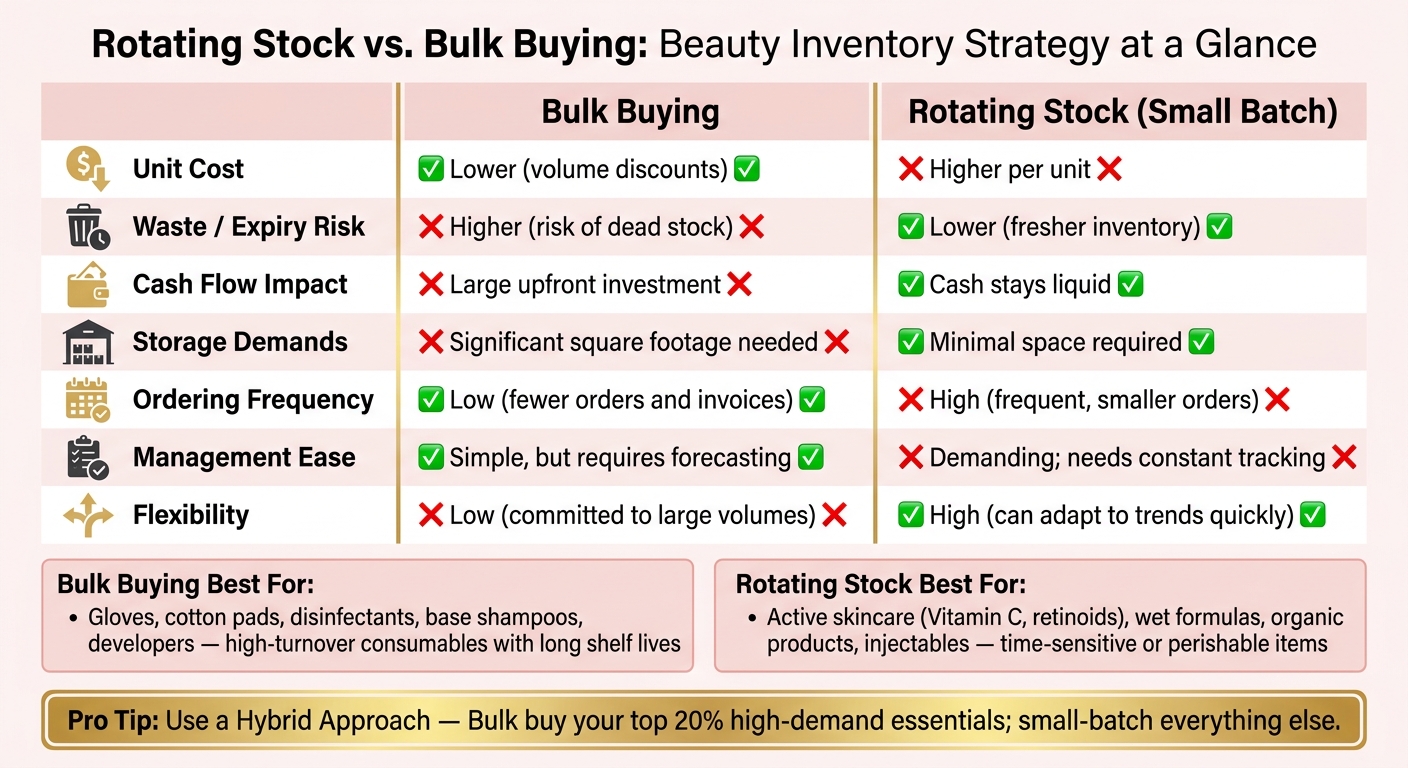
Rotating Stock vs. Bulk Buying: Beauty Inventory Strategy Comparison
Comparison Table
Each method has its own strengths and challenges, addressing different needs for beauty professionals. Here’s a breakdown of how they compare across key factors:
| Factor | Bulk Buying | Rotating Stock (Small Batch) |
|---|---|---|
| Unit Cost | Lower (volume discounts) | Higher per unit |
| Waste/Expiry Risk | Higher (risk of dead stock) | Lower (fresher inventory) |
| Cash Flow Impact | Large upfront investment | Cash stays liquid |
| Storage Demands | Significant square footage needed | Minimal space required |
| Ordering Frequency | Low (fewer orders and invoices) | High (frequent, smaller orders) |
| Management Ease | Simple, but requires forecasting | Demanding; needs constant tracking |
| Flexibility | Low (committed to large volumes) | High (can adapt to trends quickly) |
Understanding the Trade-Offs
For beauty professionals in Canada, reducing waste means carefully weighing these trade-offs. Neither approach is inherently better - it all depends on your business needs and the products you carry.
Bulk buying is appealing for its lower unit costs and simplicity, but it only works if you can use the stock before it expires. As Hairco & Beauty wisely notes: "A discount is only valuable if the stock is used before it expires." For high-demand essentials like gloves, developers, or disinfectants, bulk buying can save money. However, for items with shorter shelf lives, those savings disappear if the product goes unused.
On the other hand, rotating stock ensures fresher inventory and better cash flow but comes with its own challenges. Frequent orders mean more invoices, deliveries, and administrative tasks. For solo aestheticians or small spa teams, this added effort can quickly become overwhelming.
"Inventory should be a sweet spot: enough stock to meet demand, but not so much that products expire." - Grace Laurent, Consultant and Salon Expert, Suplery
Bulk buying also introduces a hidden cost: operational pressure. When shelves are packed with aging stock, staff might feel pushed to promote certain treatments just to move inventory, potentially shifting the focus away from what clients actually need. It’s a subtle but important consideration that doesn’t show up in your budget.
This comparison highlights the importance of tailoring your inventory strategy to the specific demands of your product mix.
Matching Your Strategy to the Product Type
Your inventory strategy should align with the specific nature of each product type. Applying a one-size-fits-all approach across your inventory can lead to waste or missed savings. Here's how to tailor your strategy based on the product category.
Products with Short Shelf Lives or Expiry Requirements
For items like active ingredients (Vitamin C, retinoids, peptides, exfoliating masks), stock rotation is essential. These products degrade quickly, especially when exposed to air, light, or heat, which can significantly reduce their potency.
"Rotating your wet products isn't just a best practice - it's a business imperative." - The Hair Society
Injectables require an even more precise approach. Due to their high cost and strict expiry dates, a just-in-time inventory method works best. This ensures you maintain cash flow while avoiding expired stock. Marking open dates is also crucial to track their actual lifecycle, keeping efficacy intact and waste minimal.
Fast-Moving Consumables
For high-use disposables like gloves, cotton pads, disposable caps, and universal cleansers, bulk buying is the way to go. These items are used consistently and in large quantities, making volume purchases both practical and cost-effective. In fact, these "hero" products often make up about 80% of a salon or clinic's total product usage.
"Bulk buy your 'hero' products... Small-batch your 'specialists' and testers." - Pure Spa Direct
Because these products don’t degrade easily, you can safely stock up without worrying about waste. However, keep storage space in mind - bulk buying only works if you have room to store the items properly.
Managing Inventory When Storage Space is Limited
Limited storage is a common challenge for many Canadian beauty professionals, especially those working in smaller clinics or shared studios. Overstocking can waste valuable treatment or retail space and lead to forgotten products expiring at the back of a shelf.
To manage this, focus on bulk buying only for your highest-turnover consumables. For other items, opt for smaller, more frequent orders. If you operate across multiple locations, consider pooling orders with other sites to meet minimum order quantities. This way, you can take advantage of volume discounts without overwhelming your storage capacity.
| Product Category | Recommended Strategy | Reason |
|---|---|---|
| Disposables (gloves, pads, caps) | Bulk buying | Long shelf life, frequent use, low degradation risk |
| Hero products (base cleansers, shampoos) | Bulk buying | Steady demand, high usage |
| Active skincare (Vitamin C, retinol) | Stock rotation / small batch | Time-sensitive efficacy, rapid ingredient degradation |
| Injectables | Just-in-time | High cost, strict expiry dates |
| Specialty / trend items | Small batch | Risk of obsolescence if trends shift |
Using Both Methods Together: A Hybrid Approach
Combining bulk buying and stock rotation can be a game-changer for reducing waste and managing your beauty inventory effectively. This hybrid method ensures you're minimizing expired products while keeping your inventory aligned with demand.
How to Apply Both Methods in Your Business
A smart way to implement this is by following the 80/20 rule: reserve bulk buying for the 20% of high-demand essentials - like gloves, cotton pads, basic cleansers, and disinfectants - that make up 80% of your usage. For everything else, such as trend-sensitive items like fashion-tone hair colours or short-shelf-life products like high-active peels, smaller and more frequent orders are the better choice.
"Hybrid approaches work because they match reality: Bulk for stable, non-perishable essentials; Just-in-time for trend-sensitive or short-dated products." - Kenneth Jones, Mygreenbucks
To avoid running out of stock or over-ordering, track actual product usage over 30–90 days. Use this data to calculate reorder points with the formula:
Reorder Point = (Average Daily Usage × Lead Time) + Safety Stock.
This approach ensures you're always prepared without risking excess inventory that could expire.
"Bulk buying without forecasting is gambling." - Kenneth Jones, Mygreenbucks
Inventory Controls to Support a Hybrid Approach
For a hybrid strategy to succeed, proper inventory controls are essential. Your inventory log should track SKUs, arrival dates, expiry dates, and reorder points for every product. Including batch codes for each shipment helps monitor expiry dates and simplifies returns if needed.
Use the FIFO (First In, First Out) method for disposables and FEFO (First Expired, First Out) for active skincare products. If you're still relying on spreadsheets, consider upgrading to spa management software. These tools provide real-time stock tracking and automatic low-stock alerts. For most Canadian beauty businesses, weekly counts of fast-moving items and monthly full audits strike a good balance.
How Beauty Pro Supplies Canada Supports Your Inventory Strategy
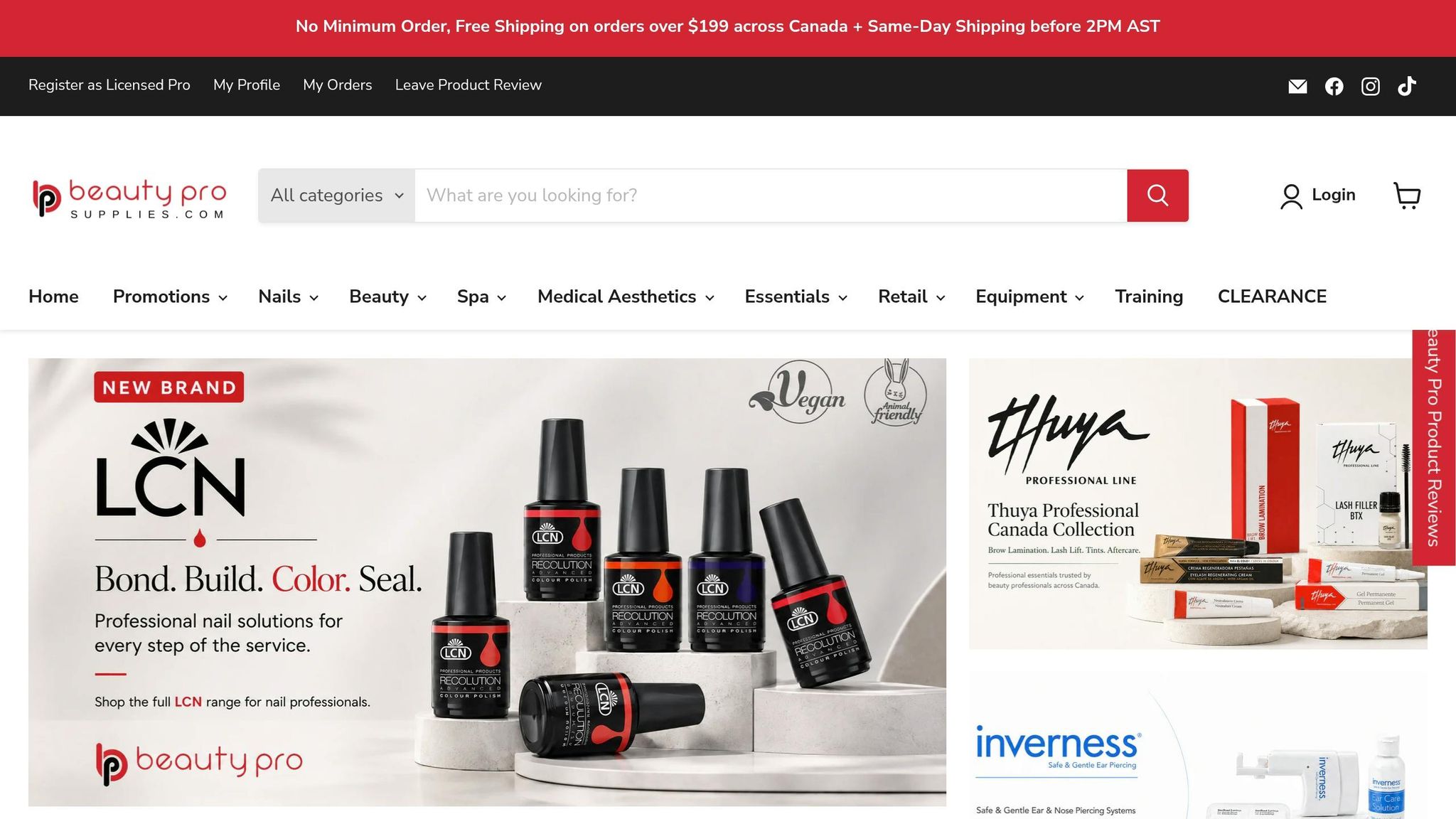
Once your inventory system is in place, partnering with a dependable supplier is key. Beauty Pro Supplies Canada offers a broad selection of professional-grade beauty, spa, and medical supplies. Whether you need bulk orders or small batches, they’ve got you covered. Plus, their interest-free payment option through Sezzle - split into four payments over six weeks - makes it easier to stock up on essentials without stretching your budget too thin.
Conclusion: Choosing the Right Approach for Your Business
Deciding on the right inventory strategy comes down to factors like product type, storage availability, and cash flow. Here's a side-by-side comparison to help you weigh your options:
| Factor | Bulk Buying | Rotating Stock / Small Batch |
|---|---|---|
| Expiry Risk | Low (for long shelf life items) | High (for perishable or active ingredients) |
| Storage Capacity | Requires ample dedicated space | Suited for limited storage |
| Product Turnover | Works best with steady, predictable demand | Ideal for seasonal or trend-based items |
If your products have a long shelf life, consistent sales, and plenty of storage space, bulk buying is likely the better choice. On the other hand, if you're dealing with perishable goods, limited space, or fluctuating demand, smaller, more frequent orders are the way to go.
To make the most of your inventory strategy, take a close look at your purchase data from the past six months. Stick to the principle, "Order what you use, not what you hope will sell," to keep waste in check and protect your profit margins. By aligning your approach with your business's unique needs, you’ll set yourself up for smoother operations and better results.
FAQs
When should I use FIFO vs FEFO?
Choose FIFO for managing general inventory, particularly for seasonal items, non-perishable goods, or products tied to trends. This approach organizes stock based on the order it was received, ensuring older inventory is sold first.
On the other hand, opt for FEFO when dealing with perishable items or regulated beauty products with specific expiration dates. FEFO focuses on using or selling items closest to their expiry, helping to maintain customer safety and reduce waste. This method is crucial for products where shelf life is a key concern.
How do I set a reorder point for bulk items?
To determine a reorder point for bulk items, combine lead time demand and safety stock. Here's how it works:
- Lead time demand is calculated by multiplying your average daily usage by the supplier's delivery time.
- Safety stock acts as a cushion for unexpected delays or increased demand.
Using inventory tracking software, especially when integrated with Beauty Pro Supplies Canada, simplifies this process. The system can automatically trigger orders as soon as your stock hits the pre-set threshold, ensuring you never run out of essential items.
What’s safe to bulk buy in a small studio?
In a small studio, it makes sense to stock up on high-use consumables with long shelf lives, like gloves, disinfectants, and basic disposables. Prioritize everyday essentials and ensure your storage conditions protect product quality - think about factors like temperature and exposure to light. On the other hand, avoid buying trend-driven or seasonal items in bulk. These are better purchased in smaller amounts to prevent waste and keep your cash flow steady.
Leave a comment