

Aesthetic Equipment Maintenance Schedule
If I skip a set maintenance routine, small equipment issues can turn into hygiene risks, staff delays, and repair costs fast. A simple schedule fixes that by splitting work into daily, weekly, monthly, and yearly tasks and assigning each job to the right person.
Here’s the short version:
- Daily: I check cords, handpieces, tubing, controls, reusable tools, and treatment surfaces.
- Between clients: I clean and disinfect touchpoints, replace barriers, and remove damaged items from use.
- Weekly: I inspect beds, chairs, stools, wheels, hinges, seams, and hydraulic parts for wear.
- Monthly: I test machine output, clear vents and filters, deep clean water units, and condition upholstery.
- Yearly: I arrange technician servicing, review logs, check calibration, and plan repairs or replacement.
A few points stand out:
- If disinfectant does not stay wet for the full label contact time, the surface is not properly disinfected.
- Cracked vinyl, damaged tool handles, frayed cords, leaks, and odd noise mean the item should be taken out of service at once.
- A common budgeting rule is the 50% rule: if a repair is about 50% of replacement cost, replacement often makes more sense.
- Logs should record the date, asset ID, task, issue, action taken, parts used, follow-up, and staff initials.
I’d treat this kind of schedule as a working clinic document, not just a checklist on paper. It helps with cleanliness, machine life, staff accountability, and inspection records across the full year.
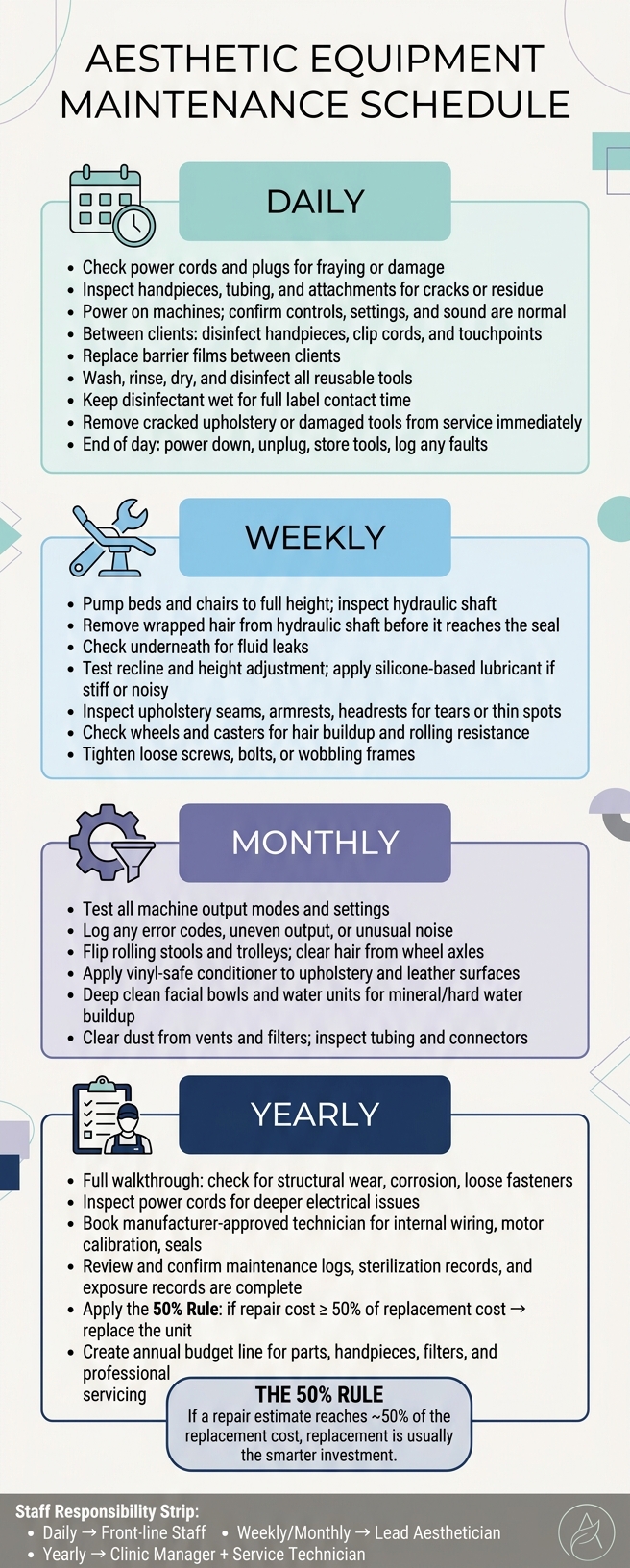
Aesthetic Equipment Maintenance Schedule: Daily to Yearly Tasks
Daily Maintenance Checklist for Facial Machines and Small Tools
Daily checks take only a few minutes, and they help stop simple problems before they turn into downtime.
Use this checklist at opening, between clients, and again at close.
Pre-Opening and Between-Client Checks
Before the first client arrives, inspect each treatment station. Look over power cables and cords for fraying or other visible damage. Make sure plugs are seated securely. Check handpieces, attachments, and tubing for cracks or residue left from the previous day. Then power on each machine and confirm that the controls, settings, and sound all seem normal.
"Run through all the massage settings, check the remote control cords for fraying, and ensure the power supply is secure. A little preventative maintenance goes a long way in keeping the mechanics happy." - Keller International
Between clients, wipe all device handpieces, clip cords, and touchpoints with an approved disinfectant. Replace barrier films. After that, wash, rinse, dry, and disinfect all reusable tools before using them again. One detail matters here: keep disinfectants wet for the full label contact time. If the surface dries too soon, the job isn’t done.
"Clean and disinfect clip cords, handpieces and the work area after each client or when they are visibly dirty." - City of Hamilton Public Health Services
Also check upholstery and tool handles between clients. If anything is cracked or damaged, take it out of service right away. Those items can’t be properly sanitised.
End-of-Day Shutdown and Storage
At the end of the day, finish with shutdown, storage, and issue logging. If a device overheats, leaks, or starts making unusual sounds, tag it and remove it from service until it has been inspected and logged.
| End-of-Day Task | Action Required |
|---|---|
| Power down and unplug devices | Follow manufacturer shutdown sequence |
| Inspect cords and plugs | Check for fraying or visible damage |
| Store reusable tools | Clean, dry, covered container; separate from used items |
| Flag equipment issues | Tag item, remove from service, log the fault with date and details |
Daily checks help you spot what’s easy to see. Weekly and monthly checks deal with wear and changes in how equipment performs.
sbb-itb-8ec3e54
Weekly and Monthly Maintenance Checklists
Weekly checks are for moving parts, upholstery, wheels, and hinges. Monthly checks are for device output, airflow, and accessories.
Weekly Checks for Beds, Stools, Upholstery, Wheels, and Hinges
Weekly checks help you spot wear before it turns into repair downtime.
Block off a bit of time each week to look more closely at furniture and mechanical parts. Pump beds and chairs to full height, inspect the hydraulic shaft, and remove any wrapped hair before it reaches the seal. Hair can coil around the shaft and damage the seal. While you're there, look underneath for fluid leaks.
Then test the recline and height adjustment parts. If anything feels stiff or sounds noisy, apply silicone-based lubricant to the joints and tracks.
Wrap up by checking upholstery seams, armrests, and headrests for small tears or thin spots. Skip alcohol- or bleach-based cleaners on vinyl, because they can make the material brittle. Once vinyl cracks, it can't be properly sanitised.
| Equipment Component | Weekly Task | What to Use |
|---|---|---|
| Hydraulic shafts | Pump to max height; remove wrapped hair | Scissors or razor blade |
| Bases and frames | Check for loose screws, bolts, or wobbling | Screwdriver or wrench |
| Wheels and casters | Inspect for hair buildup and rolling resistance | Tweezers or seam ripper |
| Recline and height hinges | Test movement; lubricate if noisy or stiff | Silicone-based lubricant |
| Upholstery | Inspect for tears, cracks, or seam stress | Warm soapy water; vinyl-safe disinfectant |
Monthly Checks for Device Performance, Vents, Filters, and Accessories
After checking for mechanical wear, move on to device output and airflow.
Monthly checks confirm that each device is running as expected and that vents, filters, and attachments stay clear. Test every machine's output settings and modes to make sure they respond the same way each time. If a device shows uneven output, error codes, or odd noise, log it and have it checked before the problem gets worse.
Once a month, flip rolling stools and trolleys over and clear hair from the wheel axles with tweezers or a seam ripper. It's a small job, but it helps stop jammed casters and protects your floors. At the same time, apply a vinyl-safe conditioner to leather and upholstery surfaces to keep the material supple and help it last longer.
| Equipment Type | Monthly Task | Responsible Staff |
|---|---|---|
| Electronic treatment devices | Test all output modes; check for error messages or unusual noise | Lead Technician |
| Rolling trolleys and stools | Flip units; remove hair from wheel axles | Assistant |
| Treatment chairs and beds | Condition vinyl or leather; wipe metal bases clean | Clinic Assistant |
| Facial bowls and water units | Deep clean for mineral and hard water buildup; check for leaks | Maintenance Staff |
| Vents, filters, and connectors | Clear dust buildup; inspect tubing and attachments | Lead Technician |
Yearly Maintenance Checklist for Servicing and Replacement Planning
After monthly checks help spot wear early, annual maintenance is where you look at the bigger picture: calibration, compliance, safety, and replacement planning. This yearly review helps you see what still works well, what needs service, and what may be near the end of its life.
Annual Audits, Calibration, and Professional Servicing
Once a year, do a full walkthrough of every piece of equipment in your clinic. Look for structural wear, corrosion, and loose fasteners. Check power cords for deeper electrical issues that may not show up during daily visual checks.
Internal wiring, motor parts, seals, and calibration should be handled by a manufacturer-approved technician. It’s best to contact your equipment manufacturer directly for a list of approved service technicians in your part of Canada, because not every technician knows every model.
Your annual review should also confirm that maintenance logs, accidental blood/body fluid exposure records, and sterilization records are complete and stored on-site based on your retention requirements. Keep maintenance, sterilization, and exposure records on site for the required retention period.
| Task | Who Completes It | Tracking Requirement |
|---|---|---|
| Internal wiring and electrical inspection | Qualified technician | Maintenance log (3-year retention recommended) |
| Motor calibration to factory specs | Manufacturer-approved technician | Service date and outcome recorded in log |
| Plumbing seals (internal) | Qualified technician | Maintenance log |
| Upholstery and structural stability audit | In-house staff | Annual audit checklist |
| Maintenance record completeness review | Clinic manager | On-site records stored according to retention requirements |
Use the audit results to decide what should be serviced, repaired, or replaced. That turns the review from a paper exercise into a working plan.
Replacement Planning and Budget Preparation
Look back at the last 12 months of service logs to spot repeat faults and likely replacements. If the same issue keeps coming back, that’s usually a sign the equipment is costing you more than it should.
A practical rule of thumb is the 50% rule: if a repair estimate reaches about 50% of the cost of a replacement unit, replacement is usually the better investment. This applies to treatment devices, hydraulic chairs, and rolling stools with power bars alike.
Set budget aside for replacement parts and servicing, including handpieces, filters, and waste filters. It also helps to create a dedicated line in your annual budget for parts and professional servicing, so these costs don’t sneak up on you mid-year.
Service Logs and Staff Responsibilities
Logs keep your maintenance schedule on track. Skip the paperwork, and small jobs start slipping. Then problems sit there, no one owns them, and you’re left scrambling when a public health inspector asks for records or a technician shows up for a service call.
What to Record in Every Maintenance Log
Once the checklist is done, record each task the same way every time.
Each log entry should include the same core fields: date (formatted as 21 Aug 2026), equipment name or asset ID, task completed, problem found, action taken, parts replaced, follow-up required, and staff initials. If a procedure uses sterile, pre-packaged items, record the lot numbers and expiry dates for any sterile, pre-packaged items used in that session too.
Record spills, damage, and corrective action right away.
Keep maintenance and exposure records on-site for the retention period required by local rules.
Use one format across all entries. When a log is easy to scan, it saves time during a service call and makes record checks much less painful for public health inspections.
Assign Responsibilities by Role
Use the logs to tie each task to the person responsible for it.
When ownership is clear, jobs are less likely to get missed. The table below shows who handles each part of the maintenance schedule:
| Role | Core Responsibilities | Frequency |
|---|---|---|
| Front-line staff | Daily cleaning of stations, tool sanitization, emptying hair traps, wiping upholstery between clients, and reporting unusual noises or leaks | Daily |
| Lead Aesthetician | Inspections of hydraulic pumps and moving parts, cleaning hair from wheel axles, and conditioning upholstery | Weekly / Monthly |
| Clinic Manager | Audits of equipment condition, such as Woods lamp inspections, log oversight, repair-or-replace decisions, and scheduling outside professional servicing | Yearly / As Needed |
| Service Technician | Internal wiring checks, motor calibration, and professional plumbing and seal inspections | Annual / Every six months |
Train every role on the full schedule so coverage stays steady. Good logs also make daily, weekly, monthly, and annual checks much easier to track.
Conclusion: Keep the Schedule Simple, Consistent, and Documented
A maintenance schedule only works if staff stick to it every time: daily cleaning, weekly checks, monthly care, and annual servicing.
Pull damaged items out of service right away, follow the manufacturer’s instructions, and replace equipment when repair costs get close to 50% of the replacement price.
Use approved disinfectant cleaners, and record what was used, when it was used, and who used it.
As soon as a task is finished, log it right away. Logs make maintenance traceable. Record the date, equipment ID, task, and staff name every single time. Steady records make the schedule easier to follow and easier to defend during inspections.
FAQs
How do I set maintenance priorities?
Set maintenance priorities by dealing with safety and compliance first. If you spot visible damage, overheating, liquid exposure, or odd equipment behaviour, get it checked right away or replace it.
After that, focus on prevention and consistency. Do daily sanitation and disinfection between clients, keep equipment clean, track problems in logs, and run weekly or monthly checks on cables, moving parts, wheels or casters, and rust.
When should I replace instead of repair?
Replace instead of repair when the repair bill is around 50% or more of the cost of a new unit, especially if the equipment is close to end-of-life or keeps causing extra downtime.
Replace right away if there’s safety-critical damage. That includes visible cord damage, signs of liquid exposure, overheating, a cracked frame, a failed main motor, or leaks that continue even after repairs.
What should I do if staff miss a check?
If a staff member misses a scheduled check, do it as soon as possible. After that, clean and disinfect any affected surfaces and equipment to your usual between-client standard. Follow the manufacturer’s required contact time.
Record the missed check and the corrective action in your service or cleaning log. Include who completed it and when. If there’s visible damage or anything beyond routine care, contact the manufacturer or distributor for technical support or warranty guidance.
Leave a comment