

Face Rollers: Guide to Tools and Techniques
If you use face rollers at work, the tool matters less than the protocol. In most treatment rooms, the best match is simple: 316L stainless steel for clinic backbar, stone for home care or relaxation-focused facials. Results are usually short-term, such as less puffiness, calmer-looking skin, smoother product spread, and a more relaxed feel.
Here’s the short version I’d want at the top of the page:
- I’d use light pressure, never scrub or roll back and forth
- I’d keep strokes upward and outward
- I’d allow 5 to 10 minutes for a focused sequence, or 2 to 3 minutes inside a 60- to 90-minute facial
- I’d avoid rolling over active acne, rosacea, broken skin, recent laser or peel sites, and recent injectable areas without medical clearance
- I’d choose non-porous tools for treatment-room use because they’re easier to clean and disinfect
- I’d chart consent, areas treated, pressure used, products, and aftercare
- In Ontario, I’d remember that client records must be kept for at least 3 years, with 1 year on-site
What face rollers do well: cooling, de-puffing, light lymphatic-style massage, and product glide.
What they don’t do: replace corrective treatments.
A few points shape day-to-day use more than anything else: material, hygiene, stroke direction, and screening. Stone rollers feel nice, but they can be harder to disinfect if chipped, cracked, or porous. Stainless steel tends to suit medical spa and clinic settings because it holds cold and stands up to repeated reprocessing.
Quick comparison
| Roller type | Best fit | Cooling | Reprocessing | Common use |
|---|---|---|---|---|
| 316L stainless steel | Backbar / clinic | High | Easier | Post-treatment cooling, de-puffing |
| Jade / rose quartz | Retail / home care | Medium | Harder | Relaxation, serum application |
| Silicone | High-hygiene settings | Low to medium | Easier | General facial massage |
If I had to sum up the whole guide in one line, it would be this: pick the right material, use short controlled strokes, and treat cleaning and client screening as part of the service, not an extra.
What professional facial rollers are and how they work
A facial roller is a handheld massage tool with a smooth cylindrical barrel. It’s usually made from polished semiprecious stone, medical-grade stainless steel, or silicone. In treatment, it applies light mechanical pressure through set strokes to support surface circulation and lymphatic drainage.
Used well, facial rollers can help spread serums more evenly and give skin a temporary de-puffing effect, a sense of relaxation, and a bit more glow. That said, they’re not a substitute for corrective treatments.
Material and head shape affect three things day to day: temperature retention, hygiene, and control.
Roller types and their main uses
In a professional setting, the roller material usually tells you what the tool does best.
| Roller Type | Material | Best Professional Use |
|---|---|---|
| Jade / Rose Quartz | Natural stone | Relaxation facials, light lymphatic-style massage |
| Stainless Steel (316L) | Surgical-grade metal | Post-treatment cooling, de-puffing, medical spa protocols |
| Silicone | Medical-grade silicone | High-hygiene environments, dishwasher-safe sterilization |
Jade and rose quartz work well in relaxation-led services. Stainless steel rollers, especially those made from surgical-grade 316L, are often the first pick in clinical and medical spa settings. They stay cold well, which makes them useful for calming skin after laser treatments or chemical peels.
A simple way to think about it: pick the material first, then match the roller to the client’s goal.
Also, don’t mix up facial rollers with derma rollers. Derma rollers use needles and need a separate sterilization protocol.
Design features that affect daily use
Once material is sorted out, head size and balance have a big effect on how the tool feels in practice. Dual-head rollers have a larger barrel for broad areas like the cheeks and a smaller one for tighter spots like the bridge of the nose or the under-eye area. That gives practitioners more control without having to swap tools mid-treatment.
Pen-sized wands are made for periorbital work. That matters because the skin in that area is thin, and there’s less room for error.
Grip, weight, and balance also shape control and hand fatigue over the course of a shift. For disinfection, non-porous materials like stainless steel and medical-grade silicone are usually the practical option in Canadian treatment rooms. Natural stone is porous, which makes thorough disinfection harder between clients.
Matching roller use to client concerns
Different goals call for different roller choices, and this is where the tool earns its keep.
For morning puffiness or fluid retention, a chilled stainless steel roller used in upward, outward strokes along the jawline and under the eyes is the most direct fit. If the issue is facial tension, which shows up a lot in the jaw and forehead, a stone roller used slowly with light pressure can help the client relax during a longer facial.
For dull, tired-looking skin, rolling after serum application helps spread product evenly and gives a temporary circulation boost. The result is skin that looks brighter right after treatment.
In post-treatment settings, such as after a mild peel or a non-invasive service, a cooled stainless steel roller can help calm redness and lower discomfort before the client leaves the treatment room.
sbb-itb-8ec3e54
Roller techniques and massage patterns
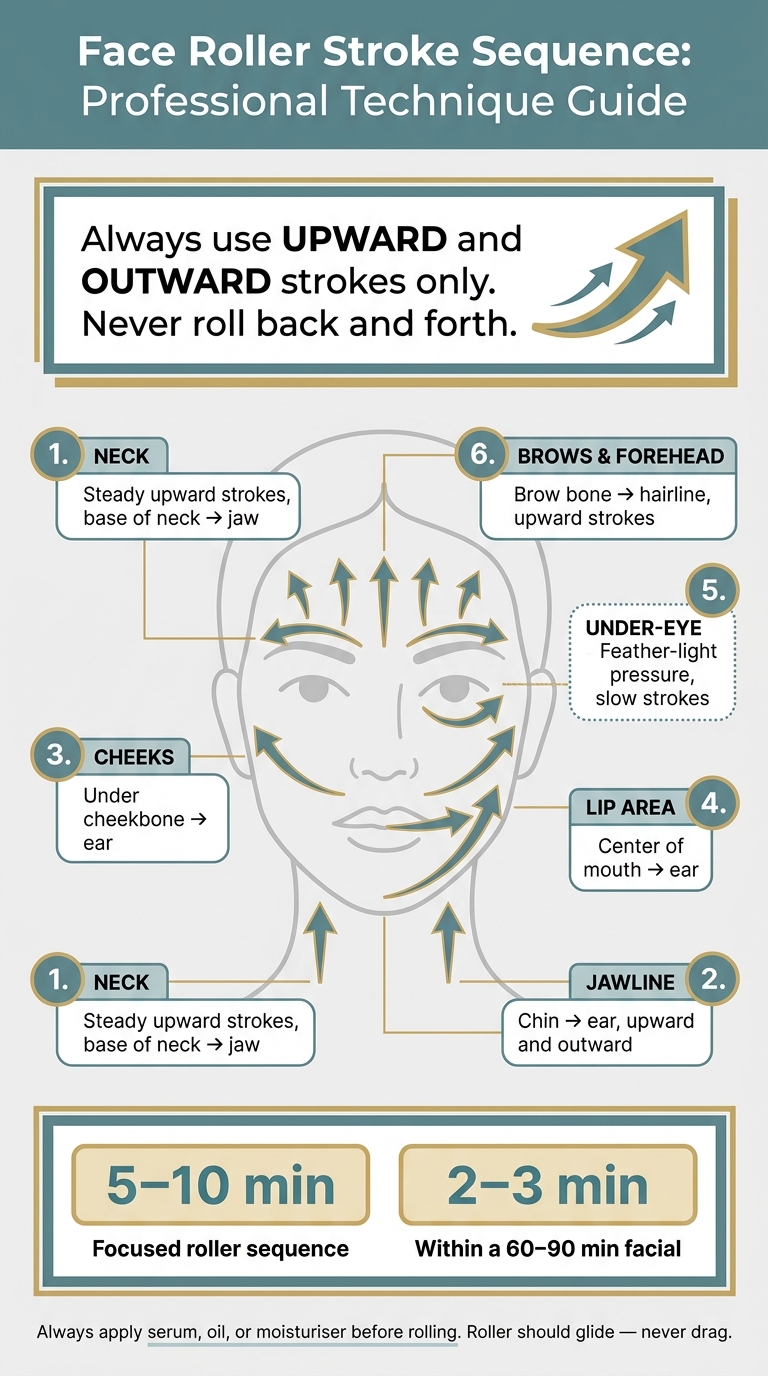
Face Roller Technique: Step-by-Step Stroke Guide for Professionals
Once you’ve picked the right roller from your wholesale spa supplies, use it on clean skin with enough slip so it moves smoothly.
Pre-treatment setup, skin assessment, and product glide
Cleanse the skin, rinse well, and pat it dry. Then apply a thin, even layer of serum, facial oil, cream, or moisturiser over the area you’re treating. You only need enough product to help the roller glide without pulling at the skin. Think of the roller as a short massage step within the facial, not the main event.
Skip any area with active acne, rosacea, psoriasis, sunburn, blisters, abrasions, cuts, or skin that was recently treated with chemical peels or lasers.
Rolling directions for neck, jawline, cheeks, eyes, and forehead
Use upward and outward strokes only. Don’t roll back and forth or scrub the skin.
Here’s a simple sequence to follow:
- Neck: Use steady upward movements from the base of the neck toward the jaw.
- Jawline: Start at the chin and roll upward and outward toward the ear.
- Cheeks: Roll under the cheekbone, then along the bone toward the ear.
- Lip area: Roll from the centre of the mouth outward toward the ear.
- Under-eye: Use feather-light pressure and slow strokes.
- Brows and forehead: Roll along the brow bone, then use upward strokes from the brow line to the hairline.
If the goal is drainage, keep each stroke long and direct it toward the ears and neck. Work in a steady, even way so each pass helps leave the skin calm and balanced.
Pressure, pace, and timing
Use light pressure and slow strokes so the roller glides without dragging the skin. A focused sequence usually takes 5 to 10 minutes. In a 60- to 90-minute facial, 2 to 3 minutes is usually enough for the areas you want to target.
Next, cleaning, disinfection, storage, and contraindications shape when and how the tool should be used safely.
Hygiene, safety, and contraindications
Cleaning, disinfection, and storage
Once a facial roller leaves the treatment step, what happens next matters just as much as the treatment itself. If the roller isn't cleaned and disinfected the right way, it shouldn't go back into use.
Start by removing residue. Rinse the roller with warm water, wash it with soap, and then disinfect it. If you can't clean it right away, soak it in water and detergent so residue doesn't dry onto the surface.
Use only Canadian-approved cleaners and disinfectants, such as PREempt CS20, with a DIN or NPN.
Cleaning and disinfecting also depend on what the roller is made of:
| Roller Material | Cleaning Method | Disinfectant Compatibility | Infection-Control Risk |
|---|---|---|---|
| Stainless Steel (316L) | Soap and water; manual or ultrasonic | High; compatible with most medical-grade disinfectants | Low; non-porous and durable |
| Stone (Jade/Quartz) | Soap and warm water; pat dry with lint-free cloth | Cracked or unsealed stone is harder to disinfect | Moderate; inspect regularly for surface damage |
| Silicone/Resin | Soap and water; silicone-safe spray | Moderate; avoid alcohol, petrol, or acetone | Low to moderate; non-porous but prone to surface scratches over time |
316L stainless steel is the easiest backbar option to reprocess in a professional setting.
Once the roller has been disinfected and is fully dry, store it in a clean, covered container away from dirty instruments. The reprocessing area should also have its own sink, separate from the hand-washing sink, as required under provincial personal service settings (PSS) rules such as Ontario Regulation 136/18.
Contraindications and areas requiring caution
A clean roller can still be the wrong choice if the client's skin or health status says no.
Screen every client before rolling. Do not use a roller on clients with active skin infections, open sores or lesions, warts, cancerous lesions, raised moles, rosacea, severe inflammatory acne, red or damaged skin, enlarged capillaries, or a history of recent laser treatments, chemical peels, or facial cosmetic surgery.
Health screening should also cover bleeding disorders, anticoagulant use, epilepsy, heart disease, and electronic medical implants such as pacemakers. Rolling is also contraindicated over recent injectable treatment areas unless the client has been medically cleared.
Some areas need extra care, and some should be avoided altogether. Stay away from the neck midline, chest, eyelids, eyeballs, and carotid arteries. Around the eye socket, use feather-light pressure.
Canadian practice and charting requirements
Safe use isn't just about technique. It's also about records.
Follow the personal service rules in your province or territory.
Every roller service should be charted. A full client record includes:
- consent
- contraindications reviewed
- products used, including lot numbers and expiry dates
- areas treated
- pressure level applied
- aftercare instructions, both verbal and written
In Ontario, client records must be kept for a minimum of three years, and at least one year of those records must be kept on-site. If an exposure incident happens, record it separately and keep it with the client file.
Using facial rollers in services, home care, and purchasing
Adding rollers to services and home-care plans
Once technique and hygiene are in place, the next step is simple: use the roller where it does the most good.
Facial rollers fit well into classic facials, calming treatments, and lymphatic drainage protocols. But timing matters. Rolling tends to work best after cleansing and toning, once you've applied a serum, hydrating toner, or firming cream. In a professional treatment, the roller can help spread product more evenly and keep each stroke smooth and controlled.
For post-procedure care, use a chilled stainless steel roller only if the service protocol allows it. In that setting, it can help cool the skin and ease discomfort.
Match your technique to the client's skin condition. Use feather-light pressure on sensitive skin. Stay away from any irritated, broken, or inflamed areas.
For home care, keep things easy and realistic. A short routine is more likely to stick:
- Roll for 3 to 5 minutes, once or twice a day
- Apply product first
- Use the roller on clean skin
- Clean the roller after each use
If a stone roller chips or cracks, take it out of use right away.
Choosing rollers for retail and backbar
Once you know how the roller will be used, the material choice gets much easier.
For backbar use, durability and hygiene come first. Surgical-grade 316L stainless steel is a solid pick because it's non-porous, stands up to disinfectants, and handles repeated sanitizing well. For clinical use, it's also smart to check for ISO 10993 biocompatibility certification as part of the buying process.
For retail, jade and rose quartz still have strong appeal. Many clients simply enjoy the look and feel of a ritual-focused tool they can use at home.
| Feature | Backbar (Stainless Steel) | Retail/Home Care (Stone/Jade) |
|---|---|---|
| Durability | High; resists drops and disinfectants | Moderate; breaks more easily |
| Sanitization | Non-porous; suitable for repeated disinfection | Best cleaned gently with soap and water |
| Cooling | Retains cold well; useful for post-treatment care | Naturally cool, but loses temperature faster |
| Best For | Lymphatic drainage, post-procedure care | Daily relaxation and serum application |
Plan inventory based on use: backbar or retail.
Buying from Beauty Pro Supplies Canada
For Canadian clinics, buying locally can make backbar and retail restocking a lot easier. Beauty Pro Supplies Canada carries professional-grade facial rollers and related spa tools for aesthetic and medical settings.
The supplier also offers dermaplaning online training resources, which can help with staff education when you're adding new roller protocols to your service menu.
Conclusion
Facial rollers work best when you match them to a clear goal. The first choice is the setting: 316L stainless steel fits clinical use, while natural stone suits retail and home care.
After that, technique shapes the outcome. Good results depend on proper use, skin screening, and enough product slip. A roller used after product application on screened skin does a different job than a retail tool used at home.
And even solid technique falls apart without proper reprocessing and screening. In a professional setting, use also relies on disinfection, storage, and accurate charting.
Buying choices should line up with how the roller will be used. Pick professional backbar bundles for durability and sanitization. Pick retail tools for simple home use. When used as part of a clear protocol, facial rollers can be a practical add-on for both professional services and home care. They work best as tools within a plan, not as standalone treatments.
FAQs
Which face roller material is best for my setting?
It depends on your goals and day-to-day needs.
- 316L stainless steel works well in professional spa settings because it stands up to cryogenic cooling and strict sanitization.
- Jade and rose quartz are a good fit for luxury and wellness-focused settings.
- Obsidian is often picked for detoxification-focused services.
Can I use a face roller after peels, lasers, or injectables?
Yes - facial rollers, especially ice or cryo-cooling types, are often used in professional settings after chemical peels and laser treatments to help ease discomfort and calm inflammation. Some medical spa protocols also use heated rollers after injectables.
That said, caution matters. Post-treatment skin is compromised, so both pressure and sanitation count. Make sure tools are properly disinfected or sterilized, and follow the clinician’s or manufacturer’s post-treatment protocols.
How often should I clean and replace a face roller?
Clean your face roller after every use. That part isn’t optional.
In a professional spa, disinfect it between clients with products made with ethanol, isopropanol, or hydrogen peroxide. If you use reusable metal tools, take them apart, clean them, autoclave them, and seal them in sterilization pouches at the end of the day.
You only need to replace a face roller if the material starts to wear down, the surface gets damaged, or the mechanism stops working as it should.
Leave a comment