

Dermaplaning vs Microdermabrasion: Key Differences
If I had to sum it up in one line: dermaplaning is best for smooth, hair-free skin, while microdermabrasion is best for machine-led texture work.
If you’re comparing these two services, the choice usually comes down to 6 things: exfoliation method, hair removal, skin feel, downtime, client fit, and cleaning needs. Both remove dead skin cells. But only dermaplaning removes vellus hair, and only microdermabrasion uses suction and a powered handpiece.
Here’s the short version:
- Dermaplaning uses a sterile blade for manual exfoliation
- Microdermabrasion uses a machine with a tip, friction, and suction
- Dermaplaning gives an instant smooth finish for makeup and event prep
- Microdermabrasion is often used for pore, tone, and surface texture work
- Both have low downtime, though microdermabrasion can leave redness a bit longer
- Both need proper screening for inflamed, infected, or damaged skin
- Dermaplaning often has lower start-up cost
- Microdermabrasion often needs more spend on equipment, parts, and care
Microdermabrasion vs dermaplaning
sbb-itb-8ec3e54
Quick Comparison
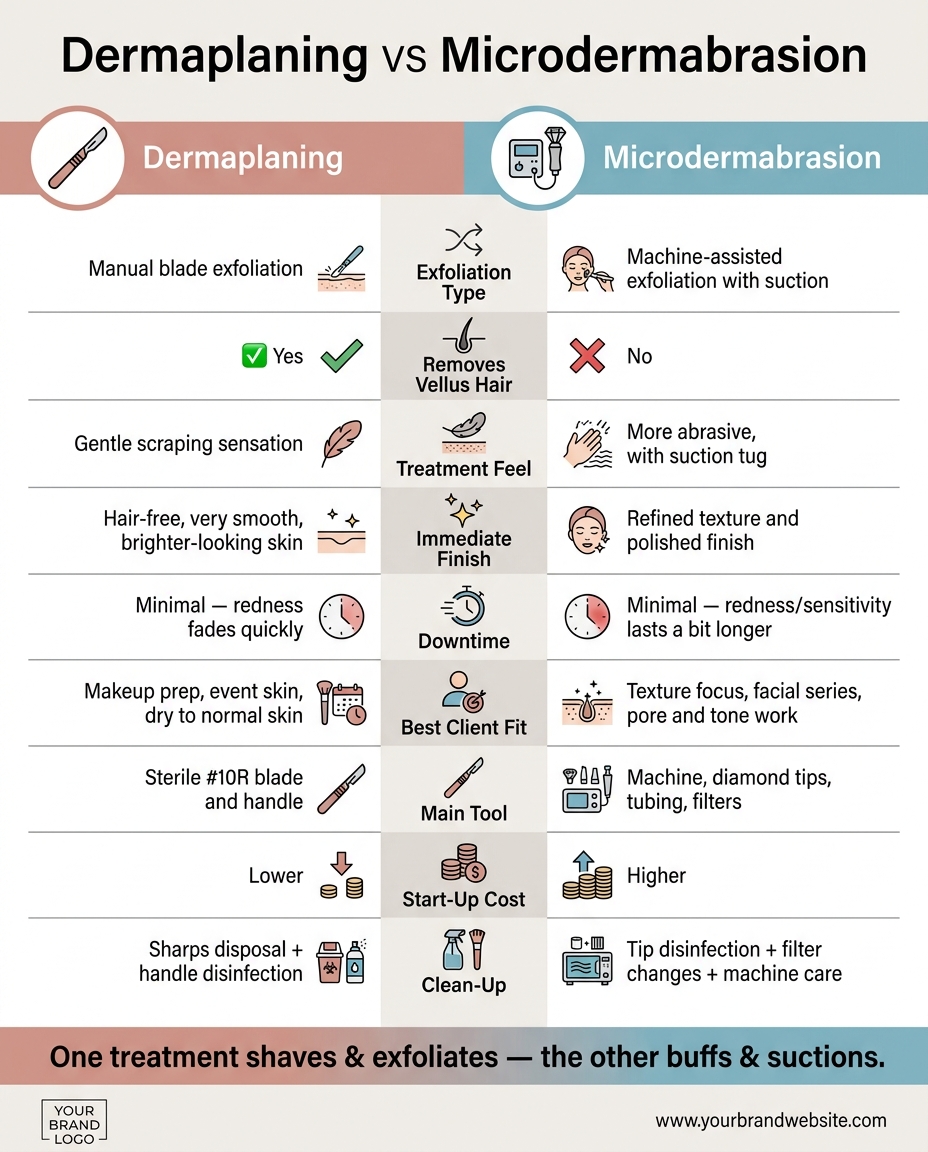
Dermaplaning vs Microdermabrasion: Side-by-Side Comparison
| Factor | Dermaplaning | Microdermabrasion |
|---|---|---|
| Exfoliation type | Manual blade exfoliation | Machine exfoliation with suction |
| Removes vellus hair | Yes | No |
| Skin feel | Light scraping | Grittier feel with tug from suction |
| Finish right after | Smooth, brighter-looking, hair-free | Polished feel and refined texture |
| Downtime | Low | Low, but can last a bit longer |
| Best fit | Makeup prep, event skin, dry to normal skin | Texture focus, facial series, pore and tone work |
| Main tool | sterile #10R blade and handle | Machine, tips, tubing, filters |
| Clean-up | Sharps disposal + handle disinfection | Tip disinfection + filter changes + machine care |
| Cost to start | Lower | Higher |
A good way to think about it: one treatment shaves and exfoliates, the other buffs and suctions. That single difference shapes the result, the client match, and the room setup.
Dermaplaning vs Microdermabrasion: Side-by-Side Comparison
Here’s a clear look at how the two treatments stack up.
| Factor | Dermaplaning | Microdermabrasion |
|---|---|---|
| Exfoliation Type | Manual blade exfoliation | Machine-assisted exfoliation with suction |
| Vellus Hair Removal | Yes | No |
| Treatment Feel | Gentle scraping sensation | More abrasive, with suction tug |
| Immediate Skin Finish | Hair-free, very smooth, brighter-looking skin | Refined texture and a more polished finish |
| Downtime | Minimal - mild redness usually fades quickly | Minimal - redness and sensitivity can last a little longer |
| Ideal Client | Clients seeking exfoliation plus vellus hair removal | Clients focused on texture refinement and polishing |
| Contraindications | Active acne, inflamed or infected skin, open lesions | Inflamed, infected, or compromised skin |
| Primary Tool | Sterile #10R blade and handle | Machine, handpiece, diamond tips, tubing |
| Consumables | Single-use blades, sharps container, PPE | Filters, tubing, crystals (if crystal-based) |
| Cleaning Needs | Dispose of blades in an approved sharps container; clean reusable handles with detergent and water before DIN- or NPN-approved disinfection | Change filters; clean and disinfect tips and handpieces; perform routine machine maintenance |
| Service Positioning | Stand-alone treatment or add-on for better product absorption | Stand-alone microdermabrasion treatment or part of a facial series |
Exfoliation Method, Skin Feel, and Results
Dermaplaning feels like a light, controlled scrape across the skin. You see the result right away: smoother, brighter-looking skin after the blade removes dead skin cells and vellus hair. That hair-free finish can also help makeup sit more evenly, which is a big reason some clients love it.
Microdermabrasion tends to feel stronger. The diamond tip or crystals create friction, while the suction adds a pulling sensation. At higher settings, some clients find it mildly uncomfortable. In exchange, the treatment gives the skin a deeper mechanical polish that can help improve texture and clarity.
Downtime, Contraindications, and Client Fit
Both treatments have minimal downtime, but they don’t always recover the same way. After dermaplaning, redness is usually mild and often settles down fast. After microdermabrasion, redness and sensitivity can stick around a bit longer.
The contraindications overlap, but they aren't identical. Dermaplaning is not suitable for active acne, inflamed or infected skin, or open lesions. Microdermabrasion should be avoided on inflamed, infected, or compromised skin. That’s why a careful skin check before the service matters. A small detail here can change which treatment makes more sense for the client’s skin and goal.
Tools, Consumables, and Cleaning Requirements
Dermaplaning usually costs less to get started. The main repeat expense is sterile single-use blades. After each treatment, every blade must go straight into an approved sharps container. Reusable handles need to be cleaned with detergent and water, then fully immersed in a DIN- or NPN-approved disinfectant bundle for use in Canada.
Microdermabrasion calls for more money up front because it relies on a machine. Day-to-day costs include replacing filters, disinfecting tips, and keeping up with routine machine maintenance. Put simply, one is a manual service with lower overhead, while the other depends on equipment and a more involved setup.
When Dermaplaning Fits Your Treatment Menu
Client Fit and Treatment Goals
If your treatment menu leans toward fast, polished results, dermaplaning is usually the easier fit.
It works well for clients who want a smoother makeup finish, especially if they’re booking for a special event, photos, or a makeup-based appointment. Think weddings, grad, brand shoots, or any day when someone wants their skin to look extra smooth up close.
Dermaplaning tends to suit normal-to-dry skin and clients booking for events, photos, or makeup application.
Room Setup, Supplies, and Turnover
Dermaplaning is pretty simple to set up. You don’t need much space, and there’s no machine, tubing, or bulky storage to deal with. That alone can make a big difference in a busy treatment room.
The main repeat supply is sterile, single-use #10R blades.
Turnover is also fast. After each service, discard the blade in an approved sharps container, then clean surfaces with a DIN- or NPN-approved disinfectant. Clean reusable handles and implements with detergent and water before disinfection.
If your menu calls for a more equipment-led exfoliation service, microdermabrasion is the next option to compare.
When Microdermabrasion Is the Better Choice
Client Fit and Treatment Goals
Microdermabrasion works well for corrective facials and treatment series, especially when a client has mild texture issues like post-acne roughness, enlarged pores, or uneven tone.
Compared with dermaplaning, it gives you more control. You can adjust the suction and choose different tips, which helps when you're treating clients with different skin thicknesses or levels of sensitivity. That kind of control can make a big difference in practice.
A skin analysis tool like a Wood's lamp can also help before treatment. It can show dehydration, oily zones, or extra layers of dead skin that may not be obvious at first glance.
In most cases, microdermabrasion is booked as a series rather than a one-off service. That gives you room to build a plan around the client's skin goals. At the same time, it comes with more equipment and upkeep than dermaplaning.
Equipment, Maintenance, and Operating Costs
Here’s the trade-off: microdermabrasion asks for more from the business side of your treatment menu.
Adding it to your services is a bigger commitment than dermaplaning. You’ll need a capital investment in a machine - either a diamond-tip or crystal-based system - along with the time and cost tied to reprocessing and upkeep.
reusable diamond tips need to be cleaned with detergent and water, then disinfected with a DIN- or NPN-authorized intermediate- to high-level disinfectant. Single-use items should be discarded after each client.
Before bringing in the service, check your provincial public health rules and your insurance requirements. Those day-to-day demands are a big part of why microdermabrasion fits a treatment menu differently than dermaplaning.
Conclusion: Choosing the Right Exfoliation Service for Your Clients
Choose the service based on the client’s main goal. If they want vellus hair removal and that instant smooth feel, dermaplaning is usually the better pick. If the focus is device-led texture refinement, microdermabrasion makes more sense. Put simply, hair-removal bookings and resurfacing bookings call for different services. Before either one, screen for skin that’s inflamed, infected, or compromised.
The business side matters too. Dermaplaning is lower cost to get started with, while microdermabrasion calls for a bigger equipment spend and more upkeep over time. Dermaplaning works well for quick, low-overhead, makeup-ready appointments. Microdermabrasion fits better into resurfacing programs and treatment plans. Beauty Pro Supplies Canada carries professional tools and training resources for both services.
FAQs
Which treatment is better for sensitive skin?
For sensitive skin, dermaplaning is usually the better pick. It works as a more controlled, surface-level exfoliation method. By contrast, microdermabrasion is more likely to irritate the skin because it uses stronger abrasion.
Choose dermaplaning when the goal is gentle smoothing without adding extra mechanical stress, especially for clients who are prone to redness or reactivity.
How often should I book each treatment?
Treatment frequency should come from a professional assessment of the client’s skin type, current condition, and overall appearance.
From there, build a custom treatment plan and book follow-up visits to keep care consistent. The right timing will depend on the client’s skin and how it responds over time. Beauty Pro Supplies Canada offers professional equipment and resources to support long-term skin health.
Can dermaplaning or microdermabrasion be added to a facial?
Yes. Dermaplaning and microdermabrasion can both be added to a facial service.
Estheticians often include both on their treatment menu. Microdermabrasion is usually offered as a facial service, while dermaplaning is used for exfoliation and hair removal as part of aesthetic treatments. Beauty Pro Supplies Canada carries professional microdermabrasion equipment and related facial tools.
Leave a comment