

Canadian-Made Beauty Products For Small Clinics
If I were stocking a small clinic in Canada, I’d start lean: one skincare line, monthly-use disposables, a few checkout retail items, and only the support tools tied to current services.
The reason is simple. Small clinics need to control cash flow, shelf space, and reorder timing at the same time. In this article, I look at four buying groups that shape that decision most:
- Professional skincare for treatment results and service margins
- Disposables and consumables for hygiene and room turnover
- Retail add-ons for extra revenue at checkout
- Treatment support products and accessories for staff flow and client comfort
A few numbers show the pattern fast:
- A C$29.95 peel can support a C$99–C$149 service
- Skincare retail can sit around 40%–50% markup
- Retail add-ons often land in the 40%–60% margin range
- CaviWipes 2.0 can cost C$0.17 per wipe in a 160-count canister
- Disposable facial wraps can be as low as C$0.05 each
- Support tools can start around C$45.00–C$80.00 before moving to larger equipment at C$210
What matters most is not buying the most products. It’s buying the right mix for the services you already do. A lean SKU count, clear CAD pricing, and local restocking can help cut stockouts, avoid dead stock, and keep day-to-day work tidy.
Quick Comparison
| Category | Main job | Cost pattern | Space use | Stock risk |
|---|---|---|---|---|
| Professional skincare | Treatment results and home care sales | Medium upfront spend | Low to medium | Higher if range is too large |
| Disposables & consumables | Hygiene and compliance | Repeat monthly spend | Medium in bulk | Low for core items |
| Retail add-ons | Extra checkout revenue | Low to medium upfront spend | Low | High if demand is guessed wrong |
| Support products & accessories | Better room setup and service flow | One-time purchase | Low to medium | Medium, mostly from duplicate buying |
If I had to sum it up in one line, it would be this: buy for your current treatment menu, keep each SKU tied to at least two uses, and reorder in small, steady cycles.
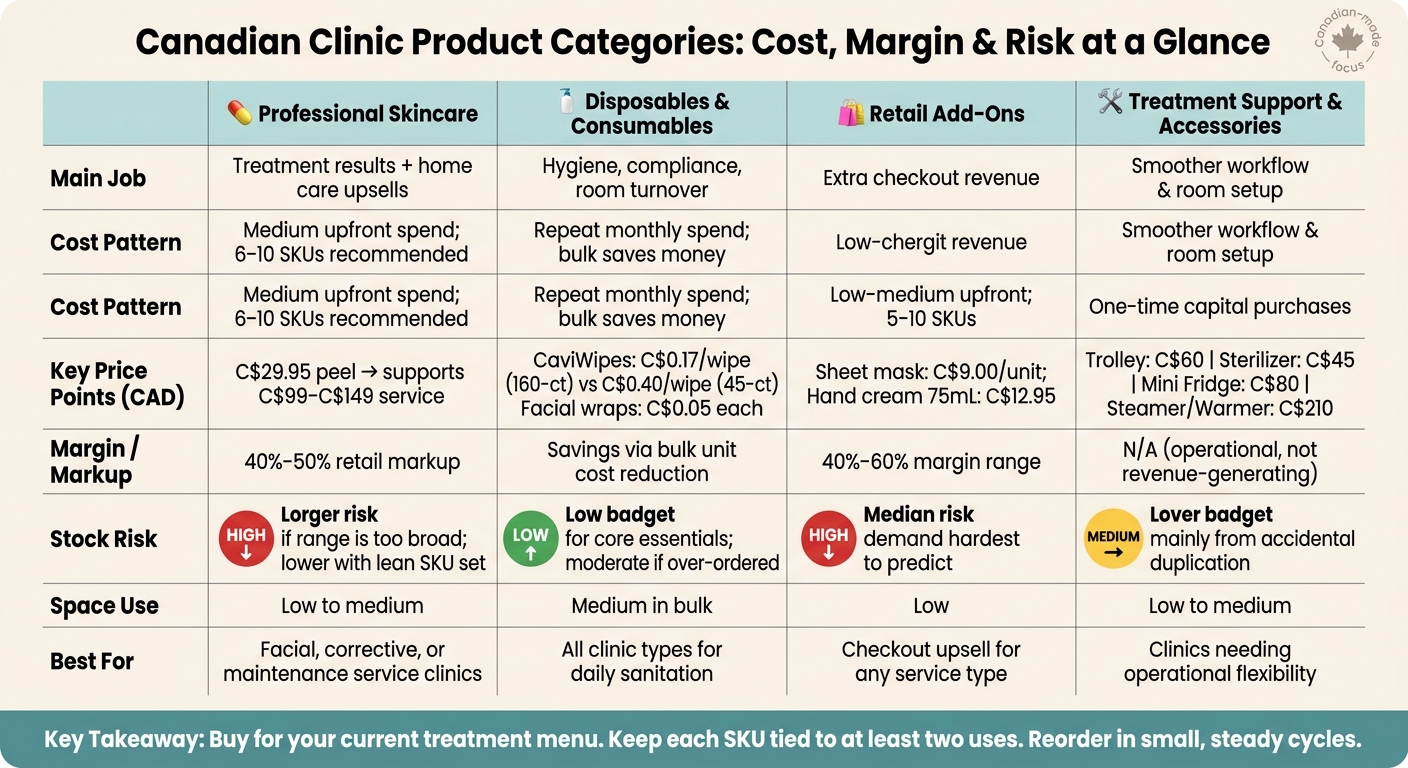
Canadian Clinic Product Categories: Cost, Margin & Risk at a Glance
1. Canadian-Made Professional Skincare
Budget Impact
Canadian professional skincare lines often support 40%–50% retail markup, so it makes sense to begin with 6–10 SKUs instead of buying a full range all at once. That keeps your opening order tighter and your cash flow under less strain.
Here’s why treatment-room skincare should come first: a C$29.95 peel that can support a C$99–C$149 service gives you a lot more room to work with than retail alone.
Once the margin checks out, the next thing to look at is storage.
Storage Footprint
Most Canadian professional skincare lines come in 30 ml serums and 50–100 ml moisturisers, which helps when space is tight. A simple setup works best: organise your backbar by protocol, not by product type.
So instead of putting all cleansers in one spot and all serums in another, group the products for a "brightening facial" or "barrier rehab" into one small tray or bin. It’s a small shift, but it keeps the treatment room neater and saves staff from digging around for the right item in the middle of a service.
That kind of compact setup only works well if the line also handles the treatments you do most.
Clinical Utility
Canadian lines such as Vivier, AlumierMD, Aliquote Skin, and Biomedika cover the clinic needs that come up again and again: ageing, acne, sensitivity, and pigment.
You don’t need a huge assortment to handle those cases. A focused essentials bundle can do the job:
- a multitasking cleanser
- a Vitamin C serum
- a hyaluronic or peptide serum
- a barrier moisturiser in two textures
- a broad-spectrum SPF
That kind of edit supports multiple protocols without stuffing your shelves with slow-moving stock.
The best lines also make daily use easier for the team.
Day-to-Day Simplicity
Canadian distributors such as Beauty Pro Supplies Canada offer online training and educational resources, which can help small teams standardise protocols in less time. Biomedika's alignment with Health Canada regulations, ISO, and GMP standards also cuts some of the guesswork around what fits a medical-aesthetic setting.
When the protocol system is clear, the day runs more smoothly. Tray setup is faster. Reordering is simpler. Staff training takes less time. In a small clinic, that matters a lot. Clear roles, fewer decisions, and faster staff training are what make a focused Canadian skincare assortment a better fit than a larger range that’s harder to manage.
sbb-itb-8ec3e54
2. Canadian-Sourced Disposables and Consumables
If skincare helps drive treatment value, disposables help protect margins. They do it in a simple way: by keeping compliance on track and helping staff move faster between clients.
Budget Impact
For small clinics, Canadian-sourced disposables are less about branding and more about staying on top of reorders, paying in CAD, and knowing the cost per treatment ahead of time.
CaviWipes 2.0 costs C$0.17 per wipe in a 160-count canister, compared with C$0.40 per wipe in a 45-count flat pack. That makes the canister the better fit for high-volume rooms, where staff go through wipes all day. Flat packs make more sense in secondary rooms, where usage is lower and space can be tighter.
Single-use consumables can cost more at the start. But they often help cut waste and lower the chance of products expiring before they’re used.
Storage Footprint
Flat packs save space, reseal cleanly, and slide easily into drawers or mobile kits. Canisters tend to work better in busy treatment rooms, where a pop-up dispenser can shave off a few seconds between clients. That may not sound like much, but over a full day, those small time savings add up.
Disposable facial mask wraps are another easy example. At C$0.05 per item, sold in 100-count packs for C$4.95, they take up very little space and are simple to rotate.
Space savings matter most when the product also helps support clinic-grade compliance. Saving room is nice. Saving room and keeping workflow clean is better.
Clinical Utility
Single-use items are mandatory compliance costs under Canadian infection-control guidance. After one client, they cannot be reprocessed.
A DIN-listed disinfectant such as CaviWipes 2.0 (DIN 02242209) gives clinics a clear compliance benchmark, and its 2-minute contact time helps keep room turnover moving. For sharps disposal, a 5.4 qt sharps container at C$14.95 is a plain, compliant option for injectables and minor aesthetic procedures.
Day-to-Day Simplicity
Pre-saturated wipes and pre-measured kits cut handling steps. That matters in the middle of a busy day, when staff don’t have time for extra prep or messy workarounds.
Same-day shipping from Halifax also makes smaller, more frequent reorders easier. That’s useful when storage space is tight and there’s no room in the budget for a dedicated inventory manager.
Once disposables are under control, the next question is which retail items can add revenue without adding storage pressure.
3. Canadian Retail Add-On Products
Once hygiene items are in place, retail add-ons are one of the simplest ways to bring in more revenue per visit without adding treatment rooms. You’re not adding appointments, staff, or floor space either. You’re just offering small products that fit the service the client already came in for.
The best approach is simple: stock compact items that match the treatment just delivered.
Budget Impact
Retail add-ons don’t take much to get started. A Renew + Refine Facial Sheet Mask retails at C$9.00 per unit, and an LCN Hand Cream (75 mL) retails at C$12.95. Those price points feel easy for many clients at checkout, especially when the product connects directly to their service.
There’s room for profit too. Most retail categories in this space carry margins in the range of 40–60%. That means even a small shelf with 5–10 SKUs can lift per-visit revenue in a meaningful way without a big upfront spend. A smart starting point is a short lineup of take-home items linked to your core services.
Storage Footprint
If your clinic is tight on space, this setup still works. Flat-pack items are easy to store and display. Sheet masks, 75 mL hand cream tubes, and small-format serums can fit on a single wall shelf or a compact display near the payment desk.
Clinical Utility
The strongest retail products don’t feel random. They connect to the service the client just had.
A sheet mask suggested as a take-home recovery step after an anti-ageing facial makes sense. So does a post-wax ingrown serum offered at checkout. These products support the treatment, help clients maintain results between visits, and make your retail shelf feel useful instead of pushy.
Clinics that offer hair removal, facials, or body treatments can each build a small retail set that lines up with those services.
Day-to-Day Simplicity
Clear, informative labels make a big difference. Staff spend less time explaining what a product does and how to use it. Pre-packaged, single-use items also cut out measuring and prep, which keeps things easy during a busy day.
Ordering through Beauty Pro Supplies Canada adds another layer of convenience. With no minimum order and free shipping over C$199, reordering stays simple and easier to plan for.
4. Canadian Treatment Support Products and Accessories
After skincare, disposables, and retail, the next step is figuring out which support items make the workday smoother without eating up too much cash or storage. Treatment support products, like facial tools, sterilisation equipment, storage carts, and room accessories, have a direct effect on service speed, consistency, and room turnover.
Unlike skincare or disposables, these products don’t usually bring in revenue on their own. That’s not the point. Their job is to remove friction from daily services. For small clinics, they usually make sense after core skincare and disposables, but before bigger décor purchases or nice-to-have upgrades.
Budget Impact
These are capital purchases, which makes them easier to phase in than repeat-use consumables. A 3 Shelf Plastic Trolley costs C$60.00, a Glass Bead Sterilizer comes in at C$45.00, and a Mini Cosmetics Fridge is C$80.00. Higher-cost items like a Facial Steamer or Towel Warmer are C$210 each, but they’re reusable and made for long-term use.
A simple approach works best here:
- Start with low-cost hand tools
- Add a facial steamer or towel warmer only when service demand supports the spend
Once spending is under control, storage is the next thing to look at.
Storage Footprint
Many of these items are easy to store if you choose carefully. Silicone bowls stack neatly. Four-piece facial sets store as one kit. Dermaplaning handles and blade boxes sit cleanly inside an instrument tray.
A mobile trolley can also do a lot of heavy lifting. It clears shelf space, keeps tools in order, and moves from room to room without forcing you to buy duplicates. For most clinics, one compact kit per treatment room is enough: a facial kit, timer, and applicators.
Clinical Utility
These tools help with precision, hygiene, and client comfort, but only if they line up with services the clinic already performs. Timers and measuring scoops help keep chemical peel exposure times accurate and repeatable. Dedicated bowls and spatulas reduce direct jar contact, which supports proper hygiene protocols.
Facial ice globes can help settle redness and discomfort after exfoliation or stronger treatments. That makes them a smart add-on for clinics that already offer peels or skin treatments. Dermaplaning handles also matter. They allow controlled, steady exfoliation that’s hard to match without the proper tool.
The tools that save the most time are usually the ones that are also easy to clean and reset.
Day-to-Day Simplicity
Pick accessories staff can clean, reset, and use without extra instruction. Silicone bowls rinse clean in seconds. Pre-assembled facial sets put everything in one place before the client even walks in. And when tools and small equipment are ordered together, restocking gets a lot less annoying.
That kind of simplicity matters more than people think. If a tool slows setup, adds cleaning steps, or creates clutter, it stops helping pretty fast.
Pros and Cons of Each Product Category for Small Canadian Clinics
There’s no one-size-fits-all starting point for a small clinic. The smarter move is to look at how each product category affects cash flow, storage, and the odds of inventory sitting on the shelf too long.
If space is tight and every dollar matters, this comparison helps show which category makes sense to buy first.
| Category | Pros | Cons | Ideal Use Case |
|---|---|---|---|
| Professional Skincare | Helps shape a signature treatment menu and creates room for retail upsells | Expiry risk; sell-through can be slower if you stock too many variants - risk is high with a broad range, lower with a lean SKU set | Clinics offering repeat facial, corrective, or maintenance services |
| Disposables & Consumables | High turnover; steady demand; moderate bulk buying can lower unit cost | Over-ordering can lock up cash and fill limited storage fast - risk is low for essentials, moderate beyond monthly usage | Daily sanitation, application, and infection control |
| Retail Add-Ons | Can lift average ticket value and support post-treatment continuity | Hardest to forecast; dead stock risk if products don’t match client needs - risk is high, as demand is least predictable in a small clinic | A small, curated assortment at checkout or for home care |
| Treatment Support Products & Accessories | Durable, reusable, and useful for smoother workflow | Easy to duplicate by accident; some items need upfront investment - risk is moderate, with duplication as the main issue | Clinics that need operational flexibility without major capital purchases |
Here’s the simple pattern: risk goes up when products move slowly or expire before they’re used. That’s why many small clinics do better with a lean skincare core first, then fast-turn consumables in moderate bulk, and support items later. Use that order to guide your next purchase cycle. You can browse our full catalog of professional supplies to find the right mix for your clinic.
Conclusion
Your best starting point comes down to the treatments your clinic will actually provide.
A start-up facial clinic should begin with one main Canadian professional skincare line, a small amount of must-have disposables, and just a few retail products that match what clients get in the treatment room - a cleanser, an SPF, and one targeted serum. That keeps your opening inventory lean and avoids tying up cash in products that sit on the shelf.
An injectables-focused clinic should put medical-grade disposables and sterile consumables first. Skincare can stay limited to pre- and post-procedure products that help with healing and barrier repair.
A small multi-service medspa needs one Canadian skincare line that works across facials, light body treatments, and post-procedure care. It also makes sense to choose shared-use disposables and support equipment instead of buying duplicates for every room.
No matter which of these three clinic types you're building, the same rule holds: build around your actual treatment menu, not around what might sell someday. Buy with two uses in mind. Every SKU should support at least two protocols.
FAQs
How many SKUs should a small clinic start with?
There’s no fixed number to aim for. Your starting inventory should match how fast you use items, how much space you have, and what your budget can handle.
Instead of chasing a set SKU count, set minimum stock levels for the items you can’t do without. Base those levels on your average usage and your supplier lead times. A smart place to start is with essential, high-turnover products so you don’t overbuy but still have enough stock ready when you need it.
Which product category should I buy first?
For small clinics working with tight budgets and not much storage, it makes sense to start with the basics: hygiene and disinfection supplies. That’s the stuff you use every day, and it helps keep your clinic safe, clean, and ready for audits. In Canadian clinics, that isn’t optional. It’s part of the job.
Buying from a trusted partner like Beauty Pro Supplies Canada can make that job a lot easier. You get access to professional-grade products without wasting time second-guessing quality. And if storage is tight, space-saving options like flat-pack disinfectant wipes can help. They take up less room, but still keep you ready for day-to-day clinic work.
How often should I reorder clinic supplies?
Set your reorder frequency based on two things: average usage and supplier lead times. That helps you refill stock before you run short, without piling up extra items in limited storage.
Review those levels on a regular basis. Demand can shift with trends and seasonal changes, so a reorder point that worked a few months ago might not fit now.
If you use inventory software, it can monitor usage in real time and create purchase orders when stock hits your preset thresholds.
Leave a comment