

Ultimate Guide to Esthetic Treatment Beds
If I had to narrow it down to one rule, it would be this: pick your treatment bed based on your services, your room size, and how often staff need to change positions during the day.
For most Canadian spas and clinics, the choice comes down to manual, hydraulic, or electric. Manual beds fit lower-cost facial and waxing setups. Hydraulic beds make height changes easier. Electric multi-motor chairs make more sense for laser, injectables, and mixed treatment menus where staff need more control over height, backrest, leg rest, and tilt.
I’d also check a few numbers before buying:
- Weight capacity: often 150–250 kg (330–550 lb)
- Height range: often 60–90 cm (24–35 in.)
- Bed size: often 180–200 cm long and 55–78 cm wide
- Working clearance: about 75–90 cm (30–36 in.) around the bed
- Room target: at least 2.7 m × 3.3 m, with 3 m × 4 m giving more usable space
A good bed is not just about comfort. It also affects staff posture, client entry, cleaning speed, cable safety, and how long the upholstery and motors last. In Canada, I’d also confirm 120 V power, grounded or GFCI outlets where needed, disinfectant compatibility, and CSA or similar certification before placing an order.
Techniques for the Perfect Facial Bed Setup | Associated Skin Care Professionals
sbb-itb-8ec3e54
Quick comparison
| Bed type | Best fit | Main adjustment | Best for |
|---|---|---|---|
| Manual | Lower-budget rooms | Levers, pins, cranks | Facials, waxing, short flat treatments |
| Hydraulic | Mid-range setups | Foot-pump height + manual sections | Busy facial rooms, waxing |
| Electric | Higher-use clinics | Motor controls by handset or pedal | Laser, injectables, advanced skincare |
What I’d focus on first
- Service menu: facials and waxing need less positioning than injectables and laser
- Build quality: steel or iron frames, high-density foam, smooth non-porous upholstery
- Cleaning: PU, PVC, or medical-grade vinyl must match your disinfectants
- Ergonomics: staff should not spend all day reaching, bending, or twisting
- Room fit: measure the full working footprint, not just the listed bed size
- Total budget: include C$ purchase price, delivery, assembly, and a maintenance reserve
That’s the short version: buy the bed that fits your treatments, clears your room properly, handles daily cleaning, and supports staff through a full schedule.
1. Bed types and the treatments they support
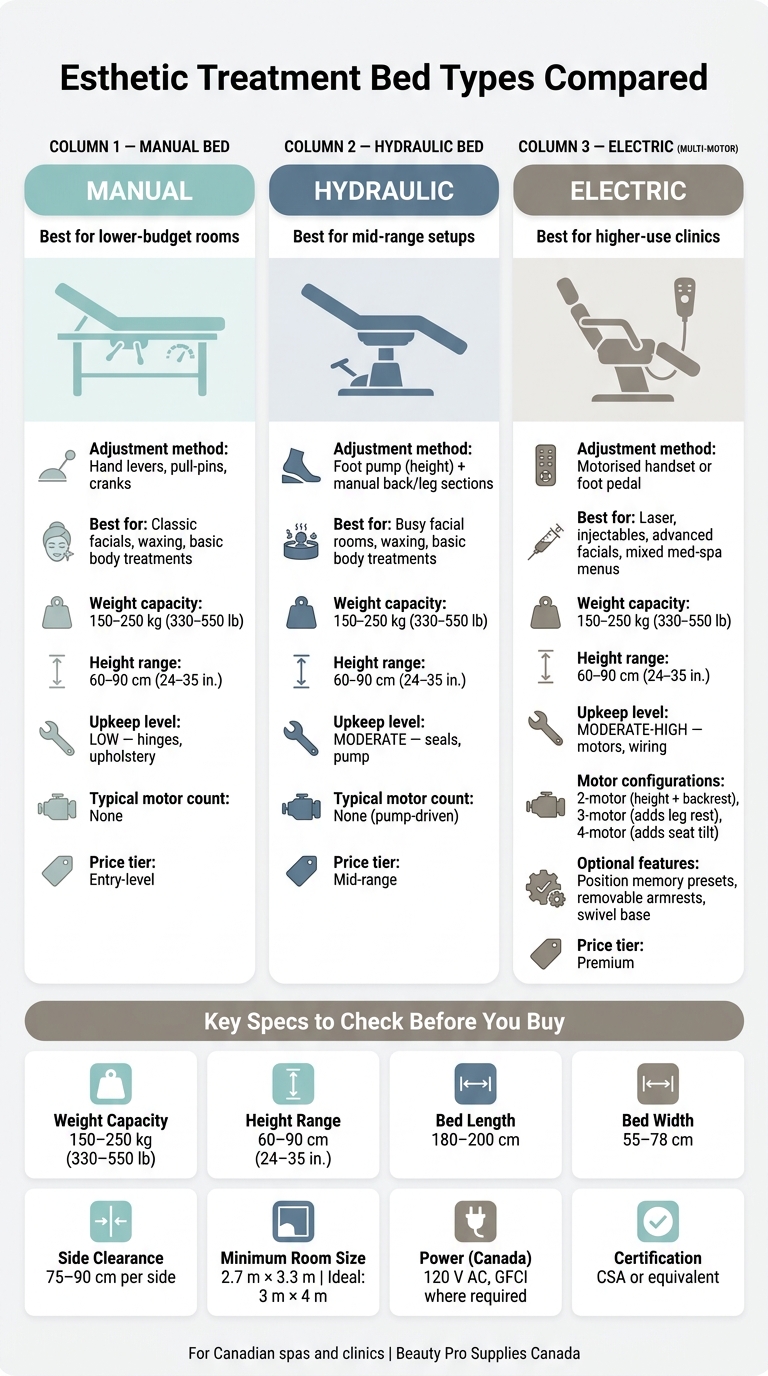
Esthetic Treatment Bed Types Compared: Manual vs Hydraulic vs Electric
Your service menu should guide this choice from day one. A clinic that mainly does classic facials and waxing needs something very different from a med-spa that offers laser treatments and cosmetic injectables. If you pick the right bed or chair early, your team can work the way they want now without swapping out furniture later when the menu expands.
Manual, hydraulic, and electric beds compared
The big difference comes down to how each bed adjusts and how much work that takes from the practitioner. Manual beds use levers, pull-pins, or cranks to move the backrest and, in some cases, the leg rest. They tend to be the lowest-cost option and fit shorter services where the client stays mostly flat.
Hydraulic beds use a foot pump for hands-free height changes, which can make day-to-day work a lot easier. Electric beds use one or more motors, controlled by a handset or foot pedal, to give smooth and exact positioning.
Use the comparison below to line up the bed type with the treatments you offer.
| Bed Type | Typical Treatments | Adjustment Method | Typical Upkeep |
|---|---|---|---|
| Manual | Classic facials, waxing, basic body treatments | Hand levers, pull-pins, cranks | Low - hinges, upholstery |
| Hydraulic | Facials, waxing, basic body treatments | Foot pump (height) + manual back/leg | Moderate - seals, pump |
| Electric (single or multi-motor) | Laser, injectables, advanced facials, mixed med-spa | Motorised handset or foot pedal | Moderate-high - motors, wiring |
Multi-motor chairs for advanced skincare and injectables
Go with a multi-motor chair when treatments call for frequent position changes or tighter control over angles and height. A 2-motor chair controls height and backrest separately, which suits advanced facials, peels, and light injectable work. A 3-motor chair adds separate leg-rest control, which helps with comfort during longer injectable or laser sessions. A 4-motor chair gives separate control of height, backrest, leg rest, and seat tilt. That setup works well for mixed service menus that shift fast between upright consults and near-flat treatment positions.
A few add-ons can also make a big difference. Removable armrests help with access. Swivel can save space and make room layout less awkward. Some premium electric chairs include position memory presets, so staff can move between saved settings for different services without fiddling with controls each time.
Matching the bed to your service menu
For facials and waxing, manual or hydraulic beds are often enough. For lashes and brows, a stable semi-reclined bed or chair with solid head and neck support usually makes more sense. For laser and injectables, electric positioning is the better fit because it gives repeatable control over height and angle.
After you’ve chosen the bed type, the next things that matter are frame quality, foam, upholstery, and adjustment range. Those details shape comfort over time and how well the bed holds up under daily use.
2. Materials, dimensions, and adjustment features
Once the bed type is set, look closely at the build details that shape comfort, hygiene, and how the room works day to day. After you’ve picked the right bed style, the next filter is simple: materials, dimensions, and adjustment range.
Frame, foam, upholstery, and weight capacity
The frame sets the tone for stability, lifespan, and how the bed feels in daily use. Most professional treatment beds use a steel or iron frame, and for good reason. These frames tend to hold up better under regular use than lighter-duty options.
Across professional models, weight capacity often falls between 150 kg and 250 kg. That number should cover both client weight and the pressure applied during treatment. If your services involve more hands-on work, this spec matters more than it may seem at first glance.
High-density foam is the usual fill for professional beds because it helps the surface keep its shape over time and supports client comfort during longer appointments.
Upholstery plays a big role too. It affects comfort, cleaning, and how well the surface holds up against oils and disinfectants. In practice, you want something smooth, non-porous, and able to handle the disinfectants your team already uses. Here’s how the three common options compare:
| Upholstery Type | Feel | Durability | Cleanability | Typical Use Case |
|---|---|---|---|---|
| PU (polyurethane) | Softer feel, comfortable for clients | Good for regular use; confirm disinfectant compatibility | Easy to wipe clean | Facial beds and general esthetic use |
| PVC | Firmer feel | Practical for busy rooms and frequent wipe-downs | Very good - more wipeable and cost-effective | High-turnover treatment rooms |
| Medical-grade vinyl | Smooth, clinical feel | Strong option for frequent cleaning and disinfectant exposure | Best when infection control is the top priority | Medical aesthetics, injectables, and clinical settings |
Before you order, confirm which disinfectants the upholstery is rated for. If the surface doesn’t work with the products your team already uses, it can crack, peel, or discolour sooner than expected.
Height range, backrest, leg rest, and tilt options
Height range is one of the most practical specs to compare. Common adjustable ranges usually run from about 60–85 cm to 74–90 cm (about 24–35 in.), measured from the floor to the top of the cushion.
That lower end helps with safe client entry. The upper end matters for practitioner comfort during standing treatments. If a bed only adjusts within a tight range, staff may end up working in awkward positions all day. That’s the kind of small issue that turns into a big one by the end of the week.
Backrest and leg rest movement should be independent. A backrest that adjusts from 0° to 85–90° gives you room to move from fully flat to near-upright without having to reposition the client. A separate leg rest, often found on multi-motor chairs, gives more control for waxing, pedicures, and body treatments. If your services call for finer positioning, check whether the bed includes seat tilt as well.
Bed size and room fit
Most professional esthetic beds are between 180–200 cm long and 55–78 cm wide, or roughly 71–79 in. × 22–31 in. Width is easy to miss when you’re comparing specs, but it has a big effect on room flow. A narrower bed can free up useful space in a small treatment room. A wider one may be a better pick for larger clients or for body treatments where comfort matters more.
Try to plan for at least 75–80 cm of clear space on each working side so staff can move around the bed, reach the client easily, and reposition tools or equipment. At the foot of the bed, allow 80 cm to 1 m for client entry and exit.
Clearance around the bed matters just as much as the bed size itself. It affects access, movement, and where equipment can go. In a single-room spa or home studio, this spacing check often decides which bed will work - not length alone. In medical aesthetics clinics, you’ll also need room for carts, sharps disposal, and companion equipment. Use 2.7 m × 3.3 m as a minimum, and 3 m × 4 m is a better target if you want easier circulation.
These choices affect staff posture and how easy the bed is to clean and use from one appointment to the next. The next section moves into ergonomics, cleaning, and daily operation.
3. Ergonomics, cleaning, and day-to-day operation
Once the bed fits the room, the next step is simple: see how it holds up through a full treatment day.
Ergonomic setup for estheticians and injectors
Set the bed height so your shoulders stay relaxed, your elbows sit close to 90°, and your neck and lower back stay in a neutral position. Small setup changes can make a big difference by the end of the day.
For facials, keep the client’s face just below shoulder level. For waxing, bring the bed up to about mid-thigh or hip height. For injectables, a semi-reclined position works well because it keeps the treatment area at eye level. For lash work, quick head-end adjustment helps, and so do short posture breaks between clients.
It also helps to change positions through the day. Switching between sitting and standing, plus taking short micro-breaks between clients, can cut down on strain that builds over time. Canadian occupational health guidance puts a lot of weight on this approach in salon and spa settings.
After posture, the next thing to check is how fast staff can clean and reset the bed.
Cleaning and disinfection by upholstery and bed type
Start by removing visible soil. Then disinfect using Health Canada–registered products, and keep the surface wet for the contact time listed on the label. On PU and vinyl, skip bleach, solvents, and abrasive products. On electric beds, put disinfectant on a cloth instead of spraying it onto the unit, and turn the bed off and unplug it before cleaning around controls and cables.
A bed can feel great on day one and still become a headache later. That’s why it’s smart to ask how it handles daily reset, not just how it feels in a showroom.
| Frequency | Upholstery & Surfaces | Hinges & Joints | Hydraulics / Motors | Controls (Hand/Foot) | Base & Stability |
|---|---|---|---|---|---|
| Daily | Wipe with approved cleaner/disinfectant; check for cuts or cracks | Confirm smooth movement; listen for unusual noises | Test height and backrest movement briefly | Confirm all buttons/pedals respond; check for cord strain | Check level; lock wheels. |
| Weekly | Inspect seams and stitching; note wear areas | Check that screws and bolts are tight | Run full range of motion; note any lag or vibration | Check cables for damage. | Check casters or glides for wear |
| Monthly | Evaluate cushioning firmness; replace damaged covers | Lubricate only if manufacturer instructions allow | Check for leaks or overheating. | Test emergency stop if present; clean control interfaces | Perform a full stability check at maximum height and tilt |
Post a laminated protocol in each treatment room based on the manufacturer’s instructions and provincial guidance. That keeps the process consistent across staff and makes training much easier.
Cleaning is only half the job. The electrical system also needs to suit daily use.
Electrical and mechanical checks before you buy
Check the bed’s voltage and amperage against the outlet capacity in the room. Most units use 120 V AC. In rooms where water is used often, GFCI outlets are the right fit and line up with Canadian electrical safety expectations.
Cord placement matters more than many buyers expect. Match the cord exit to the room layout, and keep cables out of walkways. Run cords along walls or under cord covers, away from the paths staff and clients use all day.
Control style also affects day-to-day use:
- Foot pedals work well when you need hands-free adjustment, especially during injectables or advanced facials.
- Hand remotes should be stored in a holster to avoid damage or accidental activation.
- Built-in side panels look tidy, but they can be harder to reach from the opposite side of the bed or when a client is sitting upright.
Test the bed through its full range of motion. If a motor jerks, lags, or runs loudly, pass on it. Check for overload protection and, in med-spa settings, an emergency stop function. Look for CSA or equivalent certification, and confirm that parts and service support are available before you buy.
4. Budget planning and buying criteria for Canadian businesses
What drives price from entry-level to premium
Once ergonomics and day-to-day use are sorted out, price tends to become the last big filter. And the jump can be steep. Portable tables sit at the lower end, while electric clinical beds land much higher.
That price gap usually comes down to a handful of things: motor count, frame strength, upholstery grade, warranty length, and overall build quality. In plain terms, the more work the bed needs to do, and the more often it needs to do it, the more the price climbs. It makes sense to match the bed’s capacity to your heaviest client load and the level of treatment pressure you expect each day.
A lower upfront cost can make sense for a low-volume lash room or a basic facial setup. But in a busy treatment room, a cheaper bed can end up costing more over time. Foam can wear down. Upholstery can crack or stretch. Mechanical parts can get tired faster than expected.
That’s where warranty terms start to matter. Entry-level beds often come with shorter coverage and limited parts support. Premium models often include multi-year warranties on frames and motors. Over time, that changes the cost per treatment across the life of the bed.
A buyer checklist before placing an order
Before you place an order, it helps to check the practical stuff first. These are the details that often seem minor - until delivery day arrives and something doesn’t fit, plug in, or work for your room.
| Checklist Item | Why It Matters | What to Confirm Before Purchase |
|---|---|---|
| Treatment types | Determines motor and tilt needs | Does the bed support every service on your current and future menu? |
| Room dimensions | Affects workflow and safety | Is there 75–90 cm (30–36 in.) of clearance on all sides for staff movement? |
| Weight capacity | Client safety and equipment longevity | Does the bed meet the maximum weight requirements for your clientele? |
| Grounded outlets and safe cord placement | Electric beds need grounded outlets nearby | Are outlets positioned to avoid cord hazards? |
| Upholstery compatibility | Infection control and durability | Is the surface compatible with medical-grade disinfectants? |
| Warranty and service | Protects your investment | Is the warranty in writing? Are Canadian service contacts available? |
| Delivery and assembly | Prevents costly delays | Will the unit fit through your doors or elevator? Is assembly included? |
| Lead time | Avoids gaps in your booking schedule | Is the item in stock, or is it a special order that adds extra lead time? |
| Insurance and compliance | Legal and liability protection | Does your insurer approve treatments on this bed type? Does it meet provincial health and safety standards? |
A checklist like this can save you from expensive mistakes. For example, a bed might look perfect online, but if it can’t clear your elevator or doesn’t work with your disinfecting routine, that “good deal” can fall apart fast.
Buying from a Canadian professional supplier
Beauty Pro Supplies Canada offers professional beauty, medical, and spa equipment, along with training resources for estheticians, injectors, and clinic owners.
Once your budget and supplier criteria are narrowed down, the next step is simple: match the bed to your services, your room, and the way your team works each day.
Conclusion: Choosing the bed that fits your services, room, and workflow
Start with your service menu. Electric multi-motor chairs are a better fit for injectables and advanced skincare, while hydraulic beds make sense for busy facial rooms where turnover matters.
Once you know the right service fit, look at materials. Go with medical-grade PU or vinyl that can handle repeated disinfection. Add high-density foam, and you get a surface that keeps clients comfortable during longer treatments without wearing out too fast.
Then there’s ergonomics. This part matters more than many buyers expect because it affects staff fatigue and treatment quality over a full day. Pick a height range and adjustment setup that works for both seated and standing treatments.
Before you place an order, check the room layout against the bed’s full working footprint. Measure the room with the bed in its full working position, not just its folded size. It also helps to mark the footprint on the floor before ordering so there are no surprises on install day.
Your C$ budget should cover the whole picture:
- Purchase price
- Delivery
- Installation
- A maintenance reserve
Choose the bed that fits your services, is easy to clean, supports staff posture with a luxury comfort stool, and works in the room you have. That choice can pay off through smoother workflows and fewer replacements. Beauty Pro Supplies Canada carries professional treatment beds and equipment for Canadian spa and clinic environments.
FAQs
Which bed type suits my treatments?
Choose a treatment bed that fits the services you offer and how hands-on those treatments are.
If your practice focuses on facials, a facial bed or treatment chair usually gives you the comfort and access you need. For full-body services, massage tables or multi-functional treatment beds tend to work better because they support different client positions and treatment methods.
It’s also worth checking that the bed works well with Health Canada sanitization protocols. Look for surfaces that are easy to wipe down and use disposable covers between clients.
How much room do I need around a bed?
Leave enough room around the treatment bed so people can move safely and comfortably on every side. The practitioner needs easy access to the client, space to adjust equipment, and room to carry out treatments without feeling boxed in.
How much space you need will depend on the size of the room and the equipment you use. Still, the goal stays the same: avoid a cramped layout and make day-to-day workflow feel smooth and easy.
What should I check before buying an electric bed?
Before you buy an electric treatment bed, make sure it meets the Health Canada standards and safety rules that apply to your setting. It’s also smart to check with your insurer first, so you know the bed fits your coverage and won’t cause issues later.
You’ll also want to look closely at the supplier. Are they dependable? Do they provide clear documentation? That paperwork matters more than people think.
On the practical side, check that the bed has a non-porous surface so it can be cleaned and disinfected properly. And don’t gloss over the adjustment options. The right features can make a big difference for both your treatments and your own ergonomic support during a long day.
Leave a comment