
Ultimate Guide to Client Consultation Techniques
A weak consultation can lead to poor results, consent issues, and lost repeat visits. In Canadian beauty settings, I treat the consultation as the part that sets safety, price, timing, and client expectations before any service starts.
Here’s the short version:
- I ask open questions first, not yes/no questions
- I check goals, health history, allergies, medicines, and past reactions
- I assess the area under proper lighting before I confirm any service
- I explain results, limits, risks, aftercare, and total cost in $CAD
- I get written consent before treatment
- I record findings the same day and store them under PIPEDA and, in Quebec, Law 25
- I stop or delay the service if there is a clear contraindication
A few facts shape the process. Patch tests are often read at 24 to 48 hours. In Quebec, records noted in the article should be kept for at least 5 years after the last treatment, or 5 years after a minor reaches the age of majority. Dates should stay consistent across forms, such as 06/07/2026.
What matters most is simple: listen first, assess carefully, explain clearly, and document everything. That approach helps across hair, skin, nails, and injectables, even though each service needs its own notes and risk checks.
Below, I’ve pulled the article into a short, practical read so you can see the process from greeting to final record without all the extra detail.
Core Communication Techniques That Improve Consultations
Active Listening and Open-Ended Questions
Questions steer the whole consultation.
A closed question gives you a yes or no. An open question gives you the detail you need to do the job well. So instead of asking, “Do you like your current colour?”, try something like, “What do you like least about your hair right now?” or “Walk me through your usual morning routine.”
That small shift changes everything. It helps you uncover the client’s goals, frustrations, lifestyle limits, and budget concerns, including the things they may not say on their own.
Try to let the client do most of the talking. That means holding back on advice too soon, even when you think you already know the answer. Listen first. Then paraphrase what they said before you respond:
"So if I understand correctly, you want something low-maintenance that still looks polished?"
This gives the client a chance to correct anything you got wrong before the service moves ahead. Miscommunication is one of the main reasons clients leave unhappy.
Bring up pricing early. Also explain if the result will take more than one visit. Those two habits help surface the client’s actual goals before you move into the assessment.
Clear Explanations, Non-Verbal Cues, and Expectation Management
Once you’ve listened, move into a clear explanation of the service in plain language.
Sit face-to-face instead of talking through the mirror. It feels more personal and makes eye contact easier. In those first 60 seconds, your posture, greeting, and level of attention do a lot of heavy lifting. A calm presence and warm tone can set the mood for the whole appointment.
When you explain the service, skip salon jargon. If you’d normally say you’ll “neutralise” the hair, say what that means in plain terms: a violet toner cancels out yellow tones. Simple wording helps the client follow along and feel part of the process.
If their goal will take multiple sessions to reach safely, say that up front. Don’t leave that part until the end. It’s far better to be clear early than to have the client feel blindsided later.
Pay attention to body language too. A client might say yes while their posture says something else. Hesitation, crossed arms, or less eye contact can point to doubt. When that happens, pause and ask what’s on their mind. Then confirm the main points in writing.
Respectful and Privacy-Conscious Consultation Language
Ask for the client’s preferred name and pronouns, and use them the whole way through the consultation.
This isn’t a side note. It’s part of how trust gets built from the first exchange. When clients feel respected early on, they’re usually more open during the rest of the conversation.
If you need to talk about health history, such as medications, allergies, pregnancy, or recent procedures, do it in private. Never discuss a client’s personal details in a shared or public part of your workspace.
Handling that information with care shows the client that their trust matters. Once the conversation is both clear and private, you can move into condition assessment and service planning. Using tools like a Woods Lamp during this stage can help identify underlying skin concerns that aren't visible to the naked eye.
sbb-itb-8ec3e54
Client Consultation
A Step-by-Step Consultation Process for Beauty Professionals
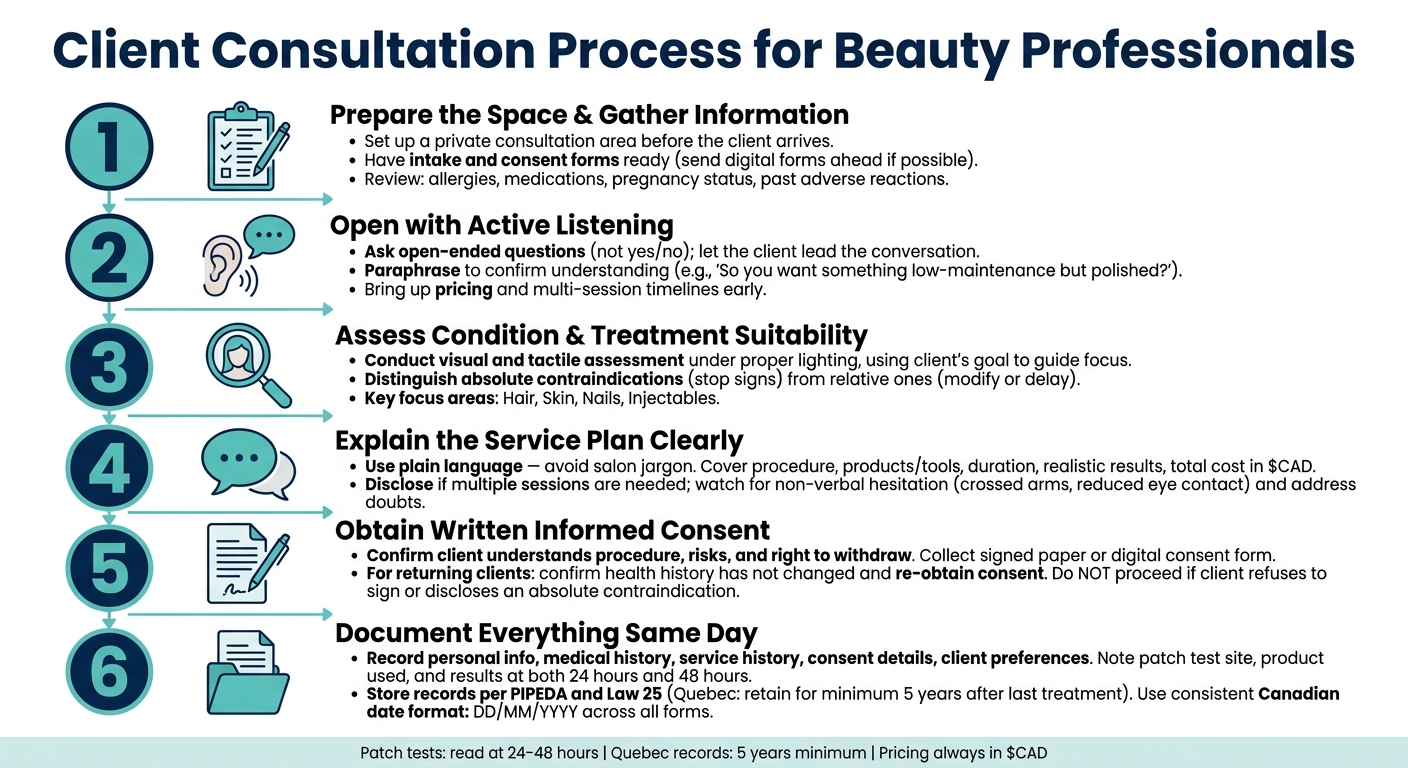
Client Consultation Process for Beauty Professionals: Step-by-Step Guide
Prepare the Space and Gather Client Information
After the consultation chat wraps up, move into a structured assessment. Set up a private consultation area before the client arrives, and have intake and consent forms ready. Keep any reference materials you use during the assessment close by too.
If you can, send digital intake forms before the appointment. That gives you time to review medical history, current product use, and lifestyle factors before the client is in the chair. It also helps you spot possible contraindications early instead of scrambling at the last minute.
At a minimum, your intake process should cover:
- allergies
- current medications
- pregnancy status, where relevant
- any past adverse reactions to treatments
With the paperwork in place, the next step is to connect the client’s goals to what the service can safely deliver.
Assess Condition, Goals, and Treatment Suitability
Once the client is settled, switch into assessment mode. The aim is simple: understand what the client wants and what their current condition can safely support.
Use the client’s stated goal to guide the assessment. If a client brings in an inspiration photo, ask what they like about it. Is it the colour, the texture, or the shape? That small question can save a lot of confusion and helps you tailor the look to their actual features instead of copying an image that may not suit them.
Then follow the discussion with a visual and tactile assessment under proper lighting with a magnifier. Different services call for different focus points:
| Service Type | Key Assessment Focus | Common Contraindications |
|---|---|---|
| Hair | Texture, porosity, elasticity, scalp health | Open lesions, positive patch test, severe damage |
| Skin | Fitzpatrick type, hydration, sensitivity | Active isotretinoin use, recent laser or dermabrasion |
| Nails | Structural integrity, signs of fungal infection | Onychomycosis, immunosuppression, psoriatic nail changes |
| Medical Aesthetics | Facial structure, procedure history, contraindications | Specific health restrictions, unrealistic expectations |
It also helps to separate absolute contraindications from relative ones. Absolute contraindications are stop signs. Relative contraindications mean you may need to adjust the service, delay it, or ask for medical clearance first.
Confirm the Service Plan and Obtain Informed Consent
Once you’ve confirmed suitability, restate the service plan in plain language before asking for consent. Go over the procedure, the products or tools involved, how long it will take, and what results are realistic. Be clear about the plan, the cost in Canadian dollars, and whether follow-up visits are needed.
Then get signed paper or digital consent confirming that the client understands the procedure, the risks, and their right to withdraw consent. For returning clients, confirm that their health history has not changed.
Documentation, Risk Assessment, and Specialty-Specific Records
Once consent is signed, write down the findings that support the service plan. This step matters. Your notes show what was disclosed, what was decided, and what happened during treatment. Each entry should make it clear why the service was approved, changed, or declined.
Store records in line with PIPEDA, Law 25, and local retention rules. In Quebec, keep records for at least 5 years after the last treatment, or 5 years after a minor reaches the age of majority. Use one Canadian date format across all intake forms, patch test logs, and consent forms, such as DD/MM/YYYY.
What to Record in Every Client File
Every client file should include the same core details, no matter the service, whether performed on a med-spa facial bed or in a styling chair. That kind of consistency makes it much easier to spot changes over time.
| Category | Required Information |
|---|---|
| Personal | Full name, date of birth, contact details |
| Medical | Allergies, current medications, pregnancy status, skin or scalp conditions |
| Service History | Past treatments, previous adverse reactions, current home-care products |
| Consent | Signed and dated authorization for the specific service, risk disclosure, photo release consent |
| Preferences | Goals, upkeep, budget |
For returning clients, update only the information that has changed and have them re-sign consent before each session.
How Consultation Findings Lead to Safer Treatment Decisions
Structured consultation notes help line up client expectations with what the service can safely deliver. This is where documentation does the heavy lifting. It turns consultation findings into treatment decisions.
The response should match the risk. Absolute contraindications - such as open lesions, contagious diseases, or a positive patch test reaction - mean the service must not go ahead. Relative contraindications call for a modified plan. In both cases, document the decision and the reason behind it.
| Risk Factor | Control Measure | Documentation Requirement |
|---|---|---|
| Skin irritation or allergy | Patch test 24 to 48 hours before service | Record the site, product used, and result at both 24 hours and 48 hours |
| Active infection or lesion | Postpone treatment; refer to a physician if needed | Note the location and appearance; record any referral given |
| Medication interaction | Substitute products or modify treatment intensity | List the medication and the adjusted protocol |
| Thin or sensitive skin | Modify treatment intensity or substitute products | Note the specific modifications made to the standard protocol |
| Unrealistic goals | Discuss achievable outcomes clearly | Document that realistic results were explained and accepted |
If a client refuses to sign a consent form or discloses an absolute contraindication, do not proceed. Record both the refusal and the exact reason in the file.
How Records Differ Across Hair, Skin, Nails, and Injectables
The main file structure stays the same across services, but each specialty needs its own set of details. Leave those out, and you create safety gaps.
| Service Type | Required Documentation Elements |
|---|---|
| Hair | Scalp assessment, PPD patch test results, formula ratios, processing time |
| Skin | Fitzpatrick skin type, current use of isotretinoin (e.g., Accutane) or retinoids, recent peel or laser history, peel depth in mm |
| Nails | Signs of onychomycosis, bleeding disorders, diabetes status, known sensitivities to monomers or acrylics |
| Injectables | Physician delegation protocols, product batch numbers, volume in mL, injection site maps, vascular risk disclosure, emergency protocol acknowledgment |
For injectables, record volume in mL, batch numbers, and exact injection sites. Templates, scripts, and digital charts can make this faster and keep records more consistent.
Tools, Training, and Key Takeaways
Forms, Scripts, Digital Systems, and Training Support
Once the process is set, the right tools help keep each consultation consistent from one client to the next. That means using one intake-and-consent package, one contraindication checklist, and one short question script that covers what the client likes, dislikes, and wants changed.
Send intake and consent forms before the appointment so clients can fill them out ahead of time. That saves time, helps records stay up to date, and makes check-in smoother. In Quebec, consent forms must be available in French. During the appointment, use short digital notes to record key details, then move them into the client record the same day.
| Tool Type | Strengths | Limitations | Best Use Case |
|---|---|---|---|
| Paper Forms | No technology required; easy to sketch diagrams | Hard to search; requires physical storage | Small salons or as a backup during outages |
| Digital Systems | Searchable; cloud backup; supports secure health data storage | Subscription costs; requires reliable internet | Medspas and high-volume clinics |
| Checklists | Ensures contraindications are not missed | Too brief for complex medical histories | High-risk services like chemical peels or injectables |
Why do these tools matter? Because they help staff gather the same facts in the same order at every visit. That kind of repeatable process cuts confusion and makes handoffs easier. Use before-and-after photos, treatment maps, and home-care notes to track progress and record recommendations.
Tools on their own aren't enough, though. The team has to use them the same way. Role-play consultation scenarios, let newer staff shadow experienced team members, and review recorded sessions to align question flow, listening, and expectation-setting. Beauty Pro Supplies Canada also offers online training resources to support consistent service delivery.
Key Takeaways for Better Client Consultations
Most client dissatisfaction starts with miscommunication or unmet expectations. That's why the consultation matters just as much as the service itself.
The habits that make the biggest difference are pretty simple:
- Build rapport before reaching for forms or devices
- Ask open questions and let the client lead
- Listen for what they like, dislike, and want changed
- Assess carefully for contraindications
- Explain the plan in plain language
- Update records the same day
When staff use these habits together, consultations become clearer, safer, and easier for clients to trust.
FAQs
When should I refuse a service?
Refuse a service when there are absolute contraindications - such as certain skin conditions, health issues, or parts of a client’s medical history - that make treatment unsafe, no matter what the client wants.
You also need to say no when a client has an undiagnosed condition that falls outside your scope of practice. That line matters. If you can’t assess it safely, you can’t treat it.
Put safety and regulatory compliance first, every time. If a service isn’t safe or can’t be done as requested, explain the reason in plain language. Then offer a realistic option, or refer the client to the right health professional.
How often should clients re-sign consent forms?
Consent forms should be updated at every visit. Consent isn’t a one-and-done form. It should be an ongoing conversation.
At each appointment, check for any changes to health history, medications, and contraindications, and keep client records up to date. This helps with regulatory compliance, protects your legal position, and builds long-term client trust.
What records should I keep after a consultation?
Keep clear, detailed records so care stays safe and consistent. That includes:
- consultation notes, your recommendations, and the client’s responses
- signed consent forms with medical history, allergies, medications, and the confirmed treatment plan
- a record of services performed and any notable reactions
- before-and-after photos
Store all personal information securely and in line with Canadian privacy legislation.
Leave a comment