

How Gua Sha Relieves Pain Naturally
Gua Sha can help ease muscle pain by using firm, one-way scraping strokes that boost local blood flow, loosen tight tissue, and calm tension. In body work, it is most often used on the neck, shoulders, back, and legs, and it can leave temporary red or purple marks that usually fade within 2 to 5 days.
If I were adding Gua Sha to a spa or clinic service using professional massage supplies, here’s what I’d want to know right away:
- What it does: helps with muscle soreness, tight movement, and long-term tension
- How it works: may increase local microcirculation by up to 400% right after treatment
- Where it fits best: curved areas like the neck, shoulders, joints, and back
- What tools matter: stainless steel, jade, bian stone, and copper/brass all feel different on the body
- What technique matters most: keep strokes one-way, use a 15–45° angle, and build pressure slowly
- What to watch for: avoid treatment over open wounds, infection, DVT, recent surgery, fractures, bleeding issues, or irritated skin
- What clients should expect: mild redness, petechiae, and some short-term soreness can happen; sharp pain should not
A few study results stand out. In one trial on chronic low back pain, pain scores dropped by about 20 mm on a 100 mm scale. In another study with older adults, Gua Sha cut pain by 21–25% and improved function by 45–52%.
Put simply: body Gua Sha is a pressure-based soft tissue treatment, not the light facial version. For me, the main takeaways are clear technique, clean tools, careful screening, and good follow-up.
The rest of this guide walks through the body areas, tool choices, setup, safety checks, and treatment flow in plain terms.
How Gua Sha Works to Reduce Pain and Tension
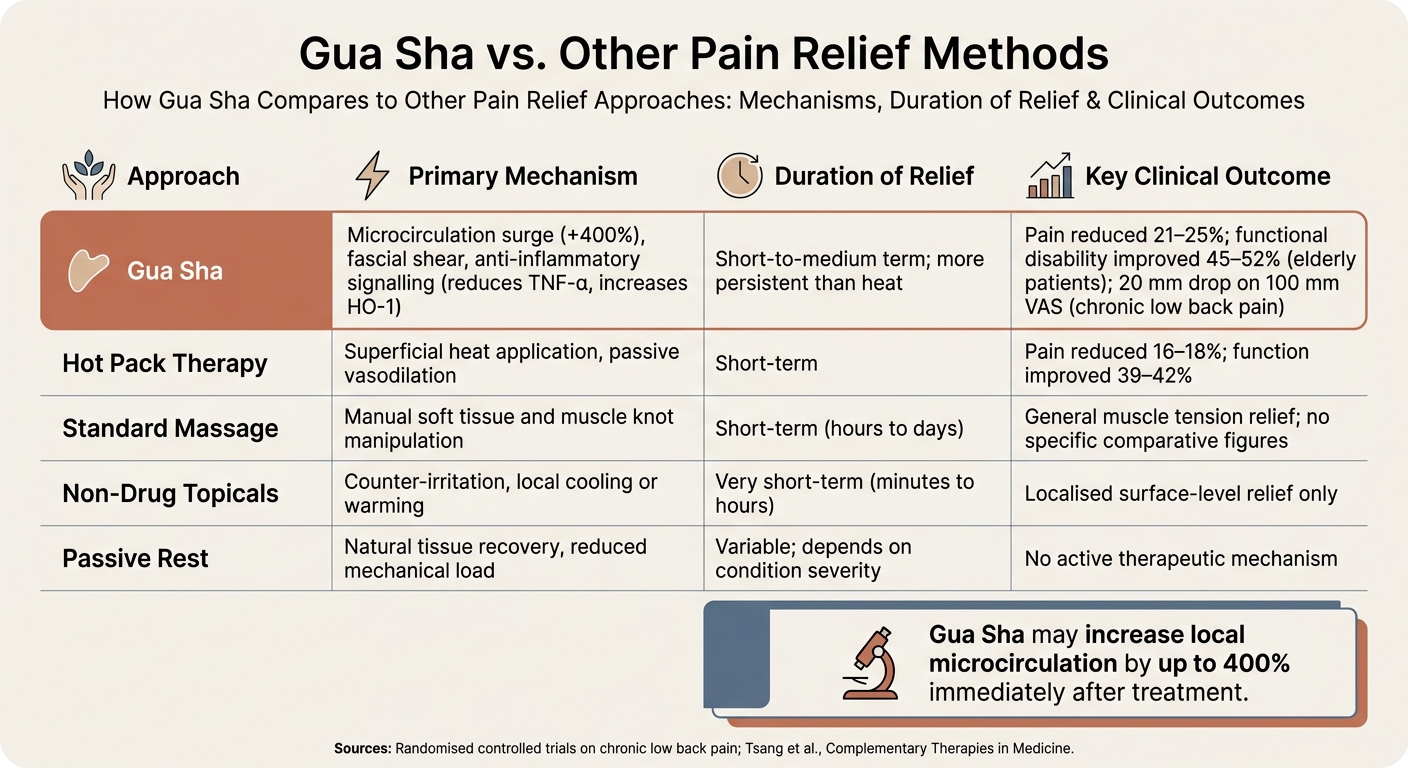
Gua Sha vs. Other Pain Relief Methods: Mechanisms & Outcomes
Origins and Current Clinical Use
Gua Sha comes from East Asian medicine. The name is pretty direct: "Gua" means to scrape, and "Sha" refers to the reddish, sand-like marks that can show up on the skin after treatment.
Today, clinicians often use it for muscle soreness, tight movement, and chronic tension, most often in the neck, shoulders, and back. In integrative care, it can also help get tissue ready for other treatments, such as acupuncture, cupping, or facial tools, by easing surface-level tightness first.
"We identify areas of tense tissue, work on them gently and gradually build up the intensity to promote circulation to help break up those areas."
- Tim Sobo, LAc, Licensed Acupuncturist, Cleveland Clinic
What Research Says About Neck, Back, and Muscle Pain Relief
Research on Gua Sha includes small clinical studies that look at pain and function. In a randomised controlled trial of 50 patients with chronic low back pain, Gua Sha led to a pain-intensity drop of about 20 mm on a 100 mm visual analogue scale.
Another study looked at elderly patients. It found that Gua Sha reduced pain by 21–25% and improved functional disability by 45–52%. By comparison, hot pack therapy reduced pain by 16–18% and improved function by 39–42%.
So what may be going on here? A few things seem to happen at once.
The scraping motion creates shear forces across layers of connective tissue. That can help loosen fascial tension and improve movement. Gua Sha also boosts local microcirculation, which brings more oxygen and nutrients to the area while helping clear metabolic waste.
There’s also an anti-inflammatory effect. Research suggests Gua Sha can reduce pro-inflammatory biomarkers like TNF-α and increase cytoprotective enzymes such as HO-1. It also inhibits the HIF-1α signalling pathway, which helps limit excess lactic acid production.
"Gua sha may exhibit a more long-lasting anti-inflammatory effect relative to hot pack for pain relief and improved mobility in elderly patients with chronic low back pain."
- William W.N. Tsang et al., Researchers, Complementary Therapies in Medicine
| Approach | Primary Mechanism | Typical Duration of Relief | Suitable Body Areas |
|---|---|---|---|
| Gua Sha | Microcirculation surge, fascial shear, and anti-inflammatory signalling | Short-to-medium term; often more persistent than heat | Neck, shoulders, back, legs |
| Passive Rest | Natural tissue recovery and reduced mechanical load | Variable; depends on condition severity | General |
| Standard Massage | Manual manipulation of soft tissue and muscle knots | Short-term (hours to days) | General muscle groups |
| Non-Drug Topicals | Counter-irritation or local cooling/warming | Very short-term (minutes to hours) | Localised skin and muscle surface |
One useful difference is where Gua Sha works best. It tends to be well suited to curved or awkward spots, like the neck and joints, where suction cups often struggle to keep a steady seal.
sbb-itb-8ec3e54
Tools, Products, and Treatment Setup for Professional Use
Choosing the Right Gua Sha Tool for Each Body Area
Once you understand how Gua Sha works, the next step is simple: match the tool to the body area and the amount of pressure you want to use. The tool changes how pressure feels, how smoothly it glides, and how easy it is to sanitise between clients.
For larger muscle groups like the back and legs, heavier tools such as Bian stone or copper/brass tend to work well. The extra weight helps you keep steady pressure without having to push as hard with your hands. Over a longer session, that can save a lot of strain.
For the neck, shoulders, and spots close to bony landmarks, smaller, contoured tools usually give better control. Jade tools are often used here because it feels cool on the skin and sits nicely over curved areas.
| Material | Surface Feel | Pressure Depth | Best Body Regions | Cleaning Requirements |
|---|---|---|---|---|
| Bian Stone | Textured/Grip | Deep | Back, low back, legs | Requires thorough sanitisation |
| Jade | Cooling/Smooth | Medium | Neck, shoulders | Fragile; sanitise carefully |
| Stainless Steel | Cold/Slick | Medium to Deep | All areas; high-volume clinics | Non-porous; easiest to sanitise |
| Copper/Brass | Warm/Heavy | Sustained/Deep | Full body, back | Antimicrobial; wipe with disinfectant |
| Resin/Horn | Lightweight | Light/Medium | Contoured areas | Soap and water; disinfectant |
If your clinic sees several clients in a day, stainless steel is usually the most practical option.
Oils, Sanitization, and Client Preparation
Use a light plant oil, such as jojoba or fractionated coconut oil, to cut friction and help the tool glide. You don’t need much. After applying the oil, spend 60–90 seconds with light effleurage strokes before picking up the tool. That short prep helps warm the tissue and lowers the risk of bruising.
Stone tools should be sanitised after each use. Stainless steel and copper/brass tools should be wiped with a clinical disinfectant between clients.
Client prep should also include a short intake. Cover pain location, a 0–10 pain score, current skin condition, and key medical history. Pay close attention to whether the client is taking blood-thinning medication (INR > 3.0) or has any clotting or circulation issues. It only takes a few minutes, but it helps you set pressure properly and spot areas that should be avoided.
Keep the treatment room at 21–23 °C. After Gua Sha, microcirculation in the treated area goes up a lot, so cold air or drafts can feel unpleasant. A warm, private room also helps clients settle in, which often makes the session go more smoothly.
With the skin prepared, move into the stroke sequence for the target area.
Step-by-Step Gua Sha Techniques for Common Pain Areas
Neck and Shoulder Technique for Stiffness and Tension
Once the skin is prepped, move into stroke patterns for each area.
Position your client either seated upright or prone. Hold the tool at a 15–30° angle. If the angle gets too steep, treatment can feel more uncomfortable and the client may start guarding the area, which gets in the way of the work.
Start with light pressure, then build toward moderate pressure as the tissue begins to soften. Use short, one-way strokes, about 5–10 cm long, beside the cervical spine and across the upper trapezius. Stay off bone. Follow the muscle lines of the neck and upper trapezius, and keep every stroke unidirectional - no back-and-forth motion.
As you work, the skin will usually warm and turn red. Petechiae - small reddish spots sometimes called "sha" - may show up. That's a normal treatment response, not trauma.
Upper Back, Low Back, and Thoracolumbar Fascia Technique
With the client prone, you have clear access to the paraspinal muscles and the broad layer of connective tissue along the low back: the thoracolumbar fascia.
Use long, controlled downward strokes along the paraspinals, working from the upper back toward the sacrum. Keep the tool at a 15–45° angle and use firm pressure. If a client has dense tissue, slow the stroke and let the tool sink in a little before you move.
If the client starts to brace or their pain goes up, ease the pressure right away.
Leg Technique for Muscle Soreness and Fatigue
For the lower body, switch to longer proximal strokes over the larger muscle groups.
Keep the client prone for the hamstrings and calves. Then shift them to supine for the quadriceps. Use firm pressure throughout.
Direct all strokes proximally, toward the heart. This supports lymphatic return. Start with the hamstrings using long strokes from the knee toward the gluteal fold. Then move to the calves, keeping strokes one-way and proximal.
Do not re-treat the same area until sha has fully faded.
| Body Area | Client Position | Stroke Direction | Pressure Level |
|---|---|---|---|
| Neck | Seated or prone | Upward | Light to moderate |
| Shoulders | Seated or prone | Outward/downward | Moderate to firm |
| Upper & Low Back | Prone | Downward | Firm |
| Hamstrings & Calves | Prone | Proximal (toward heart) | Firm |
| Quadriceps | Supine | Proximal (toward heart) | Firm |
Safety, Treatment Planning, and Key Takeaways
Contraindications, Side Effects, and Infection Prevention
Once the technique is dialed in, screening is what keeps Gua Sha safe and useful.
Avoid Gua Sha over open wounds, active infection, recent surgery, suspected fracture, DVT, bleeding disorders, cancer in the treatment area, or when someone is using anticoagulant or antiplatelet medication.
It’s also smart to pause treatment for active skin issues such as eczema, psoriasis, rosacea, or sunburned skin. Recent cosmetic injectables - Botox or dermal fillers - are another reason to wait until the area has fully settled.
Petechiae, mild redness, and temporary skin discolouration are normal treatment responses. Pain is not. As Tim Sobo, Licensed Acupuncturist, Cleveland Clinic, puts it:
"If you're in pain, you're not getting a beneficial treatment. We're trying to loosen things up, but if it hurts, you're just going to tighten up more."
If a client reports pain instead of firm pressure, stop the session right away. Clean and disinfect tools between clients using professional spa supplies and a method that fits the tool material. Check tools on a regular basis, and throw out anything chipped or cracked. Organizing your workspace with a professional spa trolley can help keep these tools accessible and safe from damage.
| Category | Details |
|---|---|
| Short-Term Risks | Petechiae, minor bruising, temporary skin discolouration, post-treatment soreness |
| Contraindications | Open wounds, active infections, DVT, bleeding disorders, anticoagulant or antiplatelet use, recent surgery, cancer in the treatment area |
| Precautions | Pregnancy (with professional clearance), recent injectables, implants (e.g., pacemakers), active skin conditions like eczema or psoriasis |
Building Gua Sha into a Canadian Spa or Clinic Protocol
After screening, the next step is to standardize how every session is documented and followed up.
Start each appointment with a pre-treatment consultation. Screen for contraindications and confirm which areas will be treated. Record baseline pain, treated areas, client feedback, and follow-up scores so you can track change over time.
Post-treatment advice matters too. Tell clients to:
- stay hydrated
- protect treated areas from cold and direct sunlight until the sha fades
- report any unusual reactions between appointments
Key Takeaways on Using Gua Sha for Natural Pain Relief
When screening, hygiene, and pressure control stay consistent, Gua Sha becomes a more predictable part of pain care.
Good results depend on the full setup working together: the right tool, proper technique, and careful client screening. It’s not just one piece. If a client’s pain is persistent, getting worse, or falls outside what a spa or clinic can assess, refer them to a healthcare provider.
FAQs
How often can I get body Gua Sha?
Body Gua Sha is usually best once or twice a week. That gap matters. It gives your body time to settle, especially since temporary red or purple marks often fade within three to five days.
If you're dealing with chronic pain, regular sessions tend to work best over time. The treatment is meant to support healing and help release muscle tension.
When should I avoid Gua Sha?
Avoid Gua Sha on broken skin, open wounds, infections, rashes, sunburns, or any area that looks irritated or inflamed.
It’s also usually not advised if you have a blood clotting disorder, take blood thinners, or deal with circulation problems, diabetes, deep vein thrombosis, or cancer during chemotherapy.
If you're pregnant, or if you’ve recently had fillers or surgery, check with a healthcare provider first.
How long do Gua Sha marks last?
The red or purple marks left by Gua Sha, often called sha or petechiae, are temporary and usually fade within two to five days.
Some people may have minor bruising that lasts up to a week, but these marks are a normal part of the process and generally disappear soon after treatment.
Leave a comment