

FAQs About Facial Gua Sha for Professionals
If you offer facial Gua Sha, the main job is simple: keep it gentle, keep it clean, and keep claims modest.
I’d sum up the whole topic like this: use a smooth tool at a 15–30° angle, work with light pressure, start and finish with neck drainage, and avoid treatment on clients with active skin irritation, recent injectables, recent surgery, or open lesions. In most cases, clients may notice less puffiness, a brighter look, and less jaw or neck tension for a few hours to 1–2 days.
Before adding it to a menu, I’d focus on these points:
- Best tool for clinic use: stainless steel, because it is non-porous and stands up well to repeat disinfection
- Tool care: wash first, then disinfect with 70% isopropyl alcohol or clinic-approved product for full contact time
- Service length: about 30–45 minutes for a full treatment, or 15–20 minutes for sensitive skin
- Stroke pattern: centre of face outward, then down the neck to the collarbone
- Pressure level: light on most areas, slightly firmer on jaw and neck only when skin and client comfort allow
- What not to promise: no claims about fixing chronic pain, replacing injectables, or making permanent skin changes
- Documentation: chart skin condition, products used, treatment areas, client history, and any reaction
- Canadian practice point: follow provincial rules, insurer rules, and clinic policy; in Ontario, privacy rules include PHIPA
This article is, at heart, about safe use in a treatment room: tools, cleaning, technique, client fit, and how to explain results in plain language.
Tools, materials, and cleaning standards
Which tool materials work best in a treatment room
Once the service is set, the next step is choosing tools that are safe to use again and again in a treatment room.
The material matters more than many people think. It changes how the tool feels in the hand, how long it lasts, and how easy it is to disinfect. The main choices are jade or stone, stainless steel, and acrylic or resin.
| Material | Feel | Durability | Cleaning | Best For |
|---|---|---|---|---|
| Stainless Steel | Cooling, silky, lightweight | High - shatter-proof | Non-porous; handles repeated disinfection well | Clinical, high-volume, and medical aesthetic environments |
| Jade / Stone | Cool, smooth | Low - prone to chipping or shattering | Requires careful handling during cleaning | Relaxation-focused and traditional holistic facials |
| Acrylic / Resin | Lightweight, smooth | Medium | Non-porous; easy to disinfect | Less common as a primary facial Gua Sha tool |
If you want something that stands up to repeated use and regular disinfection, stainless steel is usually the easiest fit. Jade and other stone tools can feel lovely on the skin, but they need more care. Acrylic and resin sit somewhere in the middle, though they’re less common as a main facial Gua Sha tool.
How to clean, disinfect, and store tools between clients
Start by washing the tool with mild soap and warm water while wearing protective gloves. After that, disinfect it with 70% isopropyl alcohol or a clinic-approved disinfectant for the full contact time. That order matters. Wash first, then disinfect. If the surface isn’t clean, the disinfectant can’t do its job properly.
Dry the tool fully before putting it away. Using absorbent clinical wipes ensures no lint or moisture remains. Even a bit of moisture can create the kind of conditions bacteria like. Once the tool is dry, store it in a clean, closed container or in a dedicated instrument tray, not loose on an open counter.
Check each tool before every use. If you spot a chip or crack, take it out of service right away.
Sourcing professional tools and training in Canada
Beauty Pro Supplies Canada offers professional facial Gua Sha tools and online training resources for clinics that want to standardize technique and hygiene.
With tools and cleaning standards covered, the next piece is technique.
sbb-itb-8ec3e54
Technique basics and treatment structure
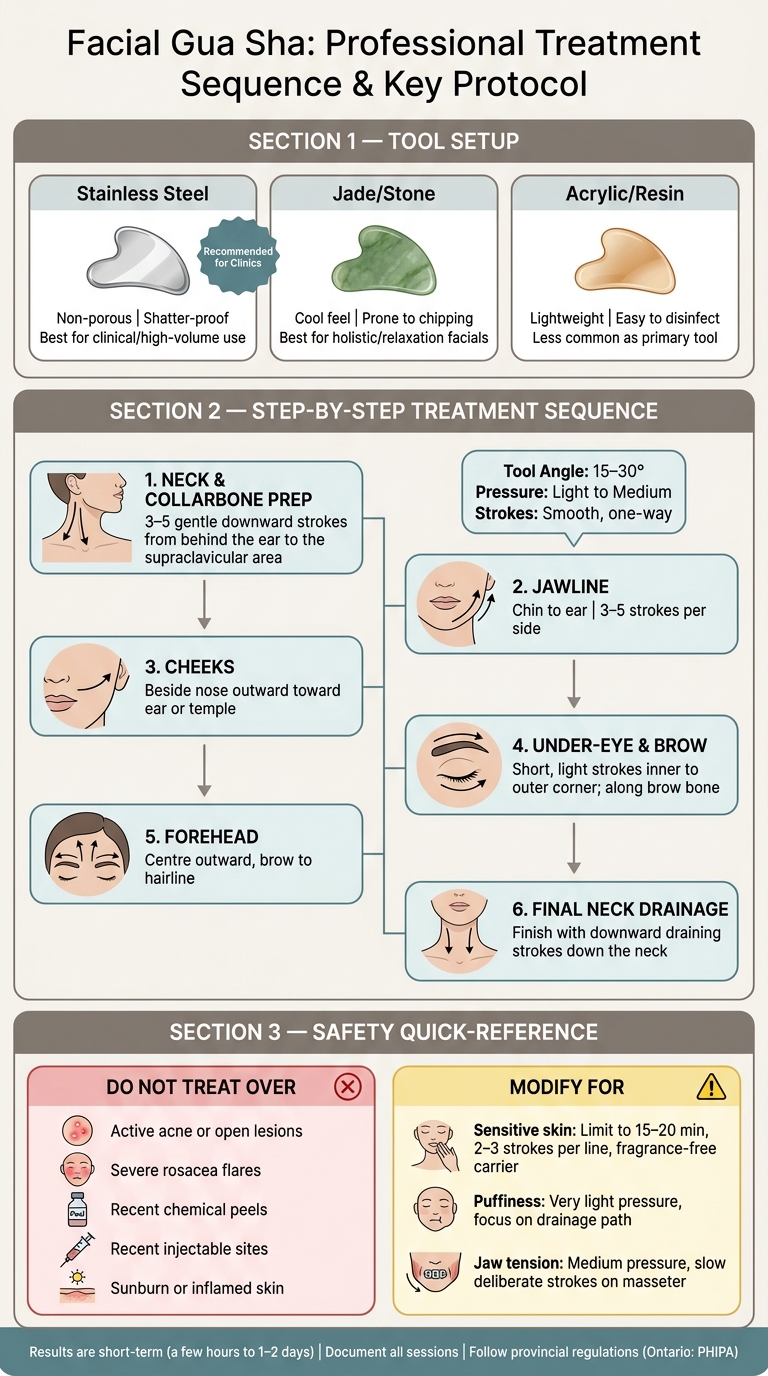
Facial Gua Sha Professional Treatment Sequence & Safety Checklist
Tool angle, pressure, and stroke direction
Keep the stainless steel gua sha tool low to the skin at about 15–30 degrees. That low angle helps cut drag and makes visible marks less likely.
For most facial work, use light to medium pressure. Go lighter around the eyes and during drainage-focused work. Along the jaw or neck, where muscle tightness often builds up, you can use slightly firmer pressure, but it still needs to stay controlled. Check in with the client as you go, and ease off right away if you notice blanching or flinching.
Strokes should be smooth, one-way, and shaped to the natural contours of the face. In most cases, that means moving from the centre outward and a little upward, then draining down through the neck and toward the collarbone. Once you’ve set the angle and pressure, stick to the same order each time.
A simple professional treatment sequence
A fixed drainage pattern helps keep the treatment consistent. Start at the neck and collarbone before you work on the face. Use 3–5 gentle downward strokes from behind the ear to the supraclavicular area to prepare the drainage pathways.
Then move through the face in a simple sequence:
- Jawline: chin to ear, 3–5 strokes per side
- Cheeks: from beside the nose outward toward the ear or temple
- Under-eye and brow area: short, light strokes from the inner to outer corner, then along the brow bone
- Forehead: centre outward, from brow to hairline
Finish with a few final draining strokes down the neck.
How to adjust for puffiness, tension, and sensitive skin
For clients with puffiness or fluid retention, keep the angle low, the pressure very light, and the strokes focused on the drainage path: from the centre of the face outward, then down the neck toward the collarbones. If you press too hard, you can work against the drainage effect.
For jaw tension, the method shifts a bit. Pressure can move closer to medium, with slower and more deliberate strokes along the masseter and jawline. In many cases, fewer strokes with more attention on the tight band works better than doing lots of passes.
Adequate slip matters in both cases. Apply a thin, even layer of non-comedogenic facial oil or serum so the facial tools glide without skipping. Jojoba-based blends and squalane are common picks in professional settings. For sensitive or reactive skin, shorten the session to 15–20 minutes, limit each line to 2–3 strokes, and use fragrance-free, hypoallergenic carriers. Those small changes often shape what clients notice after the treatment.
Client benefits, suitability, and setting expectations
What results clients may notice after treatment
Once the treatment series is done, clients will often notice less puffiness, a fresher look, and a greater sense of comfort right away. Many also say they feel more at ease, and that jaw or neck tightness has softened.
It helps to present these results as short-term. In most cases, visible changes last a few hours up to 1–2 days, depending on sleep, salt intake, hydration, and stress.
Who is a good candidate for facial Gua Sha
This treatment often suits clients with dull or tired-looking skin, mild morning puffiness, jaw tension, or stress-related facial tightness. It can also be a good fit for people who want a low-impact service that leaves them looking more rested and feeling better.
Some clients need a modified approach, and some should wait. Do not treat over areas with inflamed acne, open lesions, severe rosacea flares, recent chemical peels, or recent injectable sites. Clients taking anticoagulant medication or those with fragile capillaries need extra care. If a case feels uncertain, defer treatment and document it.
How to explain immediate versus cumulative results
Set expectations early and keep the message simple. A useful comparison is massage or stretching: one session can feel good, while regular sessions help maintain the effect. Clients often notice a same-day change, but that change is temporary.
With weekly or bi-weekly sessions over 4–6 weeks, many clients say puffiness seems to come back less noticeably and their skin looks more consistently refreshed. That said, cumulative change still depends a lot on lifestyle factors and home care, not just how often they book.
Be clear about the line this treatment does not cross. Facial Gua Sha supports skin health and comfort, but it does not replace dermatology, dentistry, or medical assessment when swelling, pain, or skin changes persist. Stating that clearly in your service descriptions and consultation notes helps protect both your clients and your practice.
| Outcome | Realistic message to use | Claim to avoid |
|---|---|---|
| Puffiness | May temporarily reduce the look of puffiness | Eliminates fluid retention |
| Glow/brightness | May create a fresher, brighter appearance after treatment | Permanently changes skin tone |
| Jaw/face tension | May help relax muscular tightness and feel soothing | Treats chronic pain |
| Anti-ageing | May support a more refreshed look with regular sessions | Reverses ageing or replaces injectables or lasers |
Safety, contraindications, and key takeaways
When to avoid or modify treatment
Technique matters. Client selection matters too. But the last step is just as important: knowing when not to treat.
Work only on intact, stable skin. Do not treat over active acne, open skin, rashes, sunburn, or inflamed or reactive skin.
Before you add facial Gua Sha to your massage supplies and services, check the rules in your province and make sure your insurer covers it.
Documentation, hygiene, and preventing visible marks
Once a client is a fit for treatment, charting and hygiene help protect the service. Record the client’s health history, current skin condition, products used, treatment areas, and any reactions noted. Use the privacy and consent training required in your province; in Ontario, this includes PHIPA.
Never work on dry skin. Keep pressure light and controlled from start to finish. Facial Gua Sha should not leave visible marks. If you see the skin reacting, ease off right away. Check every tool before use, and take cracked stone tools out of service.
Key takeaways for professional practice
| Practice area | What to do |
|---|---|
| Tool selection | Use stainless steel for professional settings; inspect before each use |
| Skin prep | Never work on dry skin |
| Pressure control | Keep strokes gentle; stop if redness or irritation appears |
| Documentation | Record health history, skin condition, products used, areas treated, and any reactions |
| Compliance | Follow the rules that apply in your province, municipality, and insurer |
Once your protocols are in place, the service is simple to repeat.
FAQs
How often should clients book facial Gua Sha?
There’s no one-size-fits-all schedule for facial Gua Sha appointments. Results tend to depend on consistency, so it’s best to suggest a session frequency based on each client’s skin concerns, goals, and routine.
Regular sessions may help support benefits like better circulation and lymphatic drainage. As a professional, you can help clients make facial Gua Sha part of their broader skin health routine.
Can facial Gua Sha be added to other facial services?
Yes. Facial Gua Sha can be added to other facial services and worked into your current facial protocol without much fuss. It can help make the treatment feel more complete by supporting circulation, lymphatic drainage, and muscle relaxation.
Before you add this, or any new service, check with your insurance provider to make sure it meets local rules and coverage requirements.
What should clients avoid after treatment?
After a facial Gua Sha treatment, encourage clients to drink plenty of water. Good hydration helps the body flush out toxins stirred up by the lymphatic drainage process.
Based on the available information, there aren’t any other specific post-treatment activities or substances clients need to avoid.
Leave a comment