

Wholesale Buying Tips for Clinics
If I want to cut supply costs without creating waste, I need to do four things: buy based on 12 months of usage, compare total landed cost in CAD, set reorder points, and lock in supplier terms before I scale orders.
That’s the short version. Wholesale buying can trim per-unit spend, but only if I avoid overstock, expiry loss, backorders, and hidden shipping or return costs. In many clinics, the biggest gains come from fast-moving consumables like gloves, gauze, swabs, and topical pain relief stock - not from buying more equipment than the clinic can use.
Here’s what matters most:
- Use 12 months of data to set order sizes around actual demand and seasonality.
- Focus on high-use items first, such as disposables, treatment-room consumables, and support supplies.
- Check supplier fit: pro-only access, product details, lot numbers, expiry dates, shipping cut-off times, and return rules.
- Measure total cost, not sticker price: product cost + shipping + GST/HST + handling.
- Reduce stock risk with FEFO/FIFO, 90-day expiry flags, and written reorder points.
- Negotiate terms, not just price: volume tiers, bundle rates, split shipments, warranty terms, training, and one account contact.
- Review inventory every quarter and supplier agreements every year to catch extra fees and dead stock.
A few numbers stand out. Volume discounts can range from 15% to 30% on top-use SKUs, but bulk buying also brings the highest stock risk if shelf life or storage is tight. For many clinics, a 2- to 3-month supply is a safer target than loading up far beyond that. And for critical items, keeping 25% to 50% of average monthly use as safety stock can help lower the chance of stockouts.
If I had to sum up the article in one line, it would be this: buy more only when the data, storage, cash flow, and supplier terms all line up.
How to Order Medical Supplies & Equipment for Your Practice
sbb-itb-8ec3e54
How to Choose Suppliers That Meet Clinic Standards
Once you know which items to buy in volume, the next step is setting supplier standards that protect those savings. A good supplier helps with documentation, delivery speed, and day-to-day clinic flow. A poor one can throw all of that off, no matter how low the unit price looks.
Check Certifications, Product Quality, and Order Accuracy
Start by confirming that the supplier limits wholesale access to licensed professionals. That matters. It helps show you're dealing with a business built for clinic use, not just a seller moving products online.
You should also check whether the supplier carries trusted clinical brands. Product labels should clearly show that the items are meant for clinic use, not retail shelves. Before placing a bulk order, ask for lot numbers and expiry dates. For unfamiliar or high-value items, see if samples are available first. That small step can save a lot of trouble later.
A few warning signs are hard to ignore:
- Prices that are far below market rates
- Generic product photos
- Refusal to provide business verification
If any of those show up, slow down and double-check.
Review Shipping, Lead Times, and Return Policies Across Canada
Shipping details can make or break a supplier relationship. Confirm whether the supplier offers same-day shipping, what their published cut-off time is, and whether they can ship reliably to your province.
If your clinic is in a remote region such as the Northwest Territories, Yukon, or Nunavut, ask ahead of time whether custom shipping quotes apply. It’s better to know that before the invoice lands in your inbox.
Returns also tend to be stricter at the wholesale level than at retail. A common policy allows 30 days for unopened items and 15 days for defective products, with the buyer paying return shipping. Hygiene products and electronics are often non-returnable.
Before you place your first large order, contact the supplier’s order desk and confirm exactly what can be returned, especially for high-value equipment. Shipping insurance can also help protect against loss or damage.
Use these checks to narrow your shortlist before you move into price and term discussions.
Supplier Evaluation Table
Use this table as a starting point when screening wholesale suppliers for your clinic:
| Evaluation Criteria | What to Look For | Beauty Pro Supplies Canada |
|---|---|---|
| Certifications | Professional-only registration; Health Canada-compliant brands | Licensed Pro registration required; carries Pre-Empt |
| Stock Depth | Depth in your highest-use clinic items | Medical aesthetics, spa furniture, surgical blades, and professional skincare |
| Delivery Reliability | Same-day shipping option; published cut-off time; Canada-wide coverage | Same-day shipping for orders placed before 2 PM AST; ships across Canada |
| Pricing Clarity | Bulk discounts visible; free shipping threshold stated; no hidden fees | Bulk pricing available; free shipping on orders over $199; interest-free payment options via Sezzle |
| Training Support | Certification or equipment training available for staff | Online certification courses offered |
| Return Risk | Clear window, conditions, and exclusions stated in writing | 30-day window for unopened items; 15 days for defective products; buyer pays return shipping |
Beauty Pro Supplies Canada is a wholesale distributor based in Nova Scotia that ships across Canada. Clinics can use the criteria above to check whether its product range, delivery terms, and return policy fit their purchasing needs.
How to Plan Purchases Around Usage, Budget, and Storage
Use 12 Months of Usage Data to Set Order Quantities
Before you place any bulk order, pull at least 12 months of consumption records from your practice management system or point of sale. A full year of data gives you a much clearer picture of demand, including seasonal spikes like winter skincare demand and higher injectable volume before the holidays.
From there, split items into two buckets. Fast-moving consumables like gloves, gauze, alcohol swabs, and disposable drapes are often good fits for bulk buying. You use them in almost every appointment, demand tends to stay steady, and shelf life is usually long enough to make larger orders make sense.
Capital items are different. Devices, treatment beds, and specialty equipment shouldn't be bought with the same approach. Use is less regular, the upfront cost is much higher, and over-ordering can leave a lot of cash sitting on the shelf.
Set order quantities based on three things:
- usage rate
- shelf life
- storage space
If your storage area can't handle the order, or the products may expire before use, the deal isn't worth it. Once you know your usage, match order size to both available space and total spend.
Budget for Total Cost, Not Just Unit Price
A low unit price can look great on paper, but it doesn't show what you're actually paying. Your total delivered cost includes the purchase price, shipping, GST/HST, and handling.
A simple way to work it out is:
(Total invoice in CAD + additional costs) ÷ total usable units = total delivered cost per unit
For equipment, think in terms of total cost of ownership. That means the purchase price, installation, maintenance, parts, and any downtime across the item's useful life. A device with a lower sticker price can still cost more over time if service calls, replacement parts, or lost treatment time start piling up.
Buying Plan Table for Core Supply Categories
Use this table as a starting point, then adjust quantities based on your clinic's volume and supplier terms.
| Supply Category | Avg. Monthly Usage | Target Order Qty | Reorder Point |
|---|---|---|---|
| Injectable Support Supplies (syringes, needles, alcohol swabs, sharps containers) | ~3,000 units | 9,000 units (quarterly) | 4,500 units |
| Skincare Consumables (cleansers, serums, applicators, peel kits) | Moderate | 2–3 months' supply | 1 month's supply |
| Linens & Disposables (exam drapes, gauze, gloves) | High | Case quantities | 2 cases remaining |
| Devices (RF, IPL, microneedling systems) | Low | 1 unit | Capital budget |
| Furniture (treatment beds, storage carts, stools) | Very low | Per room or expansion need | Capital budget |
Use these tiers to shape order size, then work on discounts and delivery terms with your supplier.
How to Negotiate Pricing and Terms Without Creating Inventory Risk
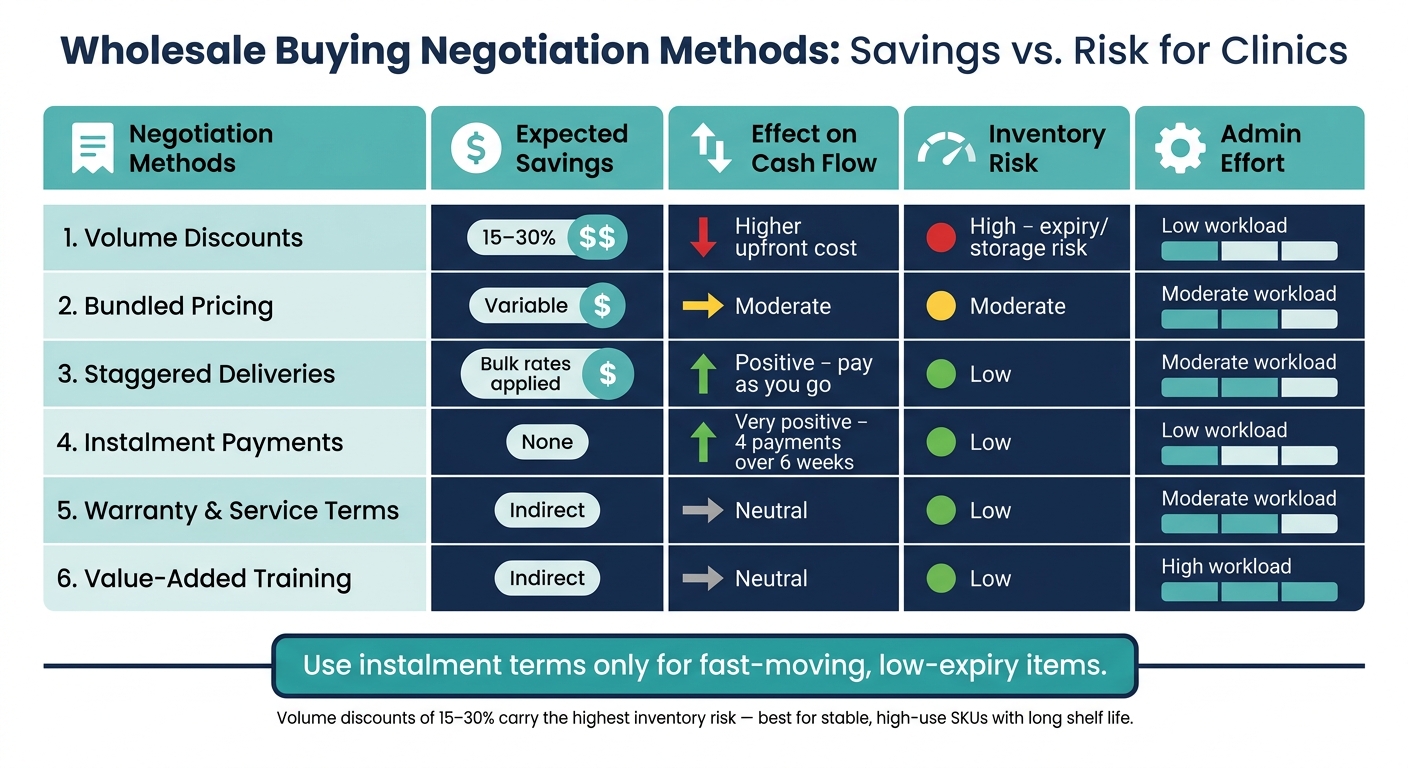
Wholesale Buying Negotiation Methods: Savings vs. Risk for Clinics
Ask for Volume Discounts, Bundled Pricing, and Staggered Deliveries
Once your order quantities are set, use that information to pin down pricing.
A good move is to bring 12 to 24 months of spend history into the discussion and use it to negotiate tiered pricing on your top 10 to 20 SKUs. These are the items that usually make up most of your consumable spend. When a supplier can see steady repeat demand, it becomes much easier for them to justify lower pricing at higher tiers.
You can also bundle related consumables to hit pricing thresholds without stocking too much of a single item. That helps you get better rates without boxing yourself into excess inventory.
Another option is to commit to annual volume, then split that volume into smaller scheduled deliveries. You still lock pricing across all shipments, but you avoid taking everything at once. Think of it like getting the bulk rate without turning your storage room into a warehouse.
Negotiate Terms That Go Beyond Price
Price matters, but it’s only part of the deal. The terms around service and support can save you a lot of hassle later.
For equipment, spell out the warranty in plain terms:
- How long it lasts
- What parts and labour are covered
- How fast service needs to happen
- Whether repairs happen on-site or require sending the unit back to the supplier
- What response times are guaranteed for service calls
For consumables, put the backorder process in writing. Be specific. Set acceptable timelines, require approval before any product substitution, and keep the right to cancel if delays go past an agreed limit. For critical items, ask for priority shipping commitments and documented turnaround times for defective products or equipment.
It also helps to include initial training and refresher access in the agreement. That can cut down on mistakes, waste, and avoidable support calls.
And yes, ask for a dedicated account contact. When something goes sideways, having one person who knows your account can save a pile of back-and-forth.
Cost-Control Negotiation Options Table
Use this table to compare trade-offs before your next supplier conversation.
| Negotiation Method | Expected Savings | Effect on Cash Flow | Inventory Risk | Admin Effort |
|---|---|---|---|---|
| Volume Discounts | 15%–30% | Higher upfront cost | High (expiry/storage) | Low |
| Bundled Pricing | Variable | Moderate | Moderate | Moderate |
| Staggered Deliveries | Bulk rates applied | Positive (pay as you go) | Low | Moderate |
| Instalment Payments | None | Very positive (4 payments over 6 weeks) | Low | Low |
| Warranty & Service Terms | Indirect (reduces repair costs) | Neutral | Low | Moderate |
| Value-Added Training | Indirect (reduces errors and waste) | Neutral | Low | High |
Use instalment terms only for fast-moving, low-expiry items.
How to Control Inventory and Build a Repeatable Purchasing System
Track Expiry Dates, Lot Numbers, and Reorder Points
Once pricing and delivery terms are locked in, inventory control is what helps you keep those savings instead of losing them to waste, expired stock, or messy recalls.
For critical items like injectables and sterilization supplies, your log should include the product name, SKU, supplier, lot/batch number, received date, and expiry date. Use YYYY-MM-DD for all dates so every staff member reads them the same way. For higher-risk or injectable products, add the practitioner responsible. If a recall happens, that detail can save a lot of time. Your log should also match the key fields on the product label for traceability, including control number and expiry date.
Use FEFO (First Expired, First Out) for anything with an expiry date. For non-perishables, use FIFO (First In, First Out). In practice, that means putting newer stock behind older stock on the shelf and marking bins with lot numbers and expiry dates so staff can tell, right away, what needs to be used first.
It also helps to flag items that are within 90 days of expiry in your tracking system. That can be inventory software with conditional formatting or even a shared spreadsheet. Then move those items into a clearly marked priority-use bin.
Set reorder points with this formula: (average daily use × supplier lead time in days) + safety stock.
For critical items, safety stock should be 25–50% of average monthly use. If you're in Canada, build in extra lead time for cross-province shipping, weather delays, and public holidays when you run those numbers. A shipment that looks fine on paper can still arrive late in February.
Reduce Waste by Standardizing and Reviewing Orders Regularly
Run quarterly inventory reviews that compare what you have on hand against actual usage from the past three to six months. If an item is used less than once per quarter, flag it. Then decide whether to reduce the order quantity, swap it for another item, or remove it from purchasing altogether.
These reviews are also a good time to spot duplicate SKUs. Maybe you're buying several brands of the same glove or gauze type without much reason. Consolidating those into one standard SKU makes weekly counts and reordering much easier.
A few habits make this process smoother:
- Use one supplier for related categories when possible to make receiving simpler and cut shipping fees.
- Review spend by supplier so you have cleaner data when it's time to renegotiate.
- Schedule annual contract reviews to catch creeping costs like fuel surcharges, small-order fees, or restocking charges.
- Check that GST/HST is being applied the right way.
- Confirm you're still meeting the volume thresholds tied to your discounted rates.
This is where small leaks show up. A low quoted unit price doesn't mean much if extra charges keep piling onto the invoice.
Conclusion: Key Steps to Smarter Wholesale Buying
Audit suppliers, standardize SKUs, set reorder points, and schedule quarterly inventory reviews along with annual contract reviews.
Write down your purchasing workflow clearly: who can place orders, which approval thresholds apply, and how receiving gets checked. That way, the process stays steady no matter who's ordering that day.
Track all costs and savings in CAD so they appear clearly in your financial reporting, not just on individual invoices.
FAQs
How do I start wholesale buying if my clinic has limited storage?
If your clinic doesn’t have much storage, you can still buy wholesale. The key is to stay on top of inventory and use your space well.
Start with organised storage and practical furniture, like storage carts, to get more out of your current setup. Sometimes a small layout tweak can make a big difference.
When you’re deciding between bulk buying and rotating stock, base that choice on two things: how much space you have and how your cash flow looks. That helps you avoid overloading your shelves or tying up more money than you need to.
Working with a dependable Canadian supplier like Beauty Pro Supplies Canada can also make ordering easier and help you keep stock moving without the squeeze of overstorage.
What should I do if a supplier has frequent backorders?
Frequent backorders can throw off your clinic’s day-to-day work. One of the best ways to lower that risk is to avoid depending on just one supplier. It also helps to look into a supplier’s track record before you commit.
Focus on suppliers that have enough stock on hand, reply promptly, and provide clear documentation. If late deliveries keep happening or customer feedback is poor, take that as a warning sign.
Which clinic supplies are safest to buy in bulk first?
Prioritize the day-to-day consumables you go through most often. The safest items to buy in bulk first are:
- nitrile gloves
- syringes, needles, and cannulas
- topical anaesthetics
- alcohol swabs, wound care products, and sharps containers
Stick with items that are Health Canada-approved and bought from a trusted distributor. That helps support safety, hygiene, and compliance.
Leave a comment