
Medical Spa Equipment Certification in Canada
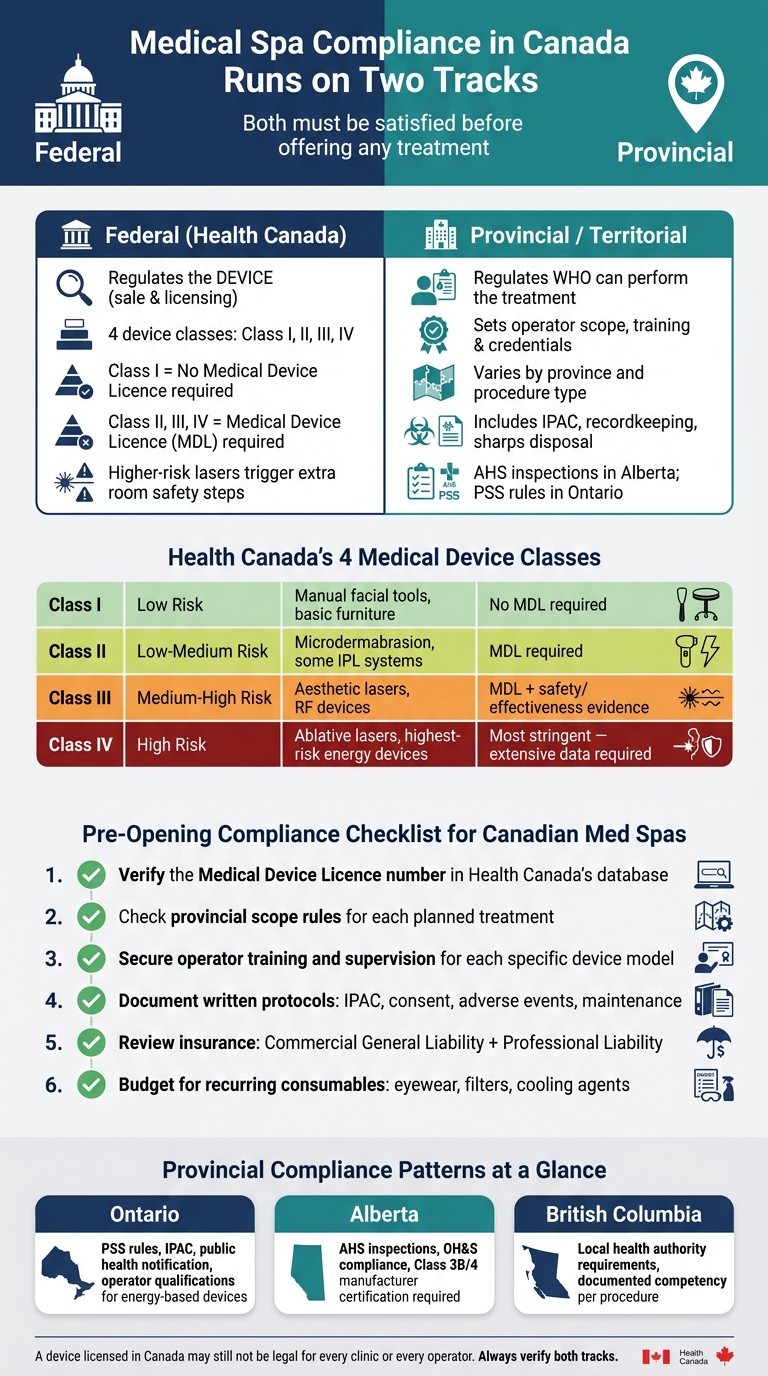
If you run a medical spa in Canada, one certificate is not enough. I need to check three separate things: the device licence, the operator’s scope and training, and the clinic’s safety rules.
Here’s the short answer:
- Health Canada regulates the device
- Provinces and territories regulate who can perform the treatment
- Clinics need written safety, cleaning, maintenance, and incident records
- Laser, IPL, RF, and microneedling often face tighter controls
- A device can be legal to sell in Canada and still not be legal for my clinic setup
A few facts matter right away:
- Canada uses 4 medical device classes
- Class I devices do not need a Medical Device Licence (such as a Woods Lamp)
- Class II, III, and IV devices do need a licence
- Higher-risk laser systems can also trigger extra room safety steps, such as an LSO, eyewear, signage, and access controls
- In some provinces, local public health, OH&S, or health authority checks may review sanitation, records, and staff training
What I should confirm before I buy or offer treatment:
- The exact device licence and approved use in Health Canada’s database
- My province’s scope rules for the treatment
- Model-specific training records for each operator
- Clinic policies for IPAC, consent, sharps, maintenance, and adverse events
- Insurance coverage for each service I plan to offer
Bottom line: medical spa compliance in Canada works on two tracks at once - equipment approval and practice rules. If either side is missing, the clinic can run into legal, safety, or insurance problems.
Medical Spa Equipment Compliance in Canada: Federal vs. Provincial Requirements
Federal rules: Health Canada device licensing and laser safety
At the federal level, the Food and Drugs Act and its Medical Devices Regulations set the ground rules for medical spa equipment in Canada.
Health Canada sorts devices by risk. That risk class affects the licence a manufacturer needs before the device can be sold in Canada. Put simply: the higher the risk, the more proof Health Canada wants to see.
How Health Canada classifies medical spa devices
Health Canada uses a four-class system. As the class goes up, the manufacturer must provide more evidence on safety and effectiveness to get a Medical Device Licence (MDL).
Here’s how common medical spa equipment usually fits into that system:
| Health Canada Class | Risk Level | Typical Medical Spa Equipment | Licensing Requirement |
|---|---|---|---|
| Class I | Low Risk | Manual facial tools, some basic examination furniture | No Medical Device Licence required; general safety and import/manufacturing rules still apply. |
| Class II | Low-Medium Risk | Microdermabrasion machines, some IPL systems | Requires a Medical Device Licence (MDL) |
| Class III | Medium-High Risk | Most aesthetic lasers, radiofrequency (RF) devices | Requires an MDL and more safety and effectiveness evidence |
| Class IV | High Risk | Ablative lasers, other highest-risk energy-based devices | Most stringent licensing; requires extensive safety and effectiveness data |
That table matters because two machines that seem similar in a sales pitch can fall into very different classes once you look at how they work and what they’re cleared to treat.
What clinic owners should check before buying equipment
Before buying advanced aesthetic equipment, check that the device has an active Health Canada licence for the exact treatment you plan to offer. That detail matters. A device being licensed in Canada doesn’t automatically mean it’s cleared for every use a seller mentions.
Clinic owners should also keep key records on file, including:
- The device manual
- Service logs
- Incident reports
Regular output checks should be part of the maintenance routine too. If a machine isn’t performing as expected, the risk doesn’t stay on paper; it shows up in the treatment room.
Once a device is licensed, safe use comes down to room setup and day-to-day controls.
Laser and IPL safety controls in the treatment room
Laser equipment in Canada should line up with CSA (Canadian Standards Association) standards and the manufacturer’s instructions. Clinics that run laser equipment should appoint a Laser Safety Officer (LSO) or a similar safety lead.
The LSO is usually the person who keeps the practical side of safety from slipping. That includes protocols, protective eyewear, warning signs, restricted access, and fire-safe room controls.
Poor maintenance can lead to uneven energy delivery, burns, eye injury, and fire risk.
Federal licensing is only the first layer; the next step is who can operate the equipment under provincial rules.
sbb-itb-8ec3e54
Provincial and territorial rules for operating medical spa equipment
Health Canada controls the sale of the device. But provinces, territories, and local health authorities decide who can use it, what training they need, and how the clinic must run.
That split matters. Before offering treatments, especially with lasers, IPL, radiofrequency, or microneedling, clinic owners should check the rules in their own jurisdiction.
Across Canada, clinics are expected to follow CSA laser safety standards and any local OH&S rules tied to:
- signage
- eyewear
- ventilation
- electrical safety
Some jurisdictions also ask for an LSO or a laser safety committee.
Ontario: controlled acts and personal service setting rules
In Ontario, personal service setting rules cover public health notification, IPAC, recordkeeping, sharps disposal, and approved disinfectants.
Clinics also need to confirm operator qualifications for medical lasers and energy-based devices under the provincial rules that apply to the treatment.
British Columbia, Nova Scotia, and other provincial patterns
The fine print changes from one province to another, and often by procedure too. Still, the pattern is pretty clear: clinics need documented competency, safety oversight, and compliance with local health authority rules.
In Alberta, AHS inspections look at sanitation, safety protocols, operator credentials, and maintenance records. Operators using Class 3B and Class 4 devices are generally expected to hold manufacturer-specific certifications, along with general aesthetic or medical training.
Comparing requirements across Canada
Use the overview below to spot the main compliance pattern in each jurisdiction.
| Province / Territory | Typical Regulatory Focus | What Clinic Owners Should Confirm |
|---|---|---|
| Ontario | PSS rules, recordkeeping, and operator qualifications for medical lasers and energy-based devices | Public health notification, IPAC requirements, and sharps/disinfectant standards |
| British Columbia | Varies by procedure | Local health authority requirements and documented competency |
| Alberta | AHS inspections and OH&S compliance | Facility sanitation, safety protocols, operator credentials, and maintenance records |
| Nova Scotia | Varies by procedure | Local health authority requirements and documented competency |
| Other Territories | Varies | Local health authority or territorial requirements |
Laser and energy-based equipment are regulated in Canada, but the exact rules depend on the province or territory.
Next comes the difference between professional licensure and device-specific training.
Training and certification paths for operators
Once you know the provincial rules, the next step is simple: separate legal scope from device skill. They’re not the same thing.
Your training path depends on two things:
- your professional licence
- the device you plan to use
Professional licensure vs. equipment-specific certificates
Professional licensure sets your legal scope. Equipment-specific certificates show you can use a certain device safely.
A professional licence comes from a regulatory body. It determines which treatments a practitioner can legally perform. An equipment-specific certificate shows that the operator has been trained to use a specific device.
This matters because the rules change by province. In Ontario, Alberta, and British Columbia, esthetics is mostly unregulated at the provincial level. Other jurisdictions may set different thresholds.
For Class 3B and Class 4 lasers, manufacturer certification matters a lot. It shows the operator has been trained on that exact device, not just lasers in general. And for some advanced treatments, physician oversight is also required.
Common training routes for aestheticians and medical aesthetics providers
Most operators start with a diploma or certificate, then add device-specific training. For laser and IPL, these certifications are often hybrid programs that mix online theory with in-person hands-on sessions.
| Certificate Type | Typical Topics | Intended Learner |
|---|---|---|
| Base Esthetics or Nursing Credential | Skin anatomy, sanitation and clinical fundamentals | Entry-level practitioners |
| Laser / IPL Certification | Device operation, Fitzpatrick typing, patch testing, contraindication screening | Technicians, nurses, estheticians |
| Ongoing Competency Records | Documented assessments, continuing education, maintenance logs | All operators of regulated devices |
Keep training records and competency logs on file. That paperwork isn’t just nice to have. Insurers often ask for proof of training before they cover treatments. Provincial health or safety authorities may also expect operator qualifications and equipment maintenance records.
Using supplier education and manufacturer guidance
After formal certification, supplier materials can help operators stay up to date on model-specific settings and product updates. That kind of education is useful, but it does not replace formal training.
"Be sure to choose a training program that is accredited and offers hands-on experience with the specific type of laser you'll be using in your medical spa." - Beauty Pro Supplies Canada
Building a compliant Canadian medical spa operation
Operating standards that support safe equipment use
Once scope and training are in place, the clinic still needs day-to-day controls that show the equipment is being used safely. In practice, that means documented IPAC, maintenance records, and incident reporting.
Laser and IPL programs should have a designated LSO or safety lead who handles maintenance and safety checks. Run manufacturer-approved calibration checks before each use and log every result. If something goes wrong, staff should have a written incident protocol that tells them what to do and how to record the event.
The controls should match the device being used. For example:
- Laser/IPL: LSO, eyewear, and maintenance checks
- Microneedling/injectables: IPAC and sharps disposal
- Microdermabrasion: filter changes and handpiece cleaning
Written protocols hold the whole system together. Consent forms, treatment records, privacy compliance, and maintenance logs should all sit in one organised system, whether that's digital or paper-based. The key is simple: an inspector or insurer should be able to review it on short notice without a scramble.
Use written protocols to make compliance part of the daily routine.
A buying and compliance checklist
Turn those requirements into a pre-opening review.
- Verify the medical device licence number in Health Canada's database.
- Check provincial scope rules. Confirm which treatments need a regulated health professional in your province or territory.
- Secure training and supervision. Make sure every operator has the credentials needed for that specific device and hands-on training with the exact model being used.
- Document your policies. Put written protocols in place for IPAC, consent, adverse events, and equipment maintenance before the first client walks in.
- Review your insurance. Confirm your policy covers both Commercial General Liability and Professional Liability for the specific treatments you plan to offer.
- Budget for recurring parts and consumables: eyewear, filters, cooling agents, and manufacturer-approved replacements.
Conclusion: Core requirements to remember
Federal device rules and provincial practice rules operate on separate tracks. A licensed device may still not be legal in every clinic or for every operator. Documentation, training, and maintenance records are what make the operation defensible and insurable.
FAQs
Do I need approval beyond a Health Canada device licence?
Yes. A Health Canada device licence is only one part of your regulatory obligations.
You may also need electrical certification such as CSA, C-UL, C-ETL, or QPS. Some devices also need laser safety oversight. On top of that, you may have to meet provincial and municipal rules, including business registration, zoning, building permits, and practitioner licensing.
Who can legally operate laser or IPL equipment in my province?
In Canada, laser and IPL use is regulated through a mix of provincial rules and federal standards.
To perform these treatments, you need to be a certified professional. In many provinces, treatments also have to be done by, or under the supervision of, a licensed medical professional such as a physician or nurse practitioner.
The exact rules depend on the province. That’s why it’s smart to check the scope of practice set by your local regulatory body.
You may also need:
- a valid training certificate
- device-specific training
- manufacturer-issued credentials for certain systems
The bottom line is simple: the same treatment can come with different rules depending on where you work in Canada.
What records should my medical spa keep for compliance?
Keep clear, up-to-date records for compliance, including:
- high-level disinfection logs
- accidental exposure to blood or body fluids
- product batch numbers and cold-chain temperature logs for items such as neurotoxins and fillers
- client consent forms and treatment documentation for every patient
Good record-keeping matters more than many clinics think. If notes are missing, incomplete, or out of date, small issues can turn into big ones fast. That’s one reason inadequate records are linked to nearly 30% of complaints against practitioners.
Leave a comment